
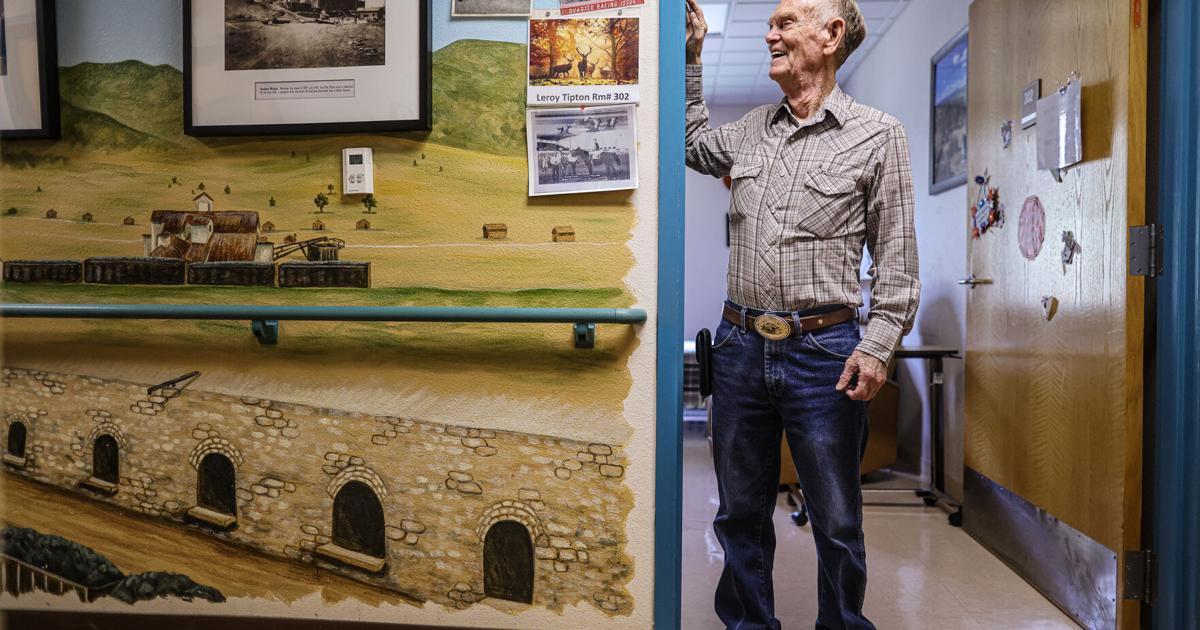
RATON — A painted phrase decorates the wall inside the front entrance of Miners’ Colfax Medical Center’s long-term care facility.
“We went in together, and we came out together,” it says.
It’s one of several hand-painted murals — most of them depicting local mines — that adorn the walls of the facility, which is tasked with caring primarily for former miners and their spouses.
Residents went into the mine together, came out together, and, now, are cared for together.
Miners’ Colfax Medical Center’s long-term care facility is a rare jewel in New Mexico’s nursing home landscape: It’s the only facility in the state to hold across-the-board five-star ratings in overall performance, health, staffing and quality from the U.S. Centers for Medicare and Medicaid Services.
Most other facilities in the state don’t even come close. Nearly a quarter of New Mexico’s 68 nursing homes received one-star overall ratings during the most recent round of inspections by the Centers for Medicare and Medicaid Services. Inspectors have cited 11 facilities for abuse.
However, whether the care available at Miners’ Colfax’s long-term care facility can be replicated elsewhere is hard to say, said Administrator Stephen Kelley. The facility primarily serves occupationally ill and injured miners and their spouses, whose care is largely paid for by century-old trust funds. That funding mechanism simply doesn’t exist for most patients.

Leroy Tipton holds out his brass check — No. 243 — from the seven or so years he spent mining coal in the 1970s. The numbered discs, typically hung on a pegboard at the mine entrance, helped mine officials identify who had exited the mine and who was still inside at a glance.
Gabriela Campos/The New Mexican
“To say that this model would work throughout New Mexico or any other state, that would be tough to say because we’re a different category,” he said.
Long-term care
Raton native Ralph Leal spent nearly 10 years underground. His commute to work involved descending thousands of feet into a Trinidad, Colo., coal mine.
By the end of his mining career, Leal joked he was “like a mushroom.”
Four or five of his co-workers died in the mine during the time he worked there, said Leal, now a 78-year-old resident of the long-term care facility.
“Thank God, I wasn’t a fatality,” he said. “We came pretty close a couple of times.”
When Leal started mining in 1971, there were more than 142,000 people working in coal mines nationwide, according to data from the U.S. Department of Labor’s Mine Safety and Health Administration. Working under the constant threat of cave-ins, explosions and exposure to toxic substances, 181 American coal miners died on the job that year.
The number of active coal miners in the U.S. has more than halved since Leal’s first year in the mine, data shows. In 2025, only eight miners died in work-related incidents — though the Occupational Safety and Health Administration still lists “underground mining machine operator” among the most dangerous jobs in the U.S.
However, many miners feel the effects of the industry long after their last day of work. Exposure to coal dust causes several pulmonary diseases, most notably coal workers’ pneumoconiosis — better known as black lung — according to the U.S. Centers for Disease Control and Prevention. The incurable disease typically takes years to develop and can result in lung impairment, disability and premature death.
Miners’ Colfax Medical Center was established to care for those miners who were injured or ill as a result of their job.
Ralph Leal points out different landmarks on a mural depicting the Sugarite mine last month at the Miners’ Colfax Medical Center in Raton. Leal spent nearly 10 years underground. His commute to work involved descending thousands of feet into a Trinidad, Colo., coal mine.
Gabriela Campos/The New Mexican
The hospital’s history predates New Mexico statehood in 1912. The Ferguson Act of 1898 granted millions of acres of land to what was then the New Mexico Territory. The State Land Office now manages 9 million surface acres and 13 million subsurface acres of trust lands given to the state by the federal government, with leasing revenue from each parcel assigned to a specific beneficiary, agency spokesperson Joey Keefe wrote in an email to The New Mexican.
Miners’ Colfax is one of those beneficiaries, with 98,558 surface acres and 120,766 subsurface acres assigned to it. In fiscal year 2025, the State Land Office distributed more than $7.7 million from two state funds to the hospital, Keefe wrote.
Today, the medical center’s long-term care facility operates out of the same building that was once Raton’s main hospital — the same building where several of its current residents were born. The main hospital, now located on the south side of town, serves as a critical access medical center in northeastern New Mexico — a federal designation under which certain rural hospitals receive additional Medicare funding to help ensure they stay open — and the institution provides black lung outreach across the state.
The long-term care facility’s charter indicates it must serve miners first, then miners’ spouses, then others, Kelley said.
“We’re only licensed for 37 beds, so we really have to be careful that we have miner beds available,” he said.
All types of miners are welcome, said Yolanda Saenz, the facility’s social services and activities manager.
“It doesn’t have to be a specific type of miner,” she said. “It could be coal, uranium, gold. As long as you have verification of working in the mine for a year, you qualify to be here.”
‘Different animal’
For most New Mexico patients in need of nursing home care, there is no option equivalent to the long-term care facility at Miners’ Colfax.
The facility’s staff provides medical care like disease management, medication assistance, and lab and X-ray services, in addition to helping with the activities of daily living like eating, bathing and using the bathroom — paid for in large part by revenue from leasing state trust lands.
That, combined with Miners’ Colfax’s small size and unique patient population, makes the Raton facility a “different animal” from most New Mexico nursing homes, Kelley said.
Leroy Tipton jokes while giving a tour of the murals depicting local mines last month at the Miners’ Colfax Medical Center in Raton.
Gabriela Campos/The New Mexican
“There are over 15,000 nursing homes in the United States, and, if the average bed capacity is 100, you’re looking at a lot of people that rely on long-term care,” he said.
Most eldercare options involve private payment, with some families spending $10,000 per month or more on assisted living facilities, or wrangling with insurance coverage for skilled nursing stays.
Medicare, the public insurance program for older adults, covers short stays at skilled nursing facilities in the aftermath of an injury or illness but it won’t pay for long-term nursing home care, said Angelina Flores-Montoya, deputy Cabinet secretary of the New Mexico Aging and Long-Term Services Department. That leaves Medicaid, the public insurance program for low-income Americans, to foot the bill for most long-term care.
Miners’ Colfax, however, can’t fill up its long-term care beds with Medicaid patients, Kelley said. If it did, it wouldn’t be fulfilling its promise to miners.
“We could fill this building up with Medicaid people instantly — but that’s not our choice,” he said.
As a state-run facility, Miners’ Colfax also has an easier time recruiting and retaining staff, a crucial step in providing high-quality care. The facility can offer retirement benefits through the Public Employees Retirement Association of New Mexico that far exceed what workers might get at private or nonprofit nursing homes, Kelley said.
Federal data shows nursing staff time averages 4 hours and 40 minutes per resident per day at Miners’ Colfax, well above the national average of 3 hours and 52 minutes and the New Mexico average of 3 hours and 32 minutes. Annual nursing staff turnover at the facility is consistent with nationwide averages but lower than the state average.
Trying to emulate Miners’ Colfax’s long-term care facility by creating other state-run or state-funded nursing homes would open up “a whole other can of worms,” said Tyler Atkins, founding partner of an Albuquerque-based law firm that takes on nursing home abuse cases.
But, he added, it would neutralize the profit motive that can lead some private facilities to cut corners, while empowering the state to ensure the facility provides quality care.
“We see what the free market gets us as far as quality of care,” Atkins said. “I would definitely not be opposed to that as some kind of a solution.”
A photograph depicts the Miners’ Colfax Medical Center when in opened in 1905 as the New Miners Hospital.
Gabriela Campos/The New Mexican
Jennifer Foote, a partner at another Albuquerque-based law firm that specializes in nursing home abuse litigation, noted care at state-operated facilities has been “variable.” The New Mexico State Veterans’ Home in Truth or Consequences serves as an example of that: It has experienced a kind of rebirth since the early 2020s, when it was the site of dozens of deaths from COVID-19, the subject of scathing legislative reports and a repeated cause for concern for state lawmakers.
However, she said, it would be nice to use the resources that tend to follow nursing home residents — specifically, Medicare and Medicaid dollars — to provide high-quality care.
“I think that would be a wonderful thing if we could figure out a way to sort of replicate that on a big scale,” Foote said.
Both time and longevity contribute to quality of care at Miners’ Colfax, Saenz said.
“Quality care is taking the time to learn your building, learn your residents, learn your staff,” she said. “Walk around — see what works and what doesn’t work.”
‘A place for miners’
Leroy Tipton still has his brass check — No. 243 — from the seven or so years he spent mining coal in the 1970s. The numbered discs, typically hung on a pegboard at the mine entrance, helped mine officials identify at a glance who had exited the mine and who was still inside.
Mining was Tipton’s second career. He previously spent about a decade traveling from horse race to horse race as a jockey.
Given the perils of that profession — jockeys can sustain serious injuries on the track and sometimes resort to crash diets to meet weight limits — Tipton said mining was probably the easier of the two jobs.
A hallway at the entrance of the Miners’ Colfax Medical Center in Raton features murals and historic photographs. The facility was established to care for those miners who were injured or ill as a result of their job.
Gabriela Campos/The New Mexican
Now 86, Tipton is grateful to live at Miners’ Colfax. The cost of miners’ care, room and board feels like a fitting trade for “the blood and sweat that we poured into that mine,” he said.
“It’s a place for miners when you get older or get broke down or something happens,” Tipton said. “Myself, I’ve got three daughters, and I didn’t want them to go through the burden of having to take care of me.”
He added, “The guy that thought of this in the beginning, I thank him every day.”