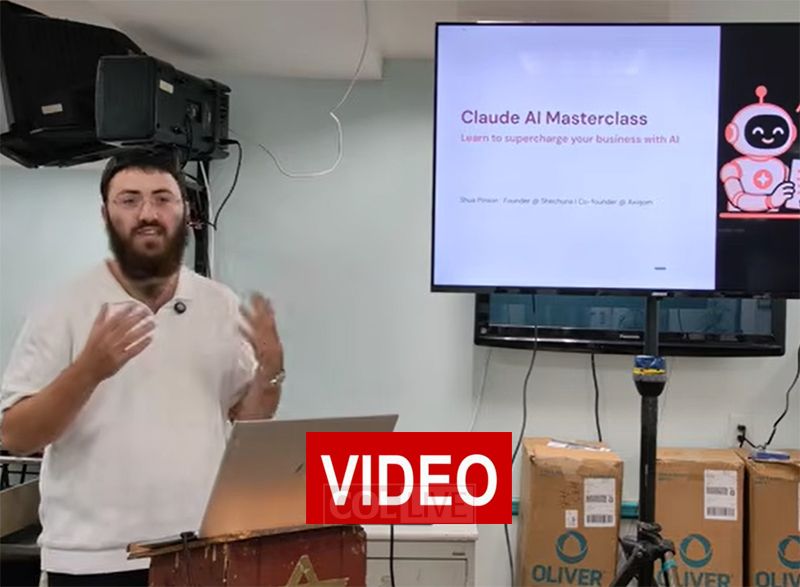
CHYE and CHJCC hosted a workshop on how AI can help your business given by Shua Pinson, founder of Axiqom, a business optimization studio. Full Story, Video
Most people have heard by now that AI can change the way a business runs. Far fewer have been shown exactly how. That was the idea behind a recent workshop hosted by CHYE and CHJCC, where local business owners, and community members packed a room to find out what the tools everyone keeps talking about can actually do for them.
For more than 13 years, CHYE.Info has helped entrepreneurs and aspiring professionals in Crown Heights gain the guidance, skills, mentorship, and connections they need to succeed. Through workshops, business mentoring, networking events, and educational programs, CHYE works to make valuable resources and emerging opportunities accessible to members of the community. This AI workshop hosted in partnership with CHJCC. Reflects a continued commitment to helping local businesses adapt, grow, and remain competitive in a rapidly changing economy.
The session was led by Shua Pinson, a Crown Heights native who built the Shechuna app, now used by close to 7,000 people in the neighborhood, and who today co-founds Axiqom, a business optimization studio that helps organizations put AI to work. His pitch was refreshingly plain. Nobody in business cares about the hype, he said. They care about results, about their business running smoother and giving them back time they do not have.
Pinson opened by clearing up a misconception. When most people picture AI, they still picture the chatbot from a few years ago, a glorified Google search that answered questions and summarized the occasional email. That is not what the tools look like now. The workshop walked through what AI can genuinely do today, and then did something rarer at events like these. It showed the audience how to set it up themselves.
To keep it grounded, Pinson built a sample business live on screen, a fictional Crown Heights contractor called Boro Restoration. He started the way most people do, asking the AI cold for a client proposal, and the result was exactly what frustrates first-time users. It guessed at prices, invented details, and produced something no contractor would send. Then he did it the right way. The single most important rule, he told the room, is to treat AI like a new employee. You would never hand a new hire a task without telling them who you are, how you price, and how you like things done. So he loaded in that context, the company’s procedures, past proposals, a real rate sheet, and writing samples so the tone matched, and organized it inside a project that remembers everything relevant to one kind of work. A few minutes later the same request produced a clean, branded, correctly priced proposal, ready to send.
From there he showed the features that make the difference. He explained connectors, the bridge that lets AI read and act inside the software a business already uses, from Gmail to a customer database. In one live demo the AI scanned an inbox, flagged the messages that mattered and drafted replies in the owner’s own voice. In another it read a customer list and pointed out which leads had gone cold.
He was careful about the fears in the room. Attendees asked the obvious questions. What about privacy. What stops it from sending something embarrassing on my behalf. His answer was consistent. It comes down to setting things up responsibly. Keep the AI on read-only access to start, require approval before it takes any action, and keep a human eye on anything that goes out.
The evening closed on the word everyone came to hear, agents. Pinson demystified it. The term comes from agency, meaning the tool can carry out a goal on its own instead of waiting for step-by-step instructions. He showed a simple one he built that checks a business inbox every hour, sorts the real inquiries from the spam, and drafts a quote reply for each, leaving the owner to glance and hit send. It never sends on its own, by design. What surprised the room was how ordinary it was to build, about fifteen minutes, and well within reach for anyone there.
For business owners and organizations who want help figuring out where AI actually fits, that is the work Axiqom does day to day, sitting with owners to find where a business loses time and building the simplest tool, automation or system that fixes it. More information is available at https://axiqom.com.