
For a position that requires so much experience to master, playing quarterback can be an old man’s game. The top three players in our first QB stock report of the season are at least 30 years old, while No. 4, the Cincinnati Bengals’ Joe Burrow, will join them in December.
But the young pups are closing in. Fast.
The New England Patriots’ Drake Maye and Chicago Bears’ Caleb Williams are a pair of 24-year-olds who might be on the verge of upsetting the NFL hierarchy, though they’ve got to buck a trend for that to happen. The last two youngsters who were projected to make such a leap — the Houston Texans’ C.J. Stroud (debuted in the QB stock report at No. 7 in 2024) and Washington Commanders’ Jayden Daniels (No. 5 in 2025) — broke down rather than broke out.
What we’re watching from Caleb Williams in 2026
Kevin Fishbain and Dan Wiederer
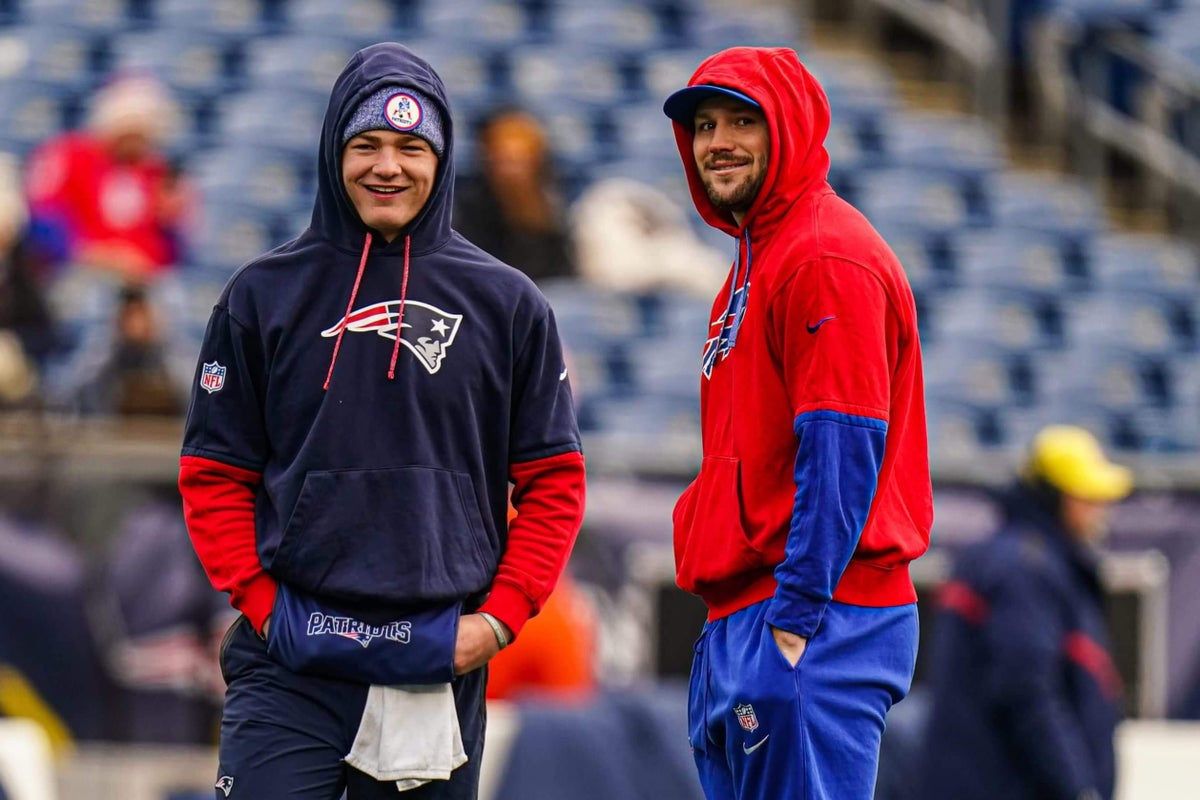
Maye and Williams could be different. First, Maye has already reached a higher apex than his counterparts, closing the 2025 season at No. 1 on the stock report, narrowly finishing second to Matthew Stafford in the MVP voting and guiding the New England Patriots to the Super Bowl. And like Maye with offensive coordinator Josh McDaniels, Williams also has system continuity with head coach Ben Johnson. Maye and Williams are also entering their third seasons, while Stroud and Daniels were reigning Offensive Rookies of the Year who were tabbed as breakout candidates prior to their sophomore seasons.
This summer, The Athletic surveyed 20 anonymous coaches and executives to name the best QB on a rookie contract. Maye garnered 12 votes to Williams’ five, while Daniels (two) and Bo Nix (one) also had supporters. Stroud, Bryce Young, Cam Ward, Jaxson Dart, Tyler Shough and Fernando Mendoza were other possible answers.
Maye didn’t just win the vote. He also garnered praise that may spark a religious experience for certain New Englanders.
“Drake has all the things you’d want at the position,” said an executive, who spoke on the condition of anonymity so he could openly discuss players on rival teams. “Being with (Josh) McDaniels and that offense, they’re grooming him to be like (Tom) Brady to win at the line of scrimmage.”
McDaniels was Brady’s offensive coordinator or positional coach for 13 seasons, while Patriots coach Mike Vrabel played with Brady for eight years. They’ve got a clear institutional knowledge of how the position can be played at the most elite level, and they’re trying to impart as much of that onto Maye.
It’s not just faint praise, either. A former head coach, who called Maye his favorite QB prospect of the past decade, agreed the Patriots are implementing some of Brady’s tools into Maye’s arsenal.
“(McDaniels) is doing an excellent job of coaching him,” the coach said.
Maye has already showcased proficiency under center and through his use of play action, as his ability to operate with his back to the line of scrimmage has accelerated his progression. The No. 3 pick in 2024 needs better protection from the Patriots’ offensive line to take the next step, and a defensive coach of another team wants to see Maye deliver with a touch more accuracy from within the pocket on throws between the numbers.
Maye has drawn comparisons to Josh Allen since his time at North Carolina because the budding AFC East rivals have the prototypical size, strength and athleticism to play the position to the modern standard. But while Maye is a more polished passer than Allen was through three seasons, Allen still possesses a level of dominance no one else has replicated.
Allen can uniquely put the Buffalo Bills on his back with a hybrid style of playground ball, while the Patriots are doing it a bit differently with Maye.
“Josh Allen’s success is built around the athlete,” the executive said. “New England is taking the high-end athlete and building him into a quarterback. That’s the Brady piece.”
Maye, of course, is still an excellent improviser in his own right, though in that regard, Williams probably has the upper hand.
An executive with another team said they were “scared to death” over the possibility of drawing the Chicago Bears in the playoffs — simply because of Williams’ ability to create plays out of thin air at the end of games. He led the league with six fourth-quarter comebacks last season.
Still, Williams must show more consistency with staying on schedule from within the pocket. While he’s incredibly dangerous off script, that’s a tough way to live in the NFL, especially for someone with a pattern of turnovers. Williams only threw three interceptions in his last 10 regular-season starts, but he was picked off five times in two playoff games.
“He’s got special (Patrick) Mahomes-type stuff in those scenarios outside the pocket, but he’s not there yet inside the pocket,” an executive said. “Maybe he’ll get there with Ben and be a top-five QB, though. I just want to see more consistent plays from the pocket.”
The league appears to be in great shape with its young quarterbacks, largely thanks to the 2024 draft class of Williams, Daniels, Maye and Nix. There’s more than enough time for Stroud to rebound, while Daniels just needs to stay healthy after a hard-luck 2025 season.
If Maye and Williams maintain their ascension from last season, they will break into that 30 Club years ahead of schedule.
QB Index
You probably noticed in the table above a statistic called QBI. What is that?
Let’s start here: We’re constantly trying to evolve and make this a better product for our readers, so this offseason, we asked The Athletic’s resident analytics guru, Austin Mock, for some help. Mock delivered, concocting a new metric for analyzing quarterback play that he’s calling QB Index or QBI
In short, QBI is a quarterback efficiency metric that attempts to remove the contributions from a quarterback’s teammates and credits only what the QB himself provides on a per-play basis. It’s not a perfect barometer of QB play — no stat is — but the hope is that QBI provides a better picture of quarterback play that can help serve as a guide as we build our weekly rankings throughout the season.
And you are going to see it every week throughout the season, right alongside the QB stock report rankings. Now, there will be plenty of times, especially early on before the sample size increases, that the rankings will not “comply” with QBI. That’s fine. The purpose of QBI is not to create the rankings for us. It’s just one tool for evaluating quarterback play, and that’s how we’ll use it.
For those who’d like to know more about QBI, Mock published his methodology on Monday. Go check it out.
Stock watch
Lamar Jackson ended last season on one of the worst stretches of his career and plummeted to No. 17 in the rankings as a result. The 29-year-old, two-time MVP is still viewed in high regard around the league, so we’ll write off that swoon for now.
But if Jackson gets off to a slow start under a new coaching staff, including first-time play-caller Declan Doyle, there’s room to fall.
Truth is, there’s a significant logjam from Nos. 6-19. Nine of those 14 QBs were ranked in the top five at some point in 2025, while Stroud was there in early 2024. The other four QBs peaked inside the top 10 last season, so they’ve all been slighted to a degree with the initial rankings of 2026.
To an extent, others need to prove they can do it again. Lawrence was terrific down the stretch, showing noticeable improvement in protecting the ball, so it’s reasonable to be bullish on a breakout season now that he’s got a full year of experience with coach Liam Coen. If Lawrence plays to the same standard, he’ll rocket up the rankings.
There’s a far less sexy reason for the logjam, too: Everybody is healthy. Eight quarterbacks in the final rankings of 2025 are currently on the bench or looking for work, so the quality diluted as injuries mounted.
For clarity, the line was drawn at No. 20 because Kyler Murray needs to prove himself in a new system, and Daniel Jones needs to show his capability in a return from a torn Achilles. There’s simply too much unknown until the games start.
Situational awareness
Cam Ward’s ranking is not an indictment on his potential — it’s more about the concern over the Titans’ ability to protect him. He was tied for the league lead with 55 sacks as a rookie, and the line still has major question marks.
As noted many times before in the QB stock report, the player’s situation always matters. Maybe Ward will unload the ball quickly to his improved group of receivers to alleviate some of the pressure on the line, but he needs to show it to make a jump. And the Titans need to help him.
Sam Darnold was the poster child of situational performance last season, performing exceedingly well as the Seahawks won their second Super Bowl. The 29-year-old has validated exactly what the Jets saw when they selected him No. 3 in 2018, and he has also showcased what’s possible when an organization supports its quarterback as opposed to … the opposite.
This isn’t about starting a franchise from scratch with a fantasy draft. It’s about assessing how quarterbacks are playing within the circumstances of their unique situation.