
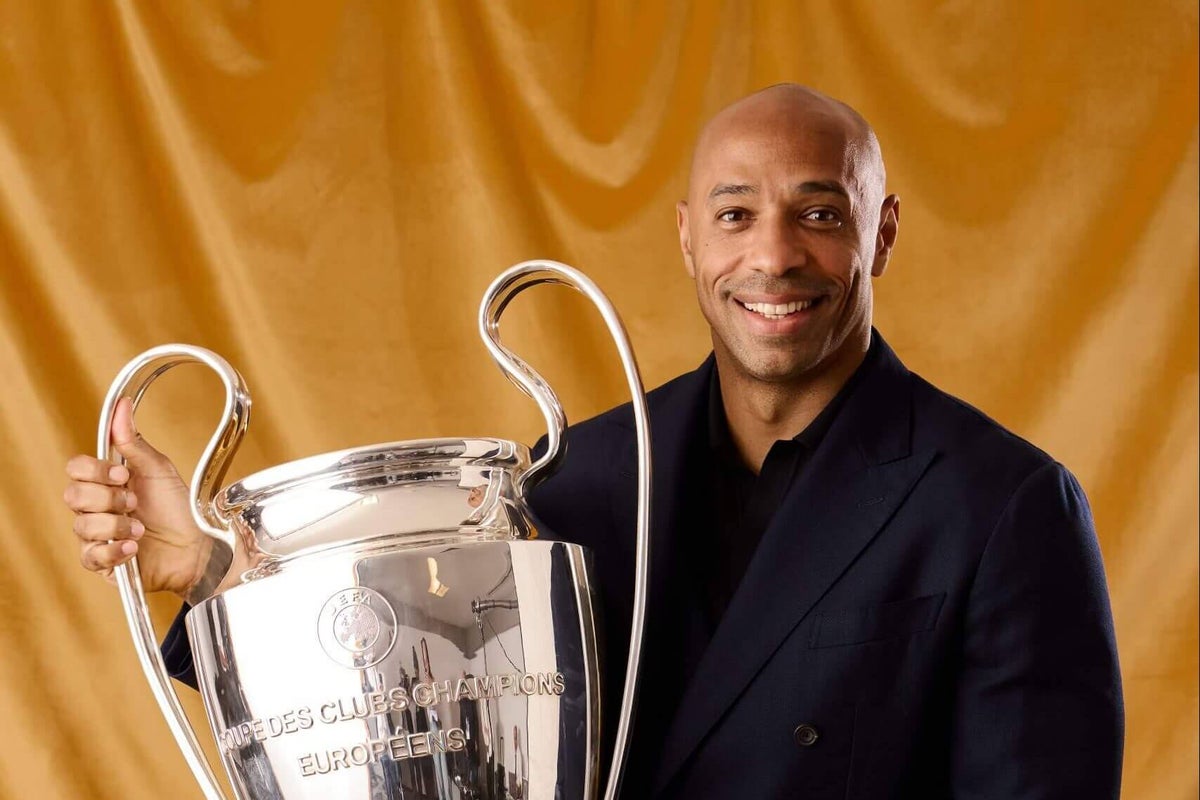
Thierry Henry is talking about last week’s end of soccer’s summer transfer window, a blitz of billion-dollar activity in which Arsenal’s Premier League rivals broke records in pursuit of Mikel Arteta’s defending champions.
Arsenal made big plays for big players of their own, both for Real Madrid’s Vinicius Junior and Atletico Madrid’s Julian Alvarez, but instead found themselves two men down in attack having sold Gabriel Martinelli, Gabriel Jesus and Leandro Trossard and sending Ethan Nwaneri out on loan for the rest of the season, despite spending €40million ($45.8m, £34m) on 24-year-old winger Christos Tzolis.
After Arteta’s team won the Premier League and reached the Champions League final last season, there were plenty of fans who craved an extra sprinkle of stardust to propel the north London club into a period of extended dominance. But former Arsenal striker Henry, speaking to The Athletic ahead of his return to the CBS Sports studio for the U.S. network’s UEFA Champions League coverage starting this week, makes a different case.
In a Premier League where change has been the order of the day, where more than half the division’s 20 managers or head coaches were appointed this calendar year and players are recycled across clubs with ever more brutality, Henry sees strength for Arsenal in continuity. He also takes lessons from the big winners of world football during the past two seasons, when Spain won the World Cup without a cast of billboard names and Paris Saint-Germain conquered Europe in both years by finally abandoning its indulgence of stars and prioritizing the collective under coach Luis Enrique.
“A lot of people right now are focusing always on names, transfer windows, and, ‘My god, this guy’s gonna change my club!’” Henry says on a video call held last week. “No. You being a team and having cohesion will change your club. You having an identity, and a coach who knows what needs to happen and 11 players running, whatever their names are, will change your club.
“Sometimes, we go so much into, ‘Let’s go and buy that guy — he will change the club’. It’s easy to say now that PSG is a good team. When all those guys (including Kylian Mbappe, Neymar and Lionel Messi) left two years ago, everyone thought, ‘Oh my god, where are they going to go from that?’
“Then they got Bradley Barcola, and then they got (fellow attacker) Desire Doue. At that time, you’re not thinking those guys are going to do what they did. But because Luis Enrique is so sound on how he likes to play, they have done it. Do you remember what (PSG’s 2025 Ballon d’Or-winning France forward) Ousmane Dembele said? He said, ‘If you don’t run at Paris Saint-Germain, you’re out’. Simple as that.
“If you look at Arsenal, you don’t have an offensive midfielder or a striker that was in a (Premier League) team of the year last season. But they’re a team.
“People might have been saying about Spain, who is that guy (Alex) Baena playing on the left, or who is (Mikel) Oyarzabal? They conceded only 10 shots on target the whole tournament. They made France and Argentina look like normal teams (in the semi-final and final, respectively).
“With transfers, you’re not sure of anything, but what I’m sure of is everybody needs to run, coaches need to have a great identity, and the plan is to be coachable.”
At Arsenal, Henry says he sees a set of players unaffected by ego or sense of place in the dressing room. He highlights how Eberechi Eze tore Tottenham Hotspur apart home and away last season, scoring five goals in those two games, but also at times accepted his contributions would come from the bench.
“When you know who the alpha is, it’s easier for the group,” Henry says. “If the alpha is the team, it is even easier. Once everybody knows the system makes them tick, everybody applies and goes with the system.
“You see how PSG press? They’re unplayable. But it took (Luis Enrique) a good five to six months to get that team going. People do forget that players need to be coachable. That’s a massive thing that people do not talk a lot about. If you’re a coach and your players are willing to do everything you ask them to do, and they have a tiny bit of quality, you can go places. If they rebel a tiny bit, it can be more difficult.”
While Arsenal’s lack of a glitzy signing since last season does not unduly worry Henry, he sees the potential to do more in those already at the club. He has challenged Bukayo Saka to hit 15 goals and 15 assists across all competitions this season, a feat the England international has never achieved before, coming closest when he scored 20 and created 14 in 2023-24. But despite Arsenal’s strong early-season form, Henry is wary of making quick judgements.
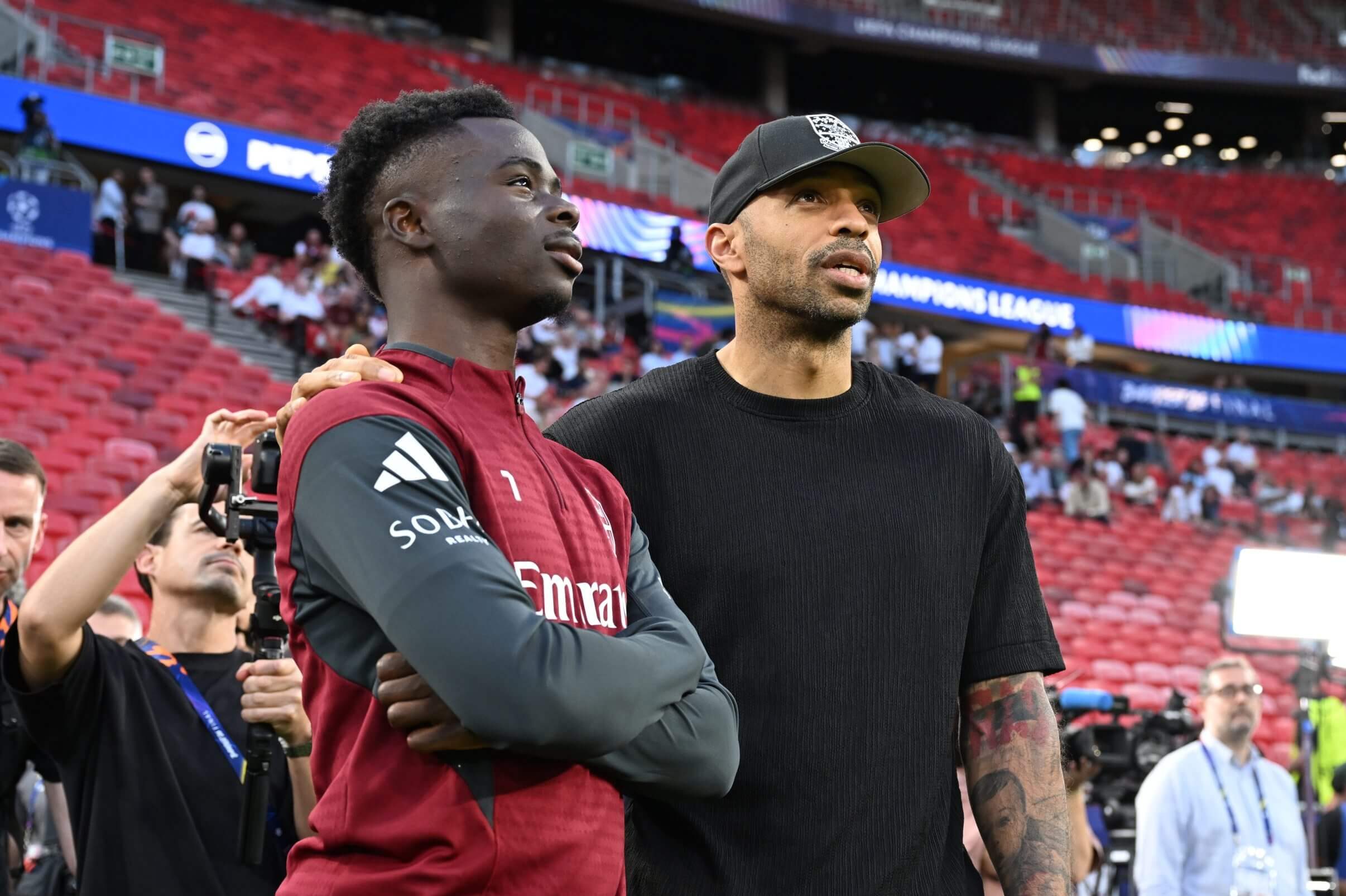
Henry made 20 assists for Arsenal in 2002-03. Can Saka get close to that this season? (Stuart MacFarlane/Arsenal FC via Getty Images)
Henry says he expects it to take a while to see the best of Chelsea and Manchester City under new managers Xabi Alonso and Enzo Maresca, particularly when there has been so much flux at those clubs. He recalls how, this time last year, champions Liverpool began the season with five league wins out of five under Arne Slot.
“Everyone was like, ‘Liverpool know how to win. I don’t see how they’re not going to win the title again’. Two weeks after, it went south for so many reasons. When they didn’t buy anyone, they won the league with Arne Slot (in 2024-25). They went on to buy people, they imploded. That’s why when people ask me, ‘Who is a challenger, who is a contender? Do you think if that player goes there, they can challenge?’, (I say) ‘Hey, we have to wait. Let Maresca work, let Xabi work’.
“Because I coached. People would tell me, ‘Thierry, you coached for one minute and a half (his sideline career includes leading France’s men to silver medals in the 2024 Olympic soccer tournament)!’ But still, (it is not easy) to put the team together during the Olympics in two weeks; a team that never played together before and will never play together after, to build an identity and a philosophy in two weeks. This is why I say let the coach work. Let’s see.”
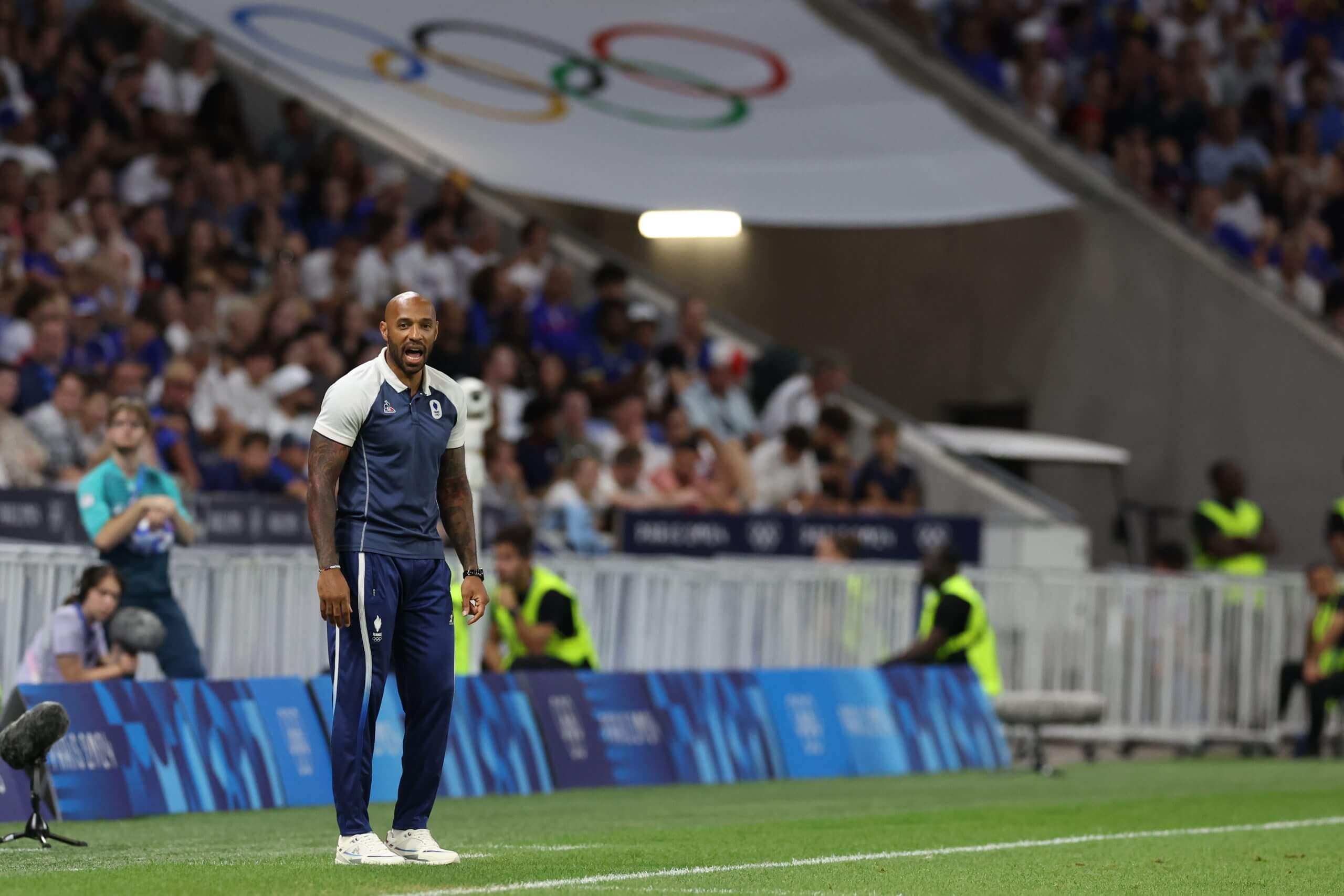
Henry managed France’s men to the Olympic soccer tournament’s final in 2024 (Claudio Villa/Getty Images)
This season’s CBS coverage, which will see Henry reunited with presenter Kate Scott and studio analysts Jamie Carragher and Micah Richards, will also devote plenty of airtime, and possibly an on-site visit, to Champions League first-timers Como, the Italian club that has qualified for the competition under his former Arsenal team-mate Cesc Fabregas.
Both Henry and Fabregas invested in Como in 2022, when it was in second-tier Serie B. Fabregas first joined as a player that same year, before coaching at under-19 level and then taking charge of the senior team, which was promoted to Serie A in 2024 and finished fourth in May, ending the campaign with the division’s best defensive record.
Como host Manchester United in the third Champions League gameweek in mid-October and travel to Fabregas’ hometown team Barcelona, where Henry also played, later in this initial eight-matches-each league phase, which runs until late January.
Henry compares their rise to a Leicester City story, albeit without the equivalent of a fairytale Premier League title just yet. Fabregas and Henry, it should be said, have the same agent.
“But people will tell you, I will call a spade a spade,” says Henry. “The guy (Fabregas) is good. He has evolved. The Cesc that I saw coming out at Arsenal at 16 years old, bossing the midfield, playing against Patrick Vieira and Gilberto Silva (in training), you’re not dumb to be able to do that at 16, so you know that guy is a thinker.”
Henry says there was a period where he wondered if Fabregas was “going to be that stubborn guy”, the type of coach who is so principled in his approach that it undermines a club’s chance of progress with them in charge. The style of the Como team is adventurous, “being on the ball and pressing”. But, Henry says, Fabregas has also shown flexibility.
“Cesc has to now be the hottest thing on the market as a coach at a non big-big club,” he adds. “He earned it, because he worked really hard. He started with the youngsters, he was the assistant when we went up, he took the team.
“If you look at our starting XI and the starting XI last year, I don’t think a lot of people would have known a lot of players. But again, we are a team. It goes back to exactly what I said before. What we brought is players that are coachable in the style that says Fabregas likes to play.
“Cesc can go places. He has that something else — when a coach speaks and people go, ‘Yes, yes, yes’, like a (Alex) Ferguson or (Jose) Mourinho. You’re like, ‘How did you manage them to make them do that?’ On top of that, he is very clever. He sees the game, he can manage the game well.”
Henry does not help to run Como day-to-day. This is the domain of the Indonesian ownership group, headed by Mirwan Suwarso, which has tapped into the club’s geographic allure (Como sits beside an idyllic lake in northern Italy) to create popular branding for jerseys and apparel. “Like the youngsters would say, there is a bit of a sauce with it,” Henry says.
How hands-on does Henry get as an investor? He says he was initially reticent to get over-involved, as he knows it may have irritated him, in his days as a coach at Monaco of France’s Ligue 1 and CF Montreal in MLS, to have other voices chiming in too often.
“I played with Cesc, so it’s a bit more intimate, so we talk about players. But he’s the coach. I don’t call after a game and say, ‘Hey, why did you play like that?’ When Cesc calls me and asks what I think about the game, I’ll tell him. It’s more of a supporting way, and obviously he calls me and we talk about shall we or shall we not go for that player? I give him my opinion. I don’t say, ‘You must…’.
“I was a coach, and it can be a bit annoying when someone is over your shoulder and you’re like, ‘Hey, can you let me work, please?’ But I view it a little as, who helps the helper? Everybody wants things from the coach. Fans, sponsors, players. And then who helps him? Sometimes, you just need to sit and listen, because that guy needs to vent.
“Who thinks about the coach? People forget that a coach is human. You don’t see players going to knock on the door of a coach and say, ‘Are you OK, Coach?’ No. It’s like, ‘Why didn’t I play yesterday?’ But, by the way, Cesc doesn’t need a lot of help.”