
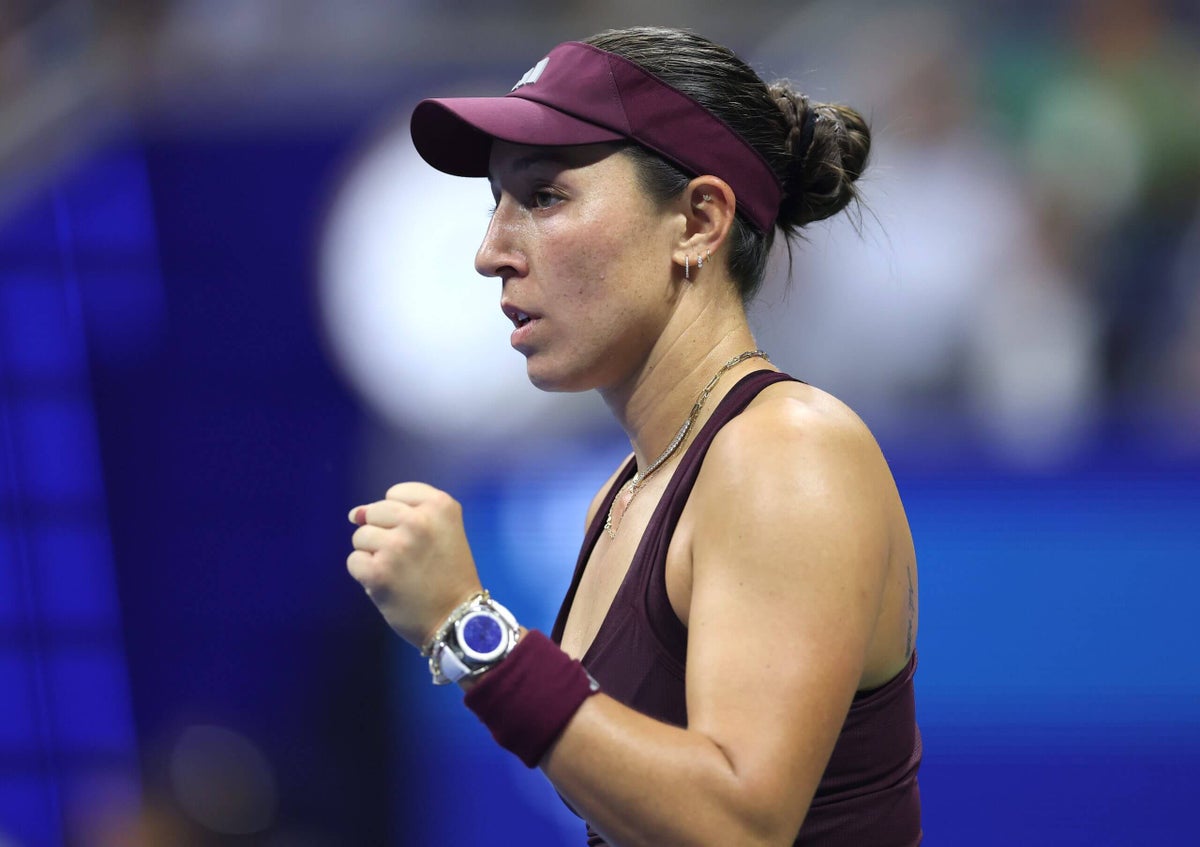
NEW YORK — Jessica Pegula came from behind in a topsy-turvy match full of breaks of serve Tuesday night, beating fellow American Emma Navarro 3-6, 6-4, 6-3 to advance to her third consecutive U.S. Open semifinal.
Her prize? A third chance at taking down Aryna Sabalenka in New York.
Pegula, the No. 3 seed, will meet the defending champion for the third consecutive year at the U.S. Open. She lost to her in the semifinals last year and in the final the year before, in what is Pegula’s only career Grand Slam final appearance.
She has won two of her past three meetings against Sabalenka, but a victory at her home major against the world No. 1 — whose top spot in the rankings she could still take with a win here — has so far eluded her.
While some athletes try their best to view each match in a rivalry as detached from the others, played under completely new circumstances, Pegula finds it motivating to think of her and Sabalenka’s matches in totality. Even if the current tally sits at 9-4 in Sabalenka’s favor.
Few top women’s players have faced off as frequently as they have in recent years.
“I think it’s fun to look at the rivalry we’ve had. She’s gotten me here the last couple of years. I have been able to beat her a few times, maybe on a smaller stage, so I think that’s going to be kind of a hurdle for me to get over,” Pegula said in a news conference.
“But at the same time, I think it’s fun. We’ve challenged each other. I know that she’s definitely pushed me to become a better player, so I always respect and appreciate that aspect of our rivalry.”
Pegula delayed her commute to the U.S. Open grounds Tuesday by a few minutes to watch Sabalenka win the deciding set tiebreak against Linda Nosková in the first quarterfinal of the day.
She isn’t surprised to be meeting Sabalenka in the semifinals despite the world No. 1’s rocky spring and summer.
“I had a pretty terrible summer last year and then was able to play really good tennis here and take a set off of her in the semis last time we played. So sometimes results don’t really matter that much,” Pegula said.
“I feel like when you’re a top player, the reason you’re there is because you can draw on experience and you can find your game in really tough moments.”
Pegula will try to draw on her recent wins against Sabalenka in preparation for their upcoming match, and pull her level back up after an off day against Navarro.
The final game Tuesday, in which Pegula missed her first match point and then cracked a winner to deny Navarro the chance to break back, was typical of the evening. There were nine breaks of serve in 28 games, with games that regularly swung back and forth from deuce.
Early in her match with Navarro, the No. 26 seed, Pegula tinkered with her choice of racket. This was her first formal night session, and she struggled to find her range from the baseline and on her serve. But as the match wore on, she found the reliable rhythm that has carried her to deep runs in Flushing Meadows the past few years.
Her serve, which has improved in pace and precision this year, is still not quite firing. Navarro took advantage of that even as Pegula’s baseline consistency grew, pressuring her serve even into what proved to be the middle of the third set.
Navarro broke Pegula’s serve to lead 2-1, on her third break point in the game. Pegula broke back to love for 2-2, but Navarro immediately brought up two more break points.
This time, Pegula held firm on her serve, despite needing a second delivery on both points. In the very next game, Pegula broke Navarro’s serve once more, and she was away.
Pegula may be the one of the most reliable winners in women’s tennis, with a tour-leading 50 wins this year and five appearances in tournament finals, but Sabalenka will be her biggest test.
Despite those two recent wins for Pegula, the Belarusian owns a 9-4 record against the American and she’s owned their only two Grand Slam meetings, both of which have come at the U.S. Open.