
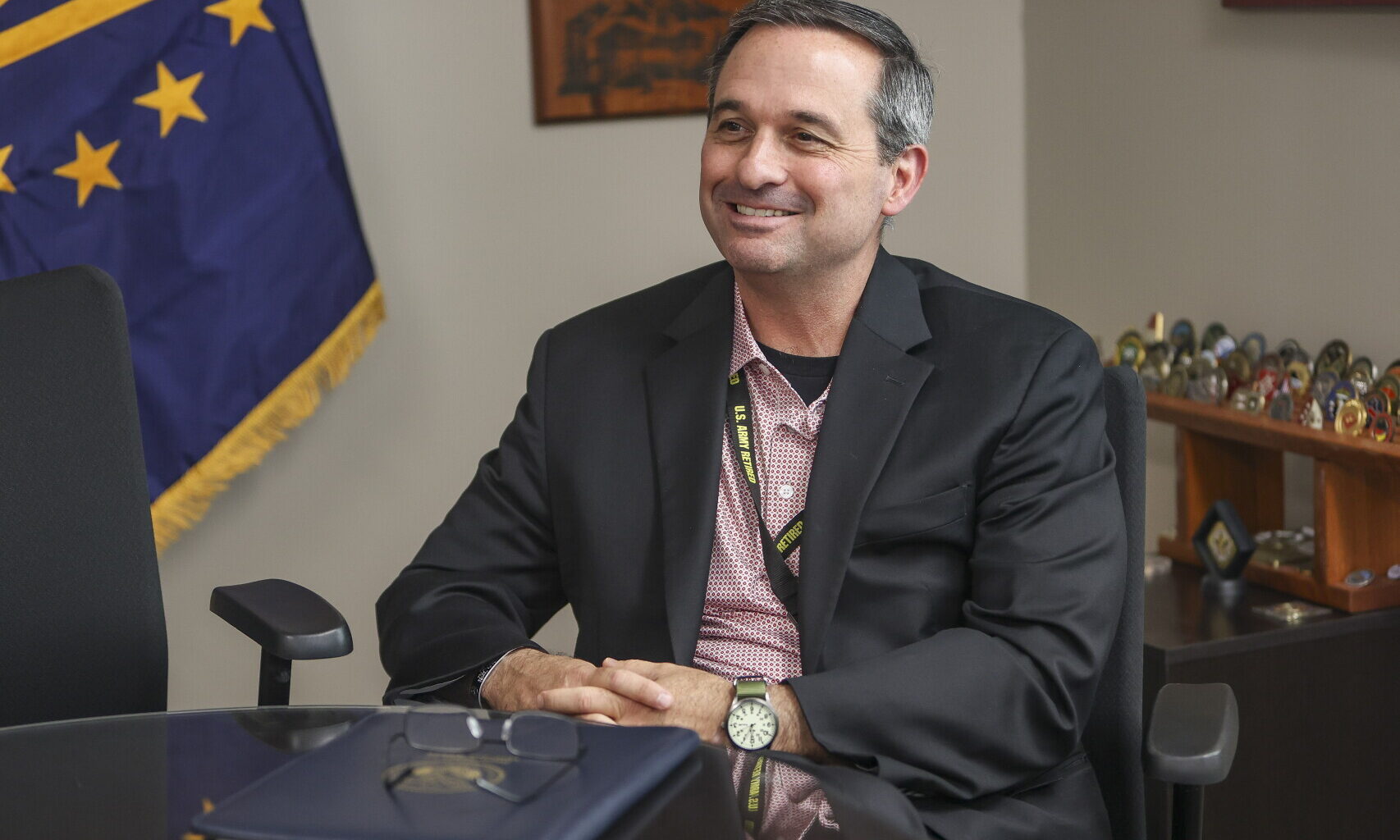
FARGO — The director of Fargo’s Veterans Affairs Health Care System is nearing his first full year on the job, with a focus on planning where the system needs to be five to 10 years from now.
Harold “Brent” Pharis was
chosen for the role in the fall of 2024
but didn’t arrive at the Fargo VA Medical Center, the main facility and hospital at 2101 Elm St. NE, until last November, due to the time it takes for appointments to go through.
Pharis said stepping into the well-established system has required understanding the hospital’s workforce culture, assessing plans that were in place prior to his arrival and to begin casting a vision for the future focused solely on veterans.
“We have to be in tune for our veterans to tell us what they want — not necessarily only what they need, but what they want — and then we model that into our healthcare system,” Pharis said.
His previous permanent duty station was as associate director for the Central Iowa VA, but Pharis most recently served as interim director of the Western New York VA in Buffalo before coming here.
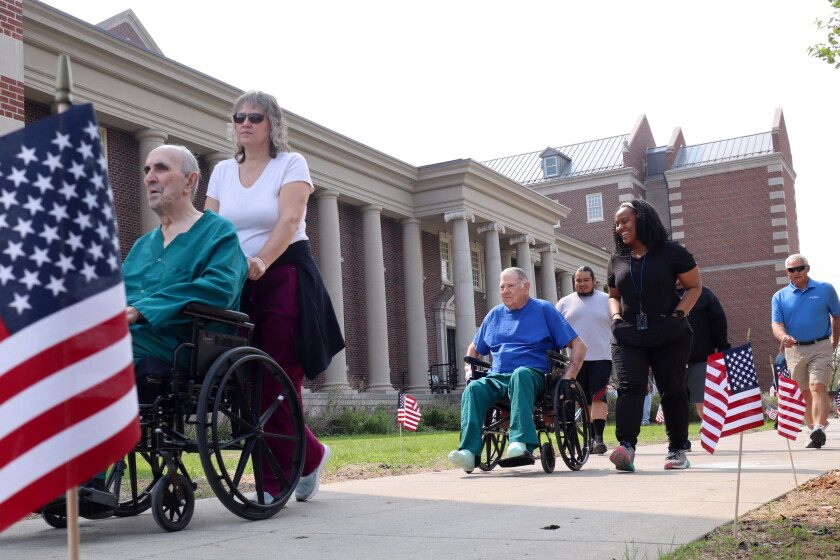
Veterans and staff at the Fargo VA Medical Center start the 13th annual VA2K Walk & Roll 1.24-mile walk Wednesday, May 17, 2023. Participants were encouraged to donate clothing, toiletries, packaged food or bottled water for local homeless veterans.
Forum file photo
Speaking with The Forum on Friday, Sept 4, the Indiana native sported team apparel underneath his jacket for “Jersey Fridays” at the Fargo VA.
The regional network, which cares for veterans in North Dakota, northwest Minnesota and a portion of South Dakota with more than 1,500 employees across 11 sites, went without a permanent director for about 18 months.
In spring 2025,
President Donald Trump’s administration announced a plan to cut about 80,000 jobs
from the VA’s service delivery system nationwide to reduce federal spending. Local veterans advocates warned at the time that those moves would harm veterans.
Pharis said while job losses did occur on the “enterprise” level, there were no cuts, such as deferred resignations, here.
“All of our positions here are critical to (the) mission,” he said.
Pharis said his work as the Fargo VA director is guided by his own military service and a focus on planning and analytics.
He holds academic degrees from Liberty University and Dallas Christian College, and a healthcare analytics certificate from the University of Nebraska, according to his bio.
His military career was spent as an Army medic, with tours including Desert Shield, Desert Storm, Afghanistan and Iraq. He retired as a master sergeant in the Army and began working for the VA in 2013.
Pharis said the VA is a health system built on eras, firstly on the veterans of World War II, Korea and Vietnam.
“When I first started with the VA … you could find World War II veteran hats everywhere in the hospital. Now if I see one, I actually stop what I’m doing and go speak to them,” he said.
The average age of the Vietnam veteran is 80.
“They’re looking for a level of acknowledgement, a level of respect” and to receive care for medical issues they probably wouldn’t be dealing with if they hadn’t been sent to war, Pharis said.
Those veterans still rely heavily on face-to-face healthcare, he said, so that approach must be maintained. But service members of more recent conflicts in the Middle East have different needs.
Newer veterans are open to virtual health visits and using technology.
“Veterans now want to be able to log in and see their lab results, see their X-ray, order their prescription or refills online. They don’t want to have to call, they don’t want to have to leave a message,” he said.
The most sought-after virtual appointments through the Fargo VA are for mental health, Pharis said. Less than 12% of primary care appointments are done virtually.
The Fargo VA is preparing for another market assessment, which helps staff stay on top of what the veteran population needs.
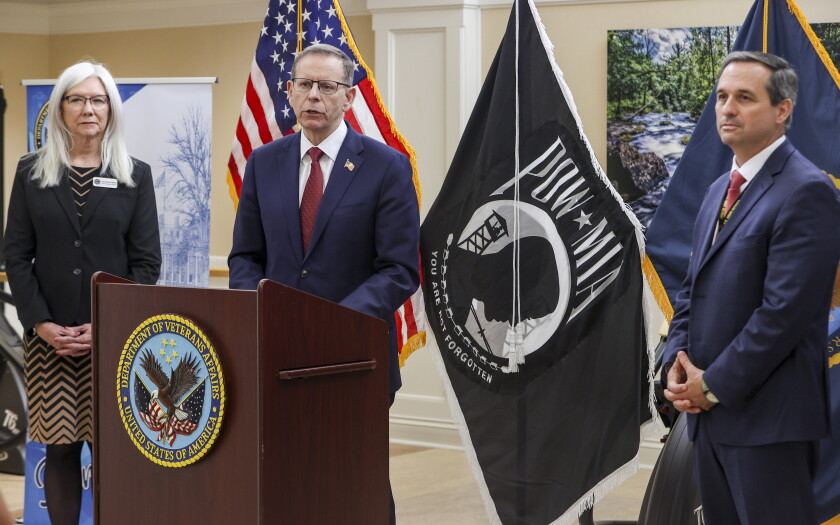
From left: Veterans Integrated Service Network Director Judith Johnson-Mekota, U.S. Department of Veterans Affairs Deputy Secretary Paul R. Lawrence and Fargo VA Director Brent Pharis talk about the medical center’s implementation of the Federal Electronic Health Record system during a press conference on Wednesday, June 17, 2026, at the Fargo VA Health Care System.
Alyssa Goelzer / The Forum
In addition, a new Veterans Affairs electronic health record system being adopted nationwide is expected to streamline all services.
It goes live in Fargo in July 2027.
Pharis said his biggest planning driver, written into a strategic plan, is the statistic that 18% of all military service members by 2040 will be female.
With World War II, Korea and Vietnam, males make up 96% of that veteran population.
“Not all female veterans would walk in here and necessarily see themselves in everything that we’re doing, and that’s what we’re going to work on for the future,” Pharis said.
The demographic shift could mean adding services and replacing others, he said.
The Fargo VA is continually assessing its wait times for veterans seeking care.
In primary care, there is an 11.8-day wait for a new patient appointment, which is within the system’s 20-day benchmark, he said.
The average wait is 19 days for mental health, 28 days for specialty care such as cardiology, urology and endocrinology, and 41 days for surgeries.
Veterans have the option of seeking healthcare elsewhere in the community, but wait times there often mirror those at the Fargo VA, he said.
Pharis also spoke about ongoing projects, including a new outpatient mental health facility near the north entrance of the Fargo campus and an integrated whole health/pain management facility there, both of which should be done in April 2027.
In Bismarck, the VA is tripling the size of its community-based outpatient clinic, which will become a multispecialty hub.
Instead of a Minot veteran coming all the way to Fargo, they’ll likely have only a 90-minute drive to Bismarck.
Also, plans are underway for
a second veterans home in northwest North Dakota,
spearheaded by U.S. Sen. John Hoeven.
The state’s only veterans home, dedicated solely to long-term care for veterans, is in Lisbon in southeastern North Dakota.
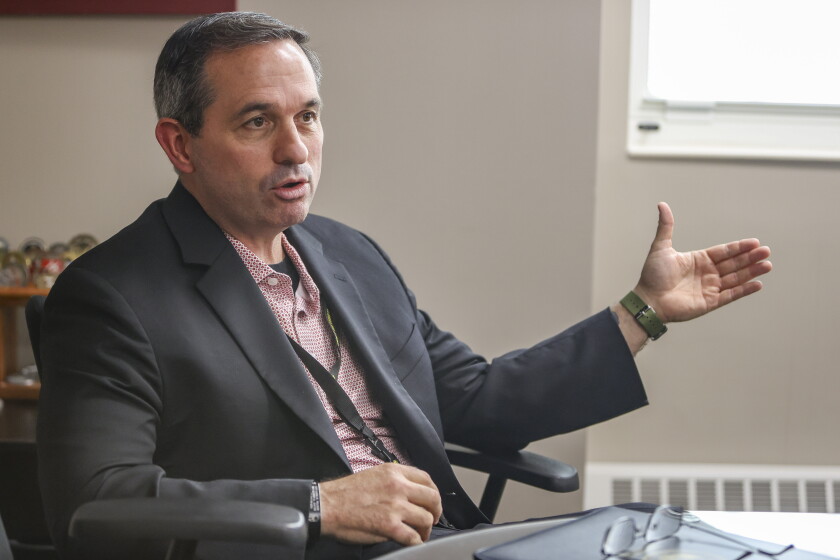
Brent Pharis, director of the Fargo Veterans Affairs Health Care System, talks about his job Friday, Sept. 4, 2026, at the Fargo VA Health Care System.
Alyssa Goelzer / The Forum
Pharis said he and his wife, who bought a home in West Fargo, are enjoying their time here as he settles into his work.
With four children and 10 grandchildren scattered across the country, the couple finds living in this area “easy” and “simple.”
“It’s been a long time since I’ve lived someplace that not only do I know my neighbor, but my neighbor came over and introduced themselves,” he said.