
Germany: Oven and utility engineering projects can integrate recovery while preserving the process conditions required by industrial bakeries.
USA: Plant-level process-heating assessments support selection of recovery projects with a defined receiving duty and operating benefit.
UK: Energy assessments and action planning can turn identified baking losses into specified equipment projects.
France: Industrial food-site efficiency programmes support matching recovered heat with recurring hot-water or process-heating needs.
Netherlands: Energy-saving obligations strengthen attention to qualifying measures and their project-level payback.
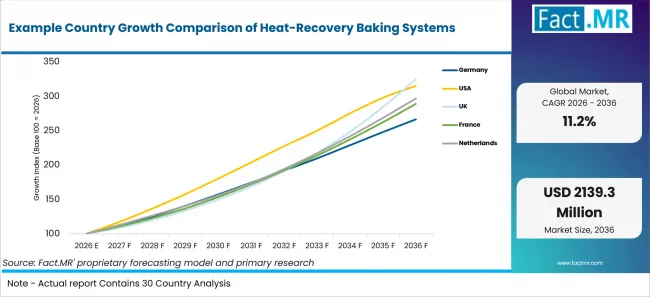
Example Country Growth Comparison Of Heat Recovery Baking Systems | Source: Fact.MR
Share
Country CAGR (2026-2036)
What is driving Germany’s growth through 2036?
Germany is forecast to grow at 10.3% CAGR.
The EU’s food, drink and milk BAT framework provides an environmental-performance context for industrial installations within its scope. For bakery investment, the practical implication is to consider energy performance alongside the wider process when an oven or utility system is renewed.
The purchasing opportunity is strongest where the recovery supplier can work with the oven and burner engineering team. A retrofit that changes exhaust resistance or introduces a difficult cleaning point can undermine the intended benefit. Integrated design and demonstrated operation through load changes can therefore influence supplier selection.
What is driving USA’s growth through 2036?
USA demand is projected to increase at 12.2% CAGR.
DOE’s process-heating sourcebook supports evaluation of the whole thermal system, including the recovery of heat that would otherwise be rejected. This provides an engineering basis for screening oven-exhaust opportunities against other efficiency measures.
A bakery can then prioritise a project whose receiving demand is available for much of the operating year. Combustion-air preheating and recurring process-water duties offer different installation and control requirements. Buyers need a site-specific comparison that includes auxiliary power, maintenance and the production interruption required for commissioning.
What is driving UK’s growth through 2036?
UK is projected to record 12.5% CAGR. The Environment Agency’s ESOS guidance addresses energy assessment and action planning for qualifying organisations. It supports a route from identifying an energy-saving opportunity to recording an implementation plan, while the scheme itself does not prescribe a heat-recovery purchase for every bakery.
The equipment sale depends on converting the assessment into a defined scope: heat source, destination, installation window and accountable performance measure. Suppliers can assist by distinguishing the heat-exchanger rating from the useful annual output expected under the bakery’s schedule. That distinction makes competing project proposals more comparable.
What is driving France’s growth through 2036?
France is forecast to expand at 11.2% CAGR.
French industrial food installations within the applicable thresholds operate in the context of the EU food, drink and milk BAT framework. Fact.MR’s demand assessment focuses on the resulting project opportunities where process renewal and energy-performance objectives coincide.
Recurring hot-water and proofing demand can offer a more persistent destination than building heating alone. Seasonal variation therefore matters when selecting the receiving duty. A bakery with several thermal users may benefit from a control arrangement that allocates recovery to the demand available at the time, provided that the additional pipework and equipment remain economically justified.
What is driving Netherlands’s growth through 2036?
Netherlands growth is projected at 11.5% CAGR.
RVO explains that the energy-saving obligation requires qualifying business locations to take energy-saving measures with a payback of five years or less. This creates a concrete project-evaluation context, although applicability and the qualifying measure must be established for the individual site.
For baking recovery, the decisive inputs include usable operating hours, displaced energy, added electricity and installation cost. Monitoring useful output can support the plant’s ongoing assessment of the measure. Condition monitoring also helps identify deterioration from fouling before it erodes the assumed operating benefit.