
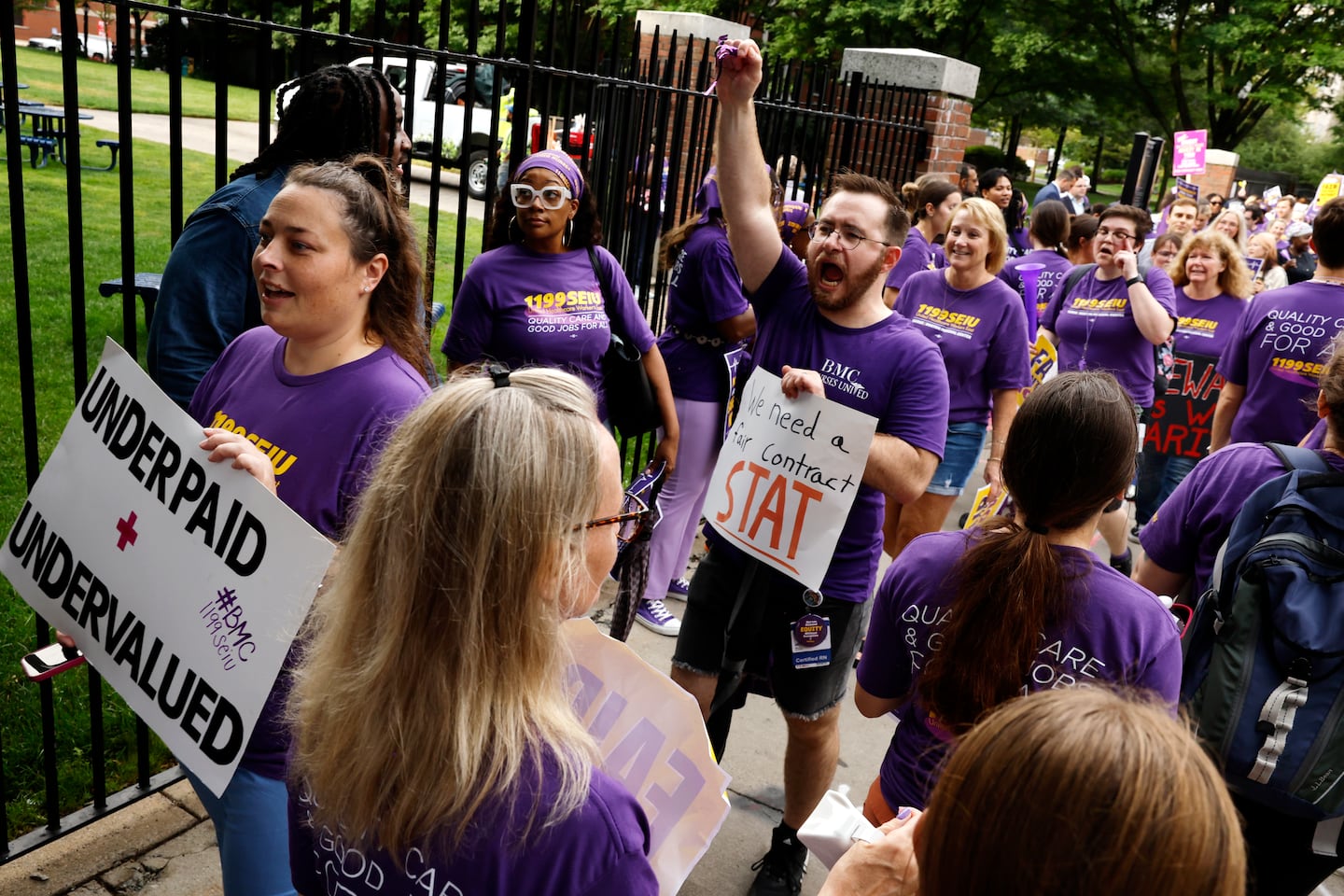
Nurses in 1199 of the Service Employees International Association and BMC management have been negotiating a new contract for more than six months with no success.
“We are a Level I trauma center,” said Allison Chase, a post-anesthesia care unit nurse at BMC. “We should be paid like the other Level I trauma centers.”
The BMC fight — which includes nurses at the hospital’s main campus and the BMC-affiliated Brockton Behavioral Health Center — is the latest in a wave of nursing strikes and other labor actions at major hospitals in Massachusetts.
Experts say the clash is a reflection of a fractured health care system suffering under the weight of enormous financial stressors.
BMC, in particular, is expected to bear an outsize hit from federal changes to Medicaid eligibility that take effect in January, which will likely increase the number of uninsured patients at the Boston hospital. Roughly 40 percent of BMC’s patients are on Medicaid, the government insurer for poor and disabled people.
BMC is hardly on steady footing as it is, having posted significant operating losses earlier this year.
In a statement, BMC said its contract proposal is informed by the financial reality of being a safety-net hospital that is reimbursed at lower rates than hospitals with greater numbers of patients with commercial insurance.
“Our offer appropriately balances our commitment to valuing our nurses, supporting retention and recruitment, and maintaining the financial stability necessary to serve our patients and community,” it said.
Chase, 36, said nurse turnover is a major issue at the hospital. She started at BMC 14 years ago with about 40 other newly graduated nurses, but is one of only a few left. She would consider leaving, too, if things don’t change.
She makes about $130,000 per year. At nearby Brigham and Women’s Hospital, where nurses went on strike earlier this summer, mid-level nurses earn a base pay of $147,000, while nurses with two decades of experience earn at least $220,000 annually.
“I feel like hospitals have this way of talking to us with this insincere, patronizing altruism. They email us and say, ‘you’re heroes,’ or ‘we couldn’t do it without you,’” Chase said. “But then won’t show us the respect we deserve.”
BMC proposed increasing wages by 15 to 20 percent over the next two years through seniority-based increases, annual pay hikes, and a ratification bonus, a hospital spokesperson said. The hospital also agreed to return to the bargaining table after two years, instead of three, to “provide flexibility to respond to changes in the financial and reimbursement environment,” they said.
Under the proposal, BMC’s most tenured nurses would receive an increase of 11 percent over the next four months, the spokesperson said, for a total salary of more than $194,000 per year for a nurse working 36 hours per week. A first-year staff nurse would make $41.59 per hour, about a 9 percent increase from current wages, under the proposal.
A union spokesperson said the nurses’ wage proposal differs from BMC’s by about 17 percent. Moreover, the spokesperson said BMC’s proposal would increase nurses’ health insurance costs, lacks paid training opportunities, and includes already guaranteed pay increases based on experience.
BMC nurses currently start at $38.05 per hour, compared to $41.71 at the Brigham and $43.01 at Tufts Medical Center, according to the union. For a nurse starting at BMC working 36 hours per week, that amounts to a salary of about $71,000. Nurses with the most seniority earn $93.65 per hour at BMC, compared to $105.62 at the Brigham.
“We’re tired of traveling nurses being brought in from out of state and paid more to do the same job, because management won’t invest in BMC’s own workforce,” said Kerry LaBarbera, an emergency room registered nurse at BMC.
Over 70 percent of nurses at BMC have been on the job six years or less, the union said.
Throughout the industry, nurses, resident doctors, and other clinicians have been pushing for higher pay throughout the summer, amid Massachusetts’ ever-increasing costs of living.
In July, more than 4,000 nurses at Brigham and Women’s Hospital walked off the job for a one-day strike that was the largest in Massachusetts history. They were locked out of the Brigham, one of Mass General Brigham’s two flagship hospitals, for an additional four days.
The hospital has yet to reach an agreement with the nurses represented by another union, the Massachusetts Nurses Association.
Around the same time, nurses at UMass Memorial Medical Center’s University Campus in Worcester authorized a 14-day strike over what they called chronic staffing shortages. The union, which has not gone on strike, is seeking more competitive wages to recruit and retain staff.
Tom Juravich, a professor of labor studies and sociology at UMass Amherst, said the three strike authorization votes since June by unionized nurses, including the vote at BMC, were unsurprising given national and local dynamics.
In the past decade, he said, the labor movement has experienced a national resurgence. Workers in health care, a dominant industry in Boston, have in particular flexed their muscles.
“Boston is a union town, and this is a highly organized industry,” he said.
And that industry is also in turmoil, with BMC particularly troubled. In May, it reported operating losses of $41.7 million for the first six months of its fiscal year, worse than the $30.4 million in losses for the same period the year before.
BMC attributed much of the losses to its acquisition of two hospitals ravaged by underinvestment that were formerly owned by Steward Health Care, the for-profit hospital system that declared bankruptcy in 2024.
The hospital will now have to contend with the public image of spending money on the Steward properties while saying there’s not much left for its nurses, Juravich said.
“We all love our nurses,” said Juravich. “Patients and families want excellent medical care, and they want nurses to be paid well enough and treated well enough so they can provide that.”
David E. Williams, president of Health Business Group, a Boston management consulting firm, said he looked back 10 years and couldn’t find another time when multiple nursing locals have authorized strikes in such a short period.
“It’s certainly unusual,” he said.
Williams added that the one-day strike at the Brigham this summer that turned into a multiday lockout presented a “cautionary tale” for nursing unions.
“A strike authorization vote gives the unions leverage at the negotiating table without risking a lockout and lost wages,” he said.
Just because the BMC nurses voted to authorize a strike doesn’t guarantee one will happen. By law, health care unions must notify hospitals of a strike at least 10 days in advance to allow the facilities time to minimize interruptions to patient care.
The BMC union has taken particular issue with how much the health system’s C-suite executives are paid when nurses say their wages aren’t keeping up with other Boston hospitals.
BMC chief executive Dr. Alastair Bell made $2.2 million in total compensation in 2024, a nearly 13 percent increase from a year prior, according to the organization’s most recent annual IRS filings. Even so, Bell is the lowest-paid leader of the state’s major health systems.
Marin Wolf can be reached at marin.wolf@globe.com. Jonathan Saltzman can be reached at jonathan.saltzman@globe.com.