
Published Sep. 13, 2026at6:00am
Stand on the first tee at Lincoln Park Golf Course, in the northwesternmost corner of San Francisco, and witness the view: Down the fairway, the Legion of Honor beckons; through the cypress trees to the right, the Golden Gate Bridge rises above the fog. It is something to behold.
What you won’t see are many golfers. Over the course of an hour on a recent Monday afternoon, all of three players teed off. In that same span, maybe a dozen duffers strolled across the links beyond. It was just another quiet afternoon at Lincoln Park.
And just another example of the often overlooked yet surprisingly broad footprint of golf in San Francisco. Lincoln Park is one of six public courses owned by the Recreation and Parks Department and one of 10 courses inside the city limits.
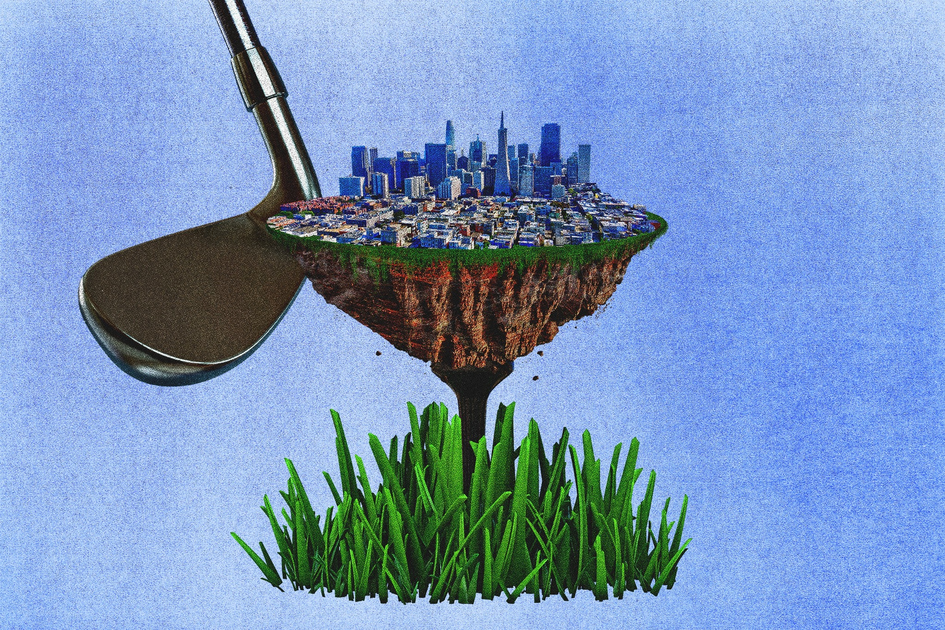
In a densely populated, housing-starved, forward-thinking city of this size, it’s remarkable just how much physical space is dedicated to golf. Of the 3,400 acres of recreation and open space owned and managed by the Recreation and Parks Department within SF, fully 10% of it is taken up by golf. Including private courses, golf occupies more than 1,000 acres. That’s more than 3% of the city’s surface area, about the same as Golden Gate Park or the Presidio.
But unlike those two parks, which draw millions of visitors every year, San Francisco’s golf courses are sparsely used, all things considered. At Lincoln Park, an average of 90 people tee off every day. Across town at Gleneagles, a nine-hole course adjacent to McLaren Park, fewer than 50 tee off a day, half as many as 20 years ago. Overall, the five municipal courses inside the city limits routinely operate at less than 50% capacity, with 10% fewer rounds played than two decades ago.
 Over the course of an hour on a recent Monday afternoon, all of three players teed off at Lincoln Park Golf Course, pictured above. | Source: Lea Suzuki/SF Chronicle/Getty Images
That is a lot of prime San Francisco real estate waiting around expectantly, like Shel Silverstein’s Giving Tree (opens in new tab), for just a few dozen players a day.
And unlike municipal golf courses in most cities, San Francisco’s operate at a deficit. In fiscal 2026-27, the city is expected to spend $4.9 million more than it earns tending to its golf courses — a massive subsidy for a sport with increasingly fewer players, who skew older, wealthier, male, and white.
Which raises the question: In San Francisco, the second-most densely populated city in the nation, where there is too little housing and a voracious appetite for public space, is so much golf the best use of so much land?
Nothing but sand
Why are there so many golf courses in San Francisco? The answer starts in the early 20th century, when just 500,000 people lived here, 95% of them white. In those years, the western side of San Francisco was justly called the Outside Lands: Sand dunes were common; houses were not. Why not build a golf course or two out there?
And so they did. Lincoln Park, built atop an old cemetery, opened in 1912. Harding Park, on the eastern shore of Lake Merced, debuted in 1925. In 1932, the city opened Sharp Park course, 10 miles south in Pacifica (the only city-owned course outside city limits). Fleming and Gleneagles, both nine-hole courses, opened during golf’s early 1960s boom years (Arnold Palmer, Gary Player, Jack Nicklaus). It is impossible to imagine the city devoting so much public space to just one sport today.
Some of these courses are historic and revered by golfers worldwide. The Presidio Golf Course was a perk prized by U.S. Army officers for a century before it went public in 1995. Harding, the city’s grand dame, hosted the PGA Championship in 2020. The exclusive San Francisco Golf Club — so exclusive it doesn’t have a website — is ranked as one of the best courses in the country. The Olympic Club, a private club with three courses tucked on $750 million of real estate (opens in new tab) against the Pacific Ocean, has hosted the U.S. Open five times, most recently in 2012.
 The Presidio Golf Course was a perk prized by U.S. Army officers for a century before it went public in 1995. | Source: Thos Robinson/Getty Images
But some courses are arguably not used to the full potential of the land they’re on. Lincoln Park may enjoy one of the nation’s most beautiful settings but is generally considered a poor playing course with shabby facilities, earning just 3 out of 5 stars (opens in new tab) on GolfPass. Gleneagles fares little better, with 3.5 stars (opens in new tab); “the course has seen better times” is a typical comment.
What the city should do with so many golf courses has been a recurring topic for Rec and Parks leadership. In 2008, the department commissioned an independent study of the city’s courses. That report (opens in new tab) aimed to answer two questions: Is there sufficient demand for municipal golf to justify the city subsidizing the courses? And would conversion to other recreation needs be appropriate?
The report acknowledged a high demand for golf in the San Francisco region but concluded that the municipal courses were poorly managed and significantly underperforming. In particular, the report flagged that the courses ran at an annual deficit of $1.5 million; at the time, that was considered a significant shortfall.
Leon Younger, president of Pros Consulting and the lead author of the 2008 report, explains why that deficit was a concern. “Most public courses are between 90% and 100% self-supporting. Many make a profit,” he said, noting that municipal leaders typically “want golf to be a profit center for the city.”
Not so in San Francisco: Upon learning that in 2026-27, the city’s golf deficit will reach $4.9 million, he was shocked. “Oh, my God. Jesus, that’s a lot,” he said. “That’s just a lot for a public golf course. Something else is going on there.”
Part of what’s going on might be how the courses are managed. For all except Gleneagles, contracted operators handle the golf business: tee times, equipment rentals, lessons, food and beverage, and so on. The city gets a cut of the fees, but Rec and Parks pays for all ground maintenance, including mowing, irrigation, and improvements. That arrangement ends up with the city holding the wrong end of the stick, for years on end.
Another issue is how many people play on the courses. In 2023-24 (the most recent year of data provided by the city), roughly 199,000 rounds of golf were played on the five municipal courses inside city limits — 10% fewer than in 2005-06. Another way to measure this is capacity: Most of San Francisco’s municipal courses operate below 50% capacity; the industry standard is 70%, according to consultant Younger.
This dropoff is despite the fact that the number of people playing on golf courses in the U.S. has stayed steady since 2003, according to the National Golf Foundation (opens in new tab). (After a big fall-off in the 2010s, golf has boomed nationwide since the pandemic. But not in SF.)
Some courses are used more than others. After an extensive remodel in 2024, Golden Gate Park Course, a nine-hole par 3, hosts about the same number of players as it did in 2005-06. According to Rec and Parks data, Harding Park operates at capacity on weekends, while Lincoln Park operates above 70% on weekends. That’s higher than the numbers from that 2008 report.
But here’s the thing: Even at peak capacity, an 18-hole golf course can accommodate a maximum of about 300 players a day (opens in new tab). Considering that the currency is hundreds of pristine acres in our oceanfront city, that is an astonishing price paid to golfers.
 TPC Harding Park hosted the PGA Championship in 2020. It operates at capacity on weekends. | Source: Orlando Ramirez/Getty Images
So put golf aside and consider these as public spaces. Are they being used efficiently? Some 25 million people visit Golden Gate Park every year. At 1,017 acres, that’s roughly 25,000 visitors per acre per year. The five municipal golf courses inside city limits, on the other hand, cover about 345 total acres, with about 200,000 rounds played in a year. That’s not even 600 visitors per acre per year — 40 times less usage than Golden Gate Park.
But perhaps it’s unfair to compare the grandeur of Golden Gate Park — the crown jewel of the city’s parks — to golf. Rather, let’s consider Sunset Dunes, which, as foes of Sunset Dunes insist, is just an asphalt remnant of a once-busy highway. With 1.7 million visitors in its first year, that 50-acre stretch is enjoyed by 34,000 people per acre — nearly 60 times as much use as the city’s golf courses.
Particularly for a shabby slab of pavement, that is a remarkably efficient and effective use of public space.
150 acres of potential
Which raises the question: If San Francisco can turn a sand-blown highway into one of its most pleasing and well-used spaces, how might some — but by no means all! — golf courses be repurposed to better serve the city and its residents?
The most obvious answer would be housing. Gleneagles borders McLaren Park, San Francisco’s second-largest and perhaps most neglected park. Looking south from the Philosopher’s Way trailhead parking lot (a favorite perch for dog walkers and dope smokers and hook-uppers), one can conjure a new neighborhood with thousands of affordable apartments, ample recreational space, and breathtaking bay views.
Such a bold step would suit the moment. The Sunnydale housing complex, which abuts the golf course, is already being redeveloped (opens in new tab) as part of the citywide HOPE SF rebuild. The pace of the HOPE SF effort has been sluggish, dragging out over decades. Tapping the Gleneagles acreage could bring new energy and ideas to the effort.
But even short of housing, these underused spaces could be remade for the benefit of thousands, rather than dozens.
 The Olympic Club is a private club with three courses tucked on $750 million of real estate against the Pacific Ocean. It has hosted the U.S. Open five times, most recently in 2012. | Source: Getty Images
San Francisco has executed some elegant reimaginings of public space in recent years. India Basin Park transformed 10 acres of fenced-off industrial waterfront into a lovely space with trails and public piers. The Port of San Francisco turned a derelict shipbuilding site into Crane Cove Park, a bayside beach teeming with paddleboarders and picnickers. Francisco Park, Tunnel Tops, the JFK Promenade, Crissy Field … the list of amazing makeovers in this city goes on and on.
Nearby, golf course reinventions have succeeded recently. In 2018, Monterey County’s 185-acre Rancho Cañada Golf Club was folded into the Palo Corona Regional Park, with mountain bike trails and dog parks for the community. That same year, in Marin County, the 157-acre San Geronimo golf course was acquired by the Trust for Public Land and converted into the San Geronimo Commons as a county park.
Marin golfers weren’t happy; they narrowly lost a ballot measure to preserve the golf course. The former course superintendent bemoaned a desiccated landscape (opens in new tab) rife with gophers, the enemy of all groundskeepers (opens in new tab), the course fading away like a “sick and dying child.”
He was wrong. Today, the former course is frequented by hundreds of hikers and dogs and dog walkers, part of a continuum of open spaces in the Marin hills.
San Francisco’s golf courses
Course
Holes
Owner
Size
Lincoln Park Golf Course
18
SF Rec & Parks
99 acres
TPC Harding Park
18
SF Rec & Parks
170 acres (incl. Fleming)
Fleming
9
SF Rec & Parks
Included in Harding
Golden Gate Golf Course
9
SF Rec & Parks
20 acres
Gleneagles
9
SF Rec & Parks
56 acres
Presidio Golf Course
18
U.S. gov (Presidio Trust)
150 acres
San Francisco Golf Club
18
Private
150 acres
Olympic Club
45 (two 18s, one 9)
Private
365 acres
But San Francisco is a city, not West Marin. So the best analogy might be converting tennis courts to pickleball courts. Pickleball is America’s fastest growing sport (opens in new tab), with an equal number of players as tennis. Like many cities, San Francisco has repurposed underused tennis courts for pickleball, repainted others for dual use, and opened several new courts dedicated to pickleball.
What would the pickleball-ification of San Francisco golf courses look like? It could involve everything (opens in new tab) from community gardens to hiking trails to restored wetlands to, yes, pickleball. Think of how many pickleball courts could be installed across just one golf course!
So what is the city’s view on this? Sarah Madland, the new GM of the Recreation and Parks Department, declined repeated requests for comment.
A Rec and Parks spokesperson said the department is reviewing “how we use our resources across the department and where our dollars can have the greatest benefit for San Franciscans. Golf is part of that. We want to understand what’s working, where there are opportunities to improve operations and financial performance, and how the system fits within the broader recreational needs we serve.” That review is expected to wrap up over the next “several months.”
The spokesperson noted that the department raised green fees in 2025 and keeps fees low to keep golf affordable. The courses support youth programs like First Tee (opens in new tab), she added, as well as public high school teams and other community functions.
Which is all to the good. None of that has to go away. Nobody, not even me, is suggesting that the city should lose all of its golf courses. But do we still need so many?
 Of the 3,400 acres of recreation and open space owned and managed by the Recreation and Parks Department within SF, fully 10% of it is taken up by golf. Above: The views from Lincoln Park in 2001. | Source: Mickey Pfleger/Sports Illustrated via Getty Images
In 2008, the consulting report made several recommendations. Lincoln Park, it suggested, should be converted to other public uses, at least in part. At other courses, management contracts should be redrawn to expect more of managers and ensure that the city breaks even or profits. The city took little action on those recommendations at the time.
Nearly 20 years later, those suggestions seem both too modest and too radical at once. Too modest because the numbers have been going in the wrong direction for 20 years. It’s unlikely that the current management contracts, with their low green fees and unaligned incentives, will somehow produce enough revenue for the city to make up its subsidy to golf enthusiasts.
Too radical because, honestly, would San Francisco actually poke the golden bear (opens in new tab) of golf? Despite their declining numbers, local golfers are a well-organized and well-connected lot (opens in new tab). Proposing to convert even one golf course would trigger a multiyear battle, with lawsuits and headlines galore. Whatever the ongoing Rec and Parks review may conclude, the easiest path for department leaders to take, alas, would leave the golf courses to the golfers and focus the department’s energies on marquee projects that would generate fanfare with less pushback.
But the harder path, oh boy, would that be a rousing challenge to the status quo. It must be possible to raise the question whether, in the year 2026, golf should still dominate this city as it does. It should be possible to reconsider why the city dedicates so much public space to one sport that is played by relatively few people. And it is surely possible for a city as great as San Francisco to reimagine what better purposes just some of that public space should be used for.
And maybe then, that magnificent view from Lincoln Park will be witnessed by more than a mere 90 people a day.