
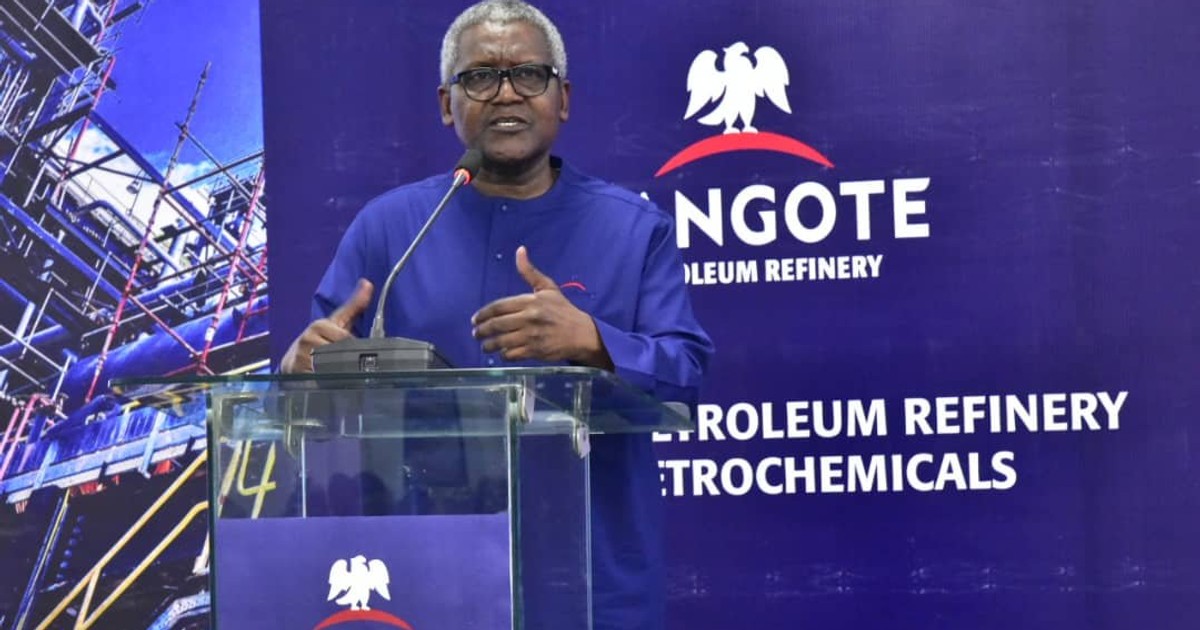
Aliko Dangote said shares in Dangote Petroleum Refinery and Petrochemicals, offered at $0.38 (N525) each, could eventually reach N10,000.
“A day will come when this share will reach N10,000,” Dangote said on Saturday, according to Punch. He added that someone who invested N5 million could eventually hold shares worth more than N50 million.
The statement gives prospective investors an easily understood wealth-creation message. But it is an ambition rather than a measurable financial forecast because Dangote did not say when the shares might reach that price.
N10,000 reached within five years would represent a very different return from the same nominal price reached after 15 or 20 years of inflation and currency depreciation.
N10,000 would place the refinery close to a $1 trillion valuation
Dangote Refinery is offering 4.1 billion new shares at N525 each, seeking approximately $1.58 billion (N2.15 trillion), based on the exchange rate used in its prospectus.
The offer is due to open on September 14 and close on October 13. The shares could begin trading on the Nigerian Exchange in late November, according to the indicative timetable reported by Reuters.

The refinery had approximately 120.13 billion issued shares before the offer. Issuing all 4.1 billion initial shares would raise the total to about 124.23 billion, before considering the offer’s possible over-allotment.
At N525 per share, that implies a post-offer value of approximately $47.8 billion (N65.2 trillion).
If those shares were valued at N10,000 each, the company’s market capitalisation would exceed $910 billion at the prospectus exchange rate. That would place it among the world’s most valuable listed companies and well above every publicly traded oil company except Saudi Aramco at present market values.
This does not mean the refinery will become a $910 billion business. Exchange rates, additional share issues, share splits and inflation could radically change the calculation before the price ever reaches N10,000.
However, it shows the scale of growth required to support Dangote’s statement in real, rather than merely nominal, terms.
Investors are not entering at a modest valuation
Dangote Refinery has moved beyond being an ambitious construction project. It is now operating, exporting fuel and generating profits.
The company recorded $13.91 billion in revenue during the first half of 2026, according to its IPO prospectus. Profit after tax reached $1.82 billion, compared with a $476 million loss for the whole of 2025.
Its products are sold across Africa and have reached the United States and Europe. The refinery has also benefited from unusually strong international refining margins caused by disruption in the Middle East.
These results help explain its premium valuation. The business combines refining, petrochemicals, fuel storage, export facilities and access to Africa’s largest economy.
Nevertheless, investors are being asked to buy into a company worth almost $48 billion. That is significantly higher than several long-established refiners.
Reuters reported in August that Turkey’s Tüpraş, whose four refineries have a combined capacity comparable to Dangote’s, was valued at about $12 billion. US-based HF Sinclair, with capacity of approximately 678,000 barrels daily, was worth around $16 billion.
The comparisons are not exact. Dangote’s integrated petrochemical operations, location and position in African fuel markets may justify a premium. But they show that the offer price already assumes substantial future earnings.

The expansion could create value and new financial risks
The strongest case for a higher valuation is Dangote’s plan to double the refinery’s processing capacity from 700,000 to 1.4 million barrels daily by 2029.
Its polypropylene capacity is also expected to rise to 2.4 million tonnes annually by 2030.
The expansion will cost approximately $14.3 billion, almost nine times the amount expected from the initial public offer.
After estimated offer expenses, the IPO’s net proceeds are expected to contribute about N2.11 trillion to the programme. The refinery must obtain the remaining money from earnings, loans, trade finance, strategic investors or future share sales.
That creates two risks for new shareholders. Heavy borrowing could increase finance costs and reduce the money available for dividends. Issuing more shares could dilute each investor’s percentage ownership, although it may still create value if the expansion generates sufficient additional profit.
The company’s ability to complete the expansion on schedule is also important. The existing refinery cost about $20 billion and took considerably longer to build than initially planned.
Dollar dividends are not guaranteed
Dangote has promoted the possibility of dividends linked to the refinery’s dollar earnings. That could appeal to African investors seeking protection from weakening domestic currencies.
However, the prospectus presents this as an intention rather than a guarantee.
Dividend payments will depend on profits, available cash, regulations, financing agreements and the company’s investment requirements. The refinery may pay in dollars, naira or another currency approved by the company.
Its $14.3 billion expansion could also compete with shareholders for cash. Management may decide that construction, debt repayment and working capital should take priority over large early dividends.
Investors should test the earnings, not just the destination
A rise from N525 to N10,000 would represent an increase of about 1,805%. Such a return is not impossible, particularly over a long period in a high-inflation economy.
But the nominal share price alone would not show whether investors had earned an equally large return in dollars or purchasing power.
The more useful tests are whether Dangote Refinery can maintain its recent profits after current global fuel shortages ease, obtain enough crude at competitive prices, operate reliably and finance its expansion without excessive debt or dilution.
Its first-half profit, enormous capacity and growing influence over African fuel supplies are real advantages. Its starting valuation and funding requirements are equally real.
Dangote has supplied investors with an eye-catching destination. Earnings per share, cash flow and dividends will determine whether the journey creates comparable wealth.