
 Uploaded to DailyKos by Ed Tracey
Here at Top Comments we strive to nourish community by rounding up some of the site’s best, funniest, most informative commentary, and we depend on your help!! Here’s how to submit nominations in DK6: If you see a comment by another Kossack that deserves wider recognition, please send it either to topcomments at gmail dot com or via kosmail to topcomments- either search for user @topcomments, or click that link then click “send message”!) by 9:30pm Eastern for inclusion in that day’s diary. Please, please include a few words about why you sent it in as well as your user name (even if you think we know it already :-)), so we can credit you with the find! It’s especially helpful if you include a link to the comment you’re nominating… hover over the comment and you’ll see Share and Report options. Click Share, then choose ”copy url” and paste that into your message to us.
One of Kurt Vonnegut’s more popular books is Cat’s Cradle, whose plot hinges on a form of ice, called ice-IX (ice-9) that freezes at 114.4o F, well above room temperature. The idea is that water on our planet is in a metastable state, whereas this newly discovered form of ice is the truly stable form for water. When a sample of this ice comes in contact with water, the water freezes and has to be heated to a very high temperature to melt it. Ice-IX was Vonnegut’s absurd metaphor for the hydrogen bomb, which has the power to destroy life on Earth.
The reason Vonnegut called it ice-IX is that, at that time, scientists knew of just 8 different possible crystal structures for ice. Of course, Vonnegut’s ice-IX was fiction, and the ice structure that scientists eventually called ice-IX does not have the properties Vonnegut proposed for the purpose of his story. The stuff we call ice is thus ice-I, the form it takes at normal temperatures and pressures. But if you vary temperature and pressure, you discover that the crystal structure of ice transforms to other structures that are better suited to the changed conditions. The last time I paid attention to the number of ice structures, about 20 years ago, the newest discovered structure was ice-XIII, stable at temperatures very close to absolute zero.
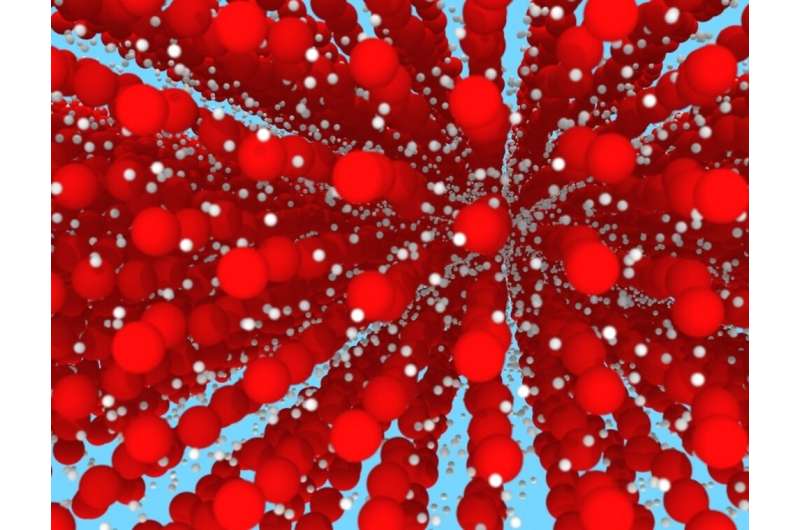
Now I have read reports about a new structure of ice, classed as ice-XVIII, but also called superionic ice. This structure is only stable at extremely high pressures (3.3 million times the pressure of Earth’s atmosphere) and high temperatures (in the range of 5,000 K, or about 8500oF). This phase of ice has been studied by computational methods, and experimentally. According to the computational results, superionic ice, as its name suggests, is capable of conducting electricity. The oxygen and hydrogen atoms exist in this phase as ions, that is H+ (the positively charged hydrogen ion, which is usually just a proton) and O2- (the oxide ion). The oxide ions are arranged in a hexagonal lattice, and the hydrogen ions can move around the structure freely. Thus, superionic ice can conduct electricity.
This ice structure is very much like the mirror image of how we visualize metals. If we think of, say, tin, we visualize tin ions (Sn2+) symmetrically arranged in a crystal lattice, while the missing electrons from the tin atoms form a sea of electrons which are free to move throughout the metal; the mobility of the electrons is what makes metal able to conduct electricity. The structure of superionic ice is similar in that the oxide ions are held in a crystal lattice arrangement while the charged protons are free to more, but the charge carriers are positively charges, and much heavier the the electrons of the metal. Nonetheless, we would expect this phase of ice to be conductive.
Experiments performed to observe superionic ice have to take place under extreme conditions. Water is placed within what’s called a diamond anvil cell; the water is between two diamonds (transparent and very hard), and by serving down the supports for the diamonds, it is possible to raise the pressure to very high levels. Heating the sample to high temperatures with lasers, and performing x-ray diffraction on the sample, revealed the predicted hexagonal structure of the oxide ions.
So what does superionic ice have to do with the planets Uranus and Neptune? Unlike any other planet in the Solar System, both of these planets have magnetic fields that do not align with the plant’s axis of rotation (59o angle between the axis of rotation and the magnetic moment of Uranus, while for Neptune, this angle is 47o). This suggests that perhaps the magnetic fields of these two planets are being generated in a different way from all the others. Theoretically, if is entirely possible that the pressures and temperatures near the cores of these planets would be in the range where superionic ice is stable, and because this phase is capable of conducting electricity, it is also capable of producing a magnetic field.
At this point, this is just a hypothesis. Myself, I am blown away with the thought that water is capable of forming a phase capable of conducting electricity by forming a structure that is analogous to that of metals, but with the charges of the ions and conducting particles reversed.
On to the Comments
No nominations tonight.
We’ll get straight to the point: The financial hardships that Daily Kos is facing this year are tough.
We continue to be paywall-free. We continue to be supported by our readers, not billionaires or corporations. But we need to bring in more revenue. We are leaning on our community more than ever to help make ends meet.
Power matters.