
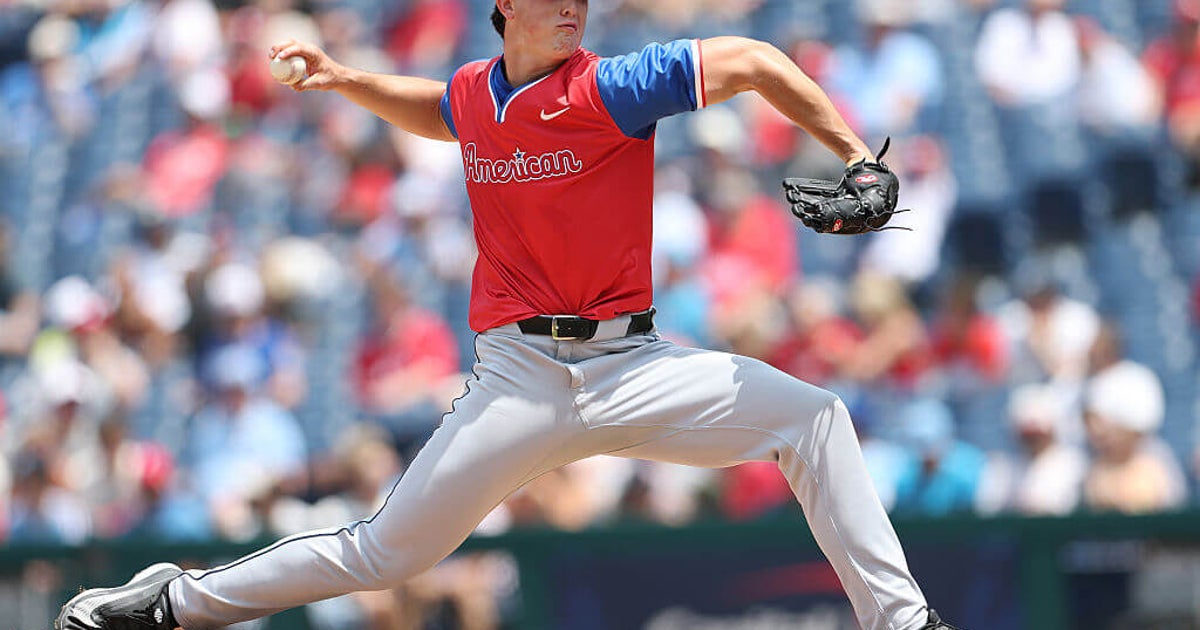
With the 2026 season coming to an end, I am diving into the profiles of five prospects who didn’t get the call this September for roster expansions. Each of these players will become important pieces of their organizations’ roster decisions in 2027.
Ryan Sloan, RHP, Seattle
Sloan is arguably the best right-handed pitching prospect in baseball and features a high-powered five-pitch mix. Currently in Double A, there was some debate regarding whether we’d see Sloan in the majors this September. He is likely to make his MLB debut next season.
Sloan does a lot of things extremely well. He limits hard contact, produces a high whiff rate and generates weak contact through ground balls. He also features plus-plus control, with a low 4 percent walk rate and high 49 percent zone rate. Sloan is not afraid to challenge hitters in zone, and the quality of his pitches makes it hard for hitters to do damage, even when he misses his spot.
Looking into his mix, he features the following:
Mid-to-upper-90s four-seamer
Mid-to-upper-90s sinker
Low-90s cutter
Mid-to-upper-80s kick-change
Mid-to-upper-80s sweeper
The four-seamer is a power fastball that rides. Sloan added the sinker to his mix this season. The movement can be inconsistent at times, meaning sometimes it has more sink and others more run. This season he seems to have been working on getting a feel for the pitch and experimenting to see what works best. As a result of adding the sinker, Sloan has seen an increase in ground balls from 49 percent in low Single A last season to 55 percent in Double A this season.
The cutter was also a newly developed pitch, as Sloan started throwing it in 2025 to lefties to provide a different look off the four-seamer.
While he uses his sweeper primarily against righties, it is a depthy pitch that allows him to utilize it to the back foot of lefties. He gets above-average swing-and-miss with the pitch, both in and out of zone.
He also throws the kick-change, another pitch developed last season, against both hands. Sloan threw a changeup prior, but modified the grip. The kick-change has more movement and is a depthy pitch that resembles a splitter. He often goes to this pitch in counts with two strikes.
Sloan has a repeatable delivery and throws from a three-quarters arm slot. At 6-foot-5, he has an intimidating presence on the mound and gets good extension. He hides the ball well during delivery.
Overall, we are looking at a high ceiling, top-of-the-rotation starter with a strong combination of plus stuff and control.
Theo Gillen, OF, Tampa Bay
Gillen is a lefty bat in Double A for the Tampa Bay organization. He ranks as the Rays’ No. 2 prospect, according to Keith Law. Gillen features an intriguing combination of power, above average feel of the zone, and speed.
Young for his level at only 20 years old, Gillen was promoted to Double A this season, and in 264 plate appearances he’s slashed .287/.392/.507. His 14 percent walk rate is in the 80th percentile for Double-A hitters.
Gillen uses a whole-field approach and hits for both average and power. He makes contact at an above-average rate in zone while keeping his strikeout rate on the lower side (22 percent).
One of the more intriguing parts of Gillen’s offensive profile is that his power is not coming at the expense of his approach. He works deep into counts and does not expand the zone, which helps him create offensive impact through different methods. He can get on base when pitchers try to work around him or do damage when they challenge him in the zone.
Gillen’s power has performed better against right-handed pitching. Of his 21 home runs this season, 19 have come against righties. That being said, he is still very competitive against lefties with a .371 OBP against them this year.
Looking at his mechanics, he has a modest leg raise and has good counter rotation, allowing Gillen to access his raw power consistently. His swing is balanced and controlled throughout.
A Theo triple for two more! 👏 pic.twitter.com/mm0Sh9ZzKF
— Montgomery Biscuits (@BiscuitBaseball) September 5, 2026
Additionally, he’s been stealing bases at an above-average rate throughout his minor-league career.
SeasonLevelPASBCS
2025
A
324
36
3
2026
A+
265
28
5
2026
AA
264
16
5
The speed gives Gillen even more value, as he will apply pressure on the base paths. Between the power, whole-field approach, ability to walk and speed, he has multiple methods for getting on base and ultimately taking extra bases.
I would expect him to start 2027 in Triple A before making his debut next season. While the pitching is more advanced in the majors, Gillen’s tools and approach will put him in a great position for success at the MLB level.
Andrew Fischer, 3B, Milwaukee
Fischer, a left-handed hitter, entered the season as Law’s No. 8 prospect for the Brewers. Splitting time between High A and Double A, Fischer showcased tremendous power across both levels in 2026. He set the record for the most single-season home runs in the minors for this century.
His contact quality is elite, and of his 48 home runs this season, 28 home runs have come in the 310 PAs since his Double-A promotion in June. His swing is designed for hitting for power. He has a crouched stance and a smooth uppercut swing. This works extremely well for him, as his pulled airball rate is in the 99th percentile for Double A.
Beyond hitting for power, he has above-average plate discipline in terms of swing decisions and walks. His walk rate is in the 96th percentile, and he swings in zone consistently while minimizing chase.
He also features even splits, and his power plays against both hands.
2026 MiLBHRSLGBB%K%
Vs LHP
9
0.614
21%
32%
Vs RHP
39
0.664
18%
33%
The catch is that he also features an extremely high strikeout rate (33 percent). This extreme profile has cost Fischer higher praise in prospect rankings. We have seen success with these types of profiles before, but there is more pressure on consistent contact quality as a result.
I would expect him to make his MLB debut next season and bring a disciplined, power-first approach to the Brewers lineup. His power is so elite that the impact of his home runs and walks should outweigh the strikeouts that come with this approach.
Joseph Dzierwa and Caden Hunter, LHPs, Baltimore
In Dzierwa and Hunter, the Orioles have two top pitching prospects who followed really similar paths this season. They are both 22-year-old lefties drafted in 2025; both were promoted three levels to Double A this season; and both have put themselves in a position to make their MLB debut next year.
Joseph Dzierwa
Dzierwa has the higher rank in the Orioles’ farm system, according to MLB’s Prospect Pipeline, and was drafted in the second round in 2025. In 18 games (16 started) this year, he finished the Double-A season with a 3.10 FIP, 28 percent strikeout rate, and 6 percent walk rate.
He has a four-pitch mix centered around his fastball and changeup. His fastball sits around 94 mph and gets above-average run. He throws from a low three-quarters arm slot that helps add natural horizontal movement. His low-80s changeup is his best pitch. Its above-average depth allows him to throw it against both hands (oftentimes changeups are more effective against the opposite hand).
He also throws two sliders — a gyro-slider and a sweeper. Because sweepers can be more effective against same-handed hitters, Dzierwa uses the shorter, tighter gyro-slider more frequently against righties and the sweeper more against lefties. He is still developing both pitches, but this ability to throw these breaking balls gives him more options for attacking hitters.
Dzierwa has plus control. His 6 percent walk rate in Double A is in the 90th percentile. He’s able to throw his stuff in-zone for strikes consistently and gets above average in-zone miss.
His strengths give him a solid foundation, but it will be important for him to continue developing his secondary pitches as he works his way toward the majors. If he can get his slider to be a consistent swing-and-miss pitch, he could improve his strikeout rate while maintaining the control that gives him a high floor.
Caden Hunter
Hunter is a little more under the radar, as he was drafted in the sixth round in 2025. He finished 2026 with a 3.37 FIP, 33 percent strikeout rate, and 11 percent walk rate through seven games started in Double A.
His ability to miss bats is his greatest strength and has led to his ascension in the prospect rankings this year. He gets high in-zone miss and generates chase with a four-pitch mix.
The fastball and changeup are his bread and butter. The fastball sits between 94 mph and 96 mph and has above-average ride. His velocity jumped a couple of miles per hour this season after dealing with a knee injury during his time at USC in 2025. Entering this season healthy, Hunter tweaked his mechanics and gained strength, allowing him to better utilize his lower half during delivery.
He throws two breaking pitches — a slider and a curveball. The slider is a swing-and-miss offering and has sharp movement. He is using the curveball as a get-me-over pitch and mixes it in every so often, but I am curious to see if he adjusts it this offseason to turn it into a more reliable weapon for deeper in counts.
His walk rate is a little high at 11 percent and is something to keep an eye on. His ability to miss bats and get chase on these out-of-zone pitches gives him some extra room for error.
Both Dzierwa and Hunter had successful seasons in 2025. It’s worth watching them in the spring to see how their off-speed pitches develop and how hitters respond to them. Both pitchers have the potential to become mid-rotation options. Dzierwa currently has a higher floor due to his control, but Hunter can close that gap if he can improve his control without sacrificing his elite swing-and-miss.