
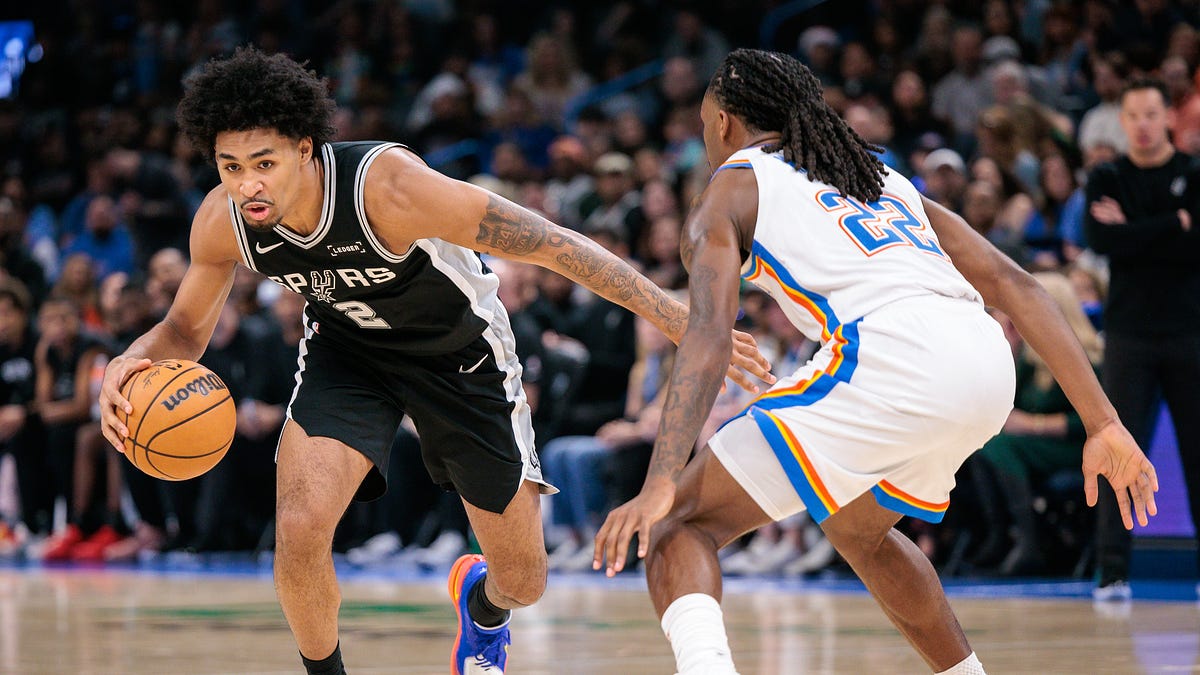
 The Spurs and Thunder are so lucky that their young players, like Dylan Harper and Cason Wallace, know how to win. But … is it really luck? WILLIAM PURNELLGETTY IMAGES
On Monday morning, David and I talked about how NBA players develop, how that’s like a group project in high school, and Cason Wallace.
Here’s a lightly edited transcript. That’s me, Henry, in bold, and David in regular font.
I’ve had many high school and college students in the back of my car talking about their stresses in life. And sometimes the issue is some group project. The message is often: “You wouldn’t believe the dumb shittery of my group.” Like: I wish I could shake these losers.
It often inspires me to say something along the lines of like, hey, you know, I get it. I probably would feel the same way. But FYI, when you’re in the workplace, if you want to be a leader, you are most valuable if you can figure out how to make those people effective.
School teaches a lot of high achievers that the best way is to mistrust everybody, and just to do all the work. But real life, at least on a management or leadership track, teaches you hey, if you can take someone who’s contributing nothing and they contribute 15 percent now … that’s gold. And if you take the 15 percent and turn them into 35 percent that’s incredible. And if you can actually make it so that you don’t do anything and they do it all, then you’re a CEO. And all of that flies on the wings of building trust.
This feels like the NBA to me, where almost everyone makes it here by being in a whole bunch of group projects—middle school basketball teams, high school, AAU, college—where they just keep leaving everyone behind. The group project is over, one guy won. That’s how the numbers work. It has to work that way.
But it sends an effed up message, because we end up with players who, when they see the machinery of teamwork breaking down on their NBA team, aren’t used to the idea that it’s on them to fix it, because in the past they’ve just left.
But now the job is to get the machine working again.
Or you’re the guy who’s going to be left behind. It’s a really great point, Henry. One thing I love to do is talk to all my players about their AAU teams, and there are very rarely five NBA players on a team. Like when I talk to [redacted] and [redacted], who played in major cities, almost all of their AAU teams were forgettable names.
There are very few places in basketball where NBA players stick together. Just like Kentucky, Duke, the Knicks have their Villanova story …
It’s just it’s getting harder even at those places. So that’s why I think I can address it, and it’s a combination of things that created this, because the reality is: my business is part of this story.
It used to be that every serious golfer and tennis player had what they called a “pro.” You had your own coach. But everyone else on a team sport, they got all their insight from their team coach. So then I come in, and am like a “pro” for basketball players.
And that business catches fire organically.
Why did it take off?
AAU started to become a thing. A lot of states, like Florida, made rules so your school team could not practice much of the year. The rules were that the millisecond your team was eliminated from competition in the state high-school association tournaments, typically late February into early March, you could not legally practice basketball until October the following fall. They rigged the system so that your basketball team couldn’t play year round because the football team wanted the best athletes in their weight room, and then in July and August on their practice fields.
In many parts of Florida, as well as around the country, school curriculums did away with one of the workaround: a team elective. In some places like Miami you could have basketball class, which meant you could get on the court for an hour, you could work out, you could lift weights. Not a lot of places had that. You could pretty much track where the state champions came from, a huge percentage of the winners came from places that allowed for basketball class year ‘round. No surprise.
Wait are you saying the basketball class caused the winning? Or did those programs attract the best athletes?
It was both situations helping each other. I absolutely think it made a difference because if you were a serious player, why wouldn’t you want to be able to practice basketball year round? So there were ways around it.
Miami High (by far the winningest large basketball program in the state) would enter into multiple spring leagues. When I was in high school, we could do a spring league too, no practices but we could play a game a week in those leagues for a month or so. So at least you had some engagement.
When I started coaching individual players, in the spring of 1993, you also started seeing a change in AAU. They started to have super teams, like Team Florida. You would have the state associations put together one All-Star team, and everyone else just played for their high school team in AAU tournaments, just to have more engagement. Literally, teams had to register as AAU teams, which helped them get around the “no school engagement” rules.
Okay, well, think about this. If you are playing with your own coach, coaching staff, teammates, the guys you grew up with who live by you, you can practice as much as you want for AAU. But if you’re playing for one of those all-star teams in your state and you’re many hours away, maybe you can get together on weekends and practice when you’re not playing games.
So what are these guys going to do to get better all week? That’s where I think this training took off. You weren’t playing for your high school team in the off season. If you were a better player, you’re on your all-star AAU team . So you’re disappearing on some weekends. But during the week, there’s nothing happening. You’re not on your local high school AAU team, and that coach who knows he’ll get his brains beat in without his studs, doesn’t even do anything. Players still have to have engagement, and they want to work. So these players are now working with, let’s for lack of a better term, trainers. I call them personal workout guys. I’m not a trainer.
Trainer is a certification.
Exactly right.
What happened is, all these players were not able to get good practices with their teams for months at a time, all while AAU tournaments were growing in popularity. At the same time, the arms race for talent grew, as local coaches worked at getting players to play for teams far from their homes often for free gear (oh yes, the sneaker companies were and are a big part of the story, for better or worse) or got to travel to play against better competition.
But those coaches were rarely high school coaches who had run a thousand practices and attended 30 coaching clinics over the years. They were connected to the game, former players themselves or perhaps the father of a good player that was friendly and charismatic, thus, good recruiters. But that’s not the same as teaching the team game.
The top talent signed up for those weekend practices or games, and those practices were mostly just five on five. They had nothing to do during the week—idle time is a killer for our species, especially for the young. Parents know that and wanted their boys to be working at something Monday through Thursday. Thus, the whole environment was ripe for people like me to get parents to spend some money on getting their child extra work all week.
Coaches have always been developing players, normally it’s their own high-school team’s players, with the tiny exception of basketball camps in the summer. I just started doing it for other team’s players for money. I made it a business. I went to Office Depot, bought a Filo Fax organizing system, organized my schedule based on geography and times available. A year later I remember getting my first Wizard because it could remind me with beeps when I needed to wrap up a workout so I could drive to my next one. Remember the Sharp Wizard?
I could finally afford one. And it helped me look professional. I’d finish a workout and grab my Wizard, then talk to the parent to set up the next session after pulling up the calendar.
I had 75 people coming weekly. That’s how big it got in those early days, but to me that was small. I had no choice but to offer group sessions,
How much did they pay?
$15 an hour for middle school, $25 for high school. Almost all of it outdoors. Sometimes on the driveway. The park I walk by twice daily is where I did a lot of my training because it is sandwiched between more affluent neighborhoods (I literally discovered the neighborhood we have lived in for 16 years because sometimes I had an hour to kill before a new session so I’d drive around “dream shopping” and found this one tucked away spot).
I had really good players, guys who would earn scholarships at schools like Maryland, Florida, and Dayton. And some players hoping to just be good high school players. That’s the other thing that happened: Because high school teams were not doing anything in the offseason, and AAU teams were just weekend engagements (more or less), players had nowhere else to turn but their local trainer.
Well for $25 bucks an hour (I don’t know what other coaches charged), they can work out, but it’s just one-on-zero. And so that combination has led to a lot of problems. It wasn’t for me because I coached two teams a day often for five years, JV and Varsity, at a top program in the largest school category in Florida, plus I worked ten camps every summer for five straight summers. I knew how to teach the game, how to get students to “see” nine guys when in actuality it was just me, them, and a trash can. Once I started doing groups we would get two offensive and defensive guys on the court sometimes, but never five-on-five.
I later learned most trainers simply didn’t know how to teach the team game, they solely focused on skill development. Players were training on how to play and win one-on-zero without any thought whatsoever to the five-on-five game.
To me that’s neurological. It’s a simple math problem. Scoring one-on-zero is a difficult athletic problem, but in terms of the number of possible outcomes, it’s just so easy to think about a one-on-one game compared to a five-on-five.
You’re not even giving an opinion. This is a fact, because the most common conversation I have with NBA executives and college coaches and NBA coaches too is about the decision-making process. This is what coaches are talking about: what they’re doing to build out that decision-making platform. How do you make them better? It’s the number one focus.
That’s different from what it used to be, which was fitness and rebounding and toughness, all of that. There’s so much effort that’s placed on rapid decision making, but here’s to me the key: watch the games in the 80s and 90s. And yes, it’s true that you couldn’t flood the ball with bodies on defense, and couldn’t shade towards the star players until they had the ball. It absolutely matters. But those decision-making processes were brilliantly fast in the Larry Bird, Magic Johnson, Michael Jordan era.
Players weren’t as long, tall, fast, quick, all of that. But there were plenty of long, tall, fast, quick, strong guys. It was a very physical game. (The only difference is the fouls they committed then, that would be called flagrants now, those were just fouls then. That was also part of decision making. Am I willing to do this when I’m going to get elbowed in the jaw?)
I love to watch old games. There’s lots of stuff I see that are slow, way fewer skills among most of the non-stars. But the decision making wasn’t slow. They were doing it just fine then.
Dr. J couldn’t dribble his left hand, but don’t tell me he didn’t have to make quick decisions all the time.
Think of it like this; if states had changed their rules, and emphasized high-school coaching year ‘round, which they absolutely should have done, I don’t think they would have leaned in as much on their personal trainer, on their personal workout guy, because they’d have been engaged with their team, learning how to play five-on-five. And that’s what we have to get back to. We want to get to fixing it.