
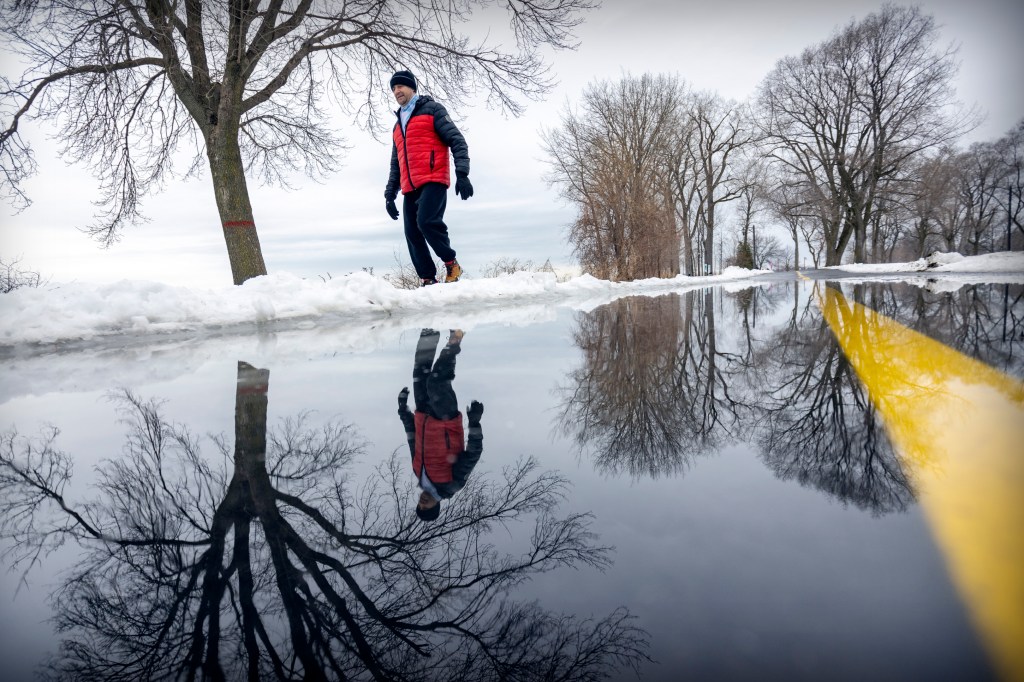
A potentially record-breaking El Niño is building in the Pacific — and this time, Montreal may not be too far east to feel it.
The U.S. National Oceanic and Atmospheric Administration (NOAA), one of the agencies that monitors El Niño globally, said last week there is a greater than 90 per cent chance of a very strong El Niño this fall and winter. Environment Canada is also forecasting an exceptionally powerful event, and its early outlook leans warmer than normal for southern Quebec.
El Niño occurs when waters in the central and eastern tropical Pacific become unusually warm, disrupting atmospheric circulation and influencing weather thousands of kilometres away.
“There is a very high probability that it will exceed three degrees, which has never been seen in the past,” said Marko Markovic, a manager with Environment and Climate Change Canada’s Meteorological Service of Canada.
“If (it’s) not the highest, then among the highest.”
He was referring to ocean temperatures in the central Pacific, where El Niño develops. An event is considered very strong once those waters reach 2 C above normal.
In Canada, those effects are normally clearest in the west.
“Historically speaking, we do not have that much impact” in southern Quebec from El Niño, Markovic said.
British Columbia, the Prairies and parts of Ontario tend to see a much clearer El Niño signal, while Montreal sits closer to the edge of its usual influence.
But the strongest El Niños tell a somewhat different story.
“What is quite striking is that if you take the strongest El Niño events, the very warm winters actually extend all the way east,” said Alain Bourque, executive director of Quebec climate consortium Ouranos.
Bourque pointed to the three strongest events over roughly the past three decades, in which the average winter temperature anomaly around Montreal was about 1.5 C warmer than normal.
Because the developing El Niño is expected to rank among the strongest on record, Bourque said there is an increased likelihood of a warmer-than-average winter here.
Environment Canada is already leaning in that direction, although it is not ready to call the winter just yet.
Its current forecast favours above-normal temperatures in southern Quebec this fall. The December-to-February outlook also points toward warmer-than-normal conditions, Markovic said, but in mid-September there is still “a lot of uncertainty” around the winter forecast.
When asked whether the warmer outlook could be attributed directly to El Niño, Markovic said: “Not necessarily.”
Other atmospheric patterns can influence any individual season, particularly in a region where El Niño’s effect is less consistent.
So, does a warmer winter mean Montrealers can expect less snow?
“There is no clear connection between El Niño and precipitation” in southern Quebec, Markovic said.
Parts of Canada, including central Quebec, tend to have drier El Niño winters, shorter snow seasons and less snowpack. Around Montreal, however, those patterns are much less reliable.
“There might be a little bit more chance of having a bit more precipitation,” Bourque said of the strongest El Niño analysis, “but to be quite honest, it’s not a very reliable signal.”
There is even less reason to start predicting freezing rain.
The exceptionally strong 1997-98 El Niño coincided with Montreal’s devastating January 1998 ice storm, but “I would avoid talking about only one event,” Markovic said.
Bourque was similarly cautious, saying there is no clear scientific evidence establishing a general link between El Niño and ice storms in Quebec.
Whatever happens this winter will also unfold against a much longer-term warming trend.
“There is also a statistically significant signal of having warmer winters just because of climate change,” Bourque said.
That means the clearest bet for Montreal right now is on temperature, not whether the city will see less snow, more rain or another season of treacherous ice.
This El Niño may be strong enough to push its usual Canadian footprint farther east. Exactly what that looks like on Montreal streets — snow, slush, rain or ice — is something the Pacific alone can’t tell us yet.
Editor’s Picks

I’m a reporter at the Montreal Gazette, covering breaking news and the issues affecting communities across Montreal. I believe some of the most interesting stories begin with an ordinary conversation.
amclaughlin@postmedia.com