

The aerospace and defense industry has remained a consistent bright star as Colorado’s slowing economy struggles with remaining competitive. Yet the state could get outshone if it doesn’t take action soon.
At least, that’s what major business organizations are warning state leaders.
Recommended Stories▶
The Colorado Chamber Foundation and the Colorado State Coalition both released reports this summer warning the state is at risk of falling behind other large aerospace hubs, finding Colorado has weak points in its supply chain and its regulatory-heavy business environment is slowing the industry.
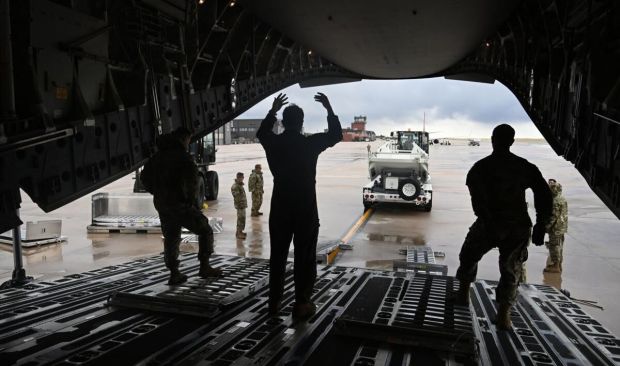 FILE PHOTO: Members of the 138th Space Control Squadron from Colorado and Air National Guard members from Mississippi guide and load a large collapsible satellite antenna. The state’s military bases are one of the reasons why Colorado is a major aerospace hub. (Jerilee Bennett, The Gazette file)
“Colorado has built one of the most complete aerospace and defense ecosystems in the country, from research and startups to major contractors, manufacturers, military missions and satellite operations,” said Rachel Beck, executive director of the Colorado Chamber Foundation, in a news release this month. “While this foundation gives us an extraordinary opportunity as the global space economy expands, that leadership cannot be taken for granted.”
In-article OneAdvertisement
The state needs to be “proactive,” Beck added.
While Florida is known for launching rockets and Houston for mission controls, the Front Range has positioned itself as a hub for research, manufacturing and satellite operations because of the advantages of its central location, higher elevation and cluster of major research institutions and military bases.
Major defense contractors, such as Lockheed Martin and BAE Systems (which acquired Broomfield-based Ball Aerospace), have built large campuses in the state and several startups that have sprung up in Colorado have gone public as billion-dollar companies like York Space Systems, Voyager Technologies and soon Ursa Major.
The industry supports more than 61,000 jobs in Colorado and $14 billion for the state’s gross domestic product, according to the Colorado Chamber Foundation’s report prepared by consulting agency Economic Leadership.
In-article TwoAdvertisement
Weaker business environment?
While Colorado has a good concentration of aerospace and defense companies, the Colorado Chamber Foundation found job growth has flattened and other states are rising in their competitiveness and are “pursuing the same opportunities more aggressively than Colorado.” It also found the weaker business environment affecting other industries in the state is starting to have an effect on Colorado’s aerospace industry.
During the 2010s, Colorado had lower operating costs and a boom in net migration compared to coastal hubs, such as California, Florida, Texas and Washington. But over this decade, the state has slipped in the rankings.
The organization gave 18 recommendations for state leaders to take — from better marketing, more engagement from the governor’s office, improving permitting, expanding the state’s incentive packages for defense companies and pushing for more job training programs and addressing the state’s high cost of living to keep the talent it has.
In-article ThreeAdvertisement
The Colorado Space Coalition, an organization under Metro Denver Economic Development Corporation, also released a preliminary study with McKinsey & Company in July showing competitor states like Virginia, Florida, Oklahoma and Texas are expanding faster than Colorado.
Shift in federal government funding
The aerospace and defense industry has been booming as the federal government has shifted its strategy in giving out contracts, emphasizing companies to develop more of their own technology and prioritizing faster and more innovative products, Parker White, director of the Colorado Competitive Council, told The Denver Gazette when the report was released.
With that, White said smaller and midsize companies are now winning contracts that would typically go to big defense contractors. There’s also been an influx of private investment to create unicorn companies that are changing who the biggest players in the industry are.
In-article FourAdvertisement
“As these new companies take shape and these new models of doing business take shape, the landscape of the business ecosystem is shifting,” White said.
These changes spurred the Colorado Space Coalition to conduct its study, which found the industry was growing faster in business-friendlier states and Colorado needs to invest in closing gaps in the supply chain.
“When you look at what those states are able to provide, the biggest thing they offer is a very, very friendly business environment,” he said. “When you move beyond those pieces, they offer the ability to grow and expand at relatively low costs compared to what that growth and expansion would cost here in Colorado.”
Another problem is that Colorado-based companies are winning contracts but are then fulfilling those deals by subcontracting their services outside of the state, he said.
Colorado does really well in the upper-midtier of the supply chain, which includes software engineering, assembly and developing space systems, White said. Due to its landlocked geography, the state can’t compete with launches.
But the state could do more to fill in gaps in the earliest stages of the supply chain from extracting raw materials to boosting manufacturing. White explained that filling those gaps will be necessary, regardless of the state’s business friendliness.
“Those downstream suppliers will always have a place because no matter where the policy goes, we know that someone will need to supply whatever they’re building with something,” he said.
This is also supported by the Colorado Chamber Foundation’s report. The state has the highest concentration of aerospace workers compared to peer states, yet manufacturing was the lowest of all the industries for Colorado.
“The lack of a strong manufacturing presence was limiting growth in aerospace,” the report said.
Finding aerospace labor to meet demand
Still, all the reports note how Colorado ranks high for its talent pool developed by its concentrated ecosystem and its leading universities.
But even getting the talent is becoming a challenge.
Matt Magaña, Voyager’s president of space, defense and national security, said demand is skyrocketing in the aerospace sector. Finding labor to meet the demand is getting harder, he said.
The company generated $52.7 million in the second quarter, according to its latest earnings report, up 51% from the first quarter. Voyager is seeing demand across several aspects in the wider aerospace industry: propulsion, advanced electronics, autonomous mission systems, artificial intelligence technologies, commercial space and projects tied to President Donald Trump’s initiative to build the “Golden Dome” missile defense system.
Colorado has developed its aerospace ecosystem a lot in the last 10 years, Magaña said. But it could fall behind like in Southern California, where there’s a “mecca” of aerospace engineers and struggles with attracting more talent to meet that demand.
“To keep pace with feeding all of those companies with high-end talent is a pretty tall ask,” Magaña said.
Colorado needs to improve its high cost of living to ensure it can keep its workforce and attract new workers to live in the state, the reports recommend.
Over the last year, state leaders have had to offer millions in tax incentives to keep several Colorado space companies from leaving the state for their expansions. Even Voyager.
Berthoud-based Ursa Major secured $35 million in job growth tax incentives and $23 million in CHIPS refundable tax credits from the Colorado Economic Development Commission if the company can uphold its goal to create 1,850 new jobs for the state within eight years.
Denver’s Voyager Technologies is growing its headquarters and the commission awarded it $920,000 to prevent it from choosing another state like California, Alabama or Arizona. One unnamed aerospace company looking to expand in Douglas County got $26 million in tax incentives.
“As we have seen Colorado become less business-friendly, we really want to be able to be that North Star in the business community, saying we’re open for business,” Ellie Reynolds, president and CEO of Douglas County EDC, told The Denver Gazette in April. ”And we want to make sure that we don’t lose any existing companies or the growth of those companies to other areas.”
Boosting economic development incentives
The Colorado Chamber Foundation recommended creating a targeted aerospace and defense tax credit to match competitor states.
It said Colorado’s job growth tax credit program is limited because it relies on giving cash once jobs are created years down the line and doesn’t offer immediate investment or grant money needed for upfront costs.
Aerospace expansions are incredibly expensive and are in need of higher incentives, and Colorado’s Strategic Fund program has been “small” compared to the size of the deals, the report said.
The report recommended more upfront funding tailored for the industry — ranging from low-cost loans to federal tax exemptions available for spaceports and infrastructure projects.
Meanwhile, White said Colorado doesn’t necessarily need to offer as many cash incentives as other states like Texas and Oklahoma to win aerospace companies due to its talent base. He added the workforce is strong enough to keep companies in state, even when Colorado can’t offer as much money or is less business-friendly.
But the state also needs to stay in the zone where it makes sense for aerospace companies to keep doing business in Colorado, White said. The state is starting to have to give higher incentives to keep companies here.
“The good news is that at least, in my opinion, that number is not as high as it would be in Oklahoma or Texas, but it may start to be higher than it is now,” White said.
Still, he said the state can do more than just give out incentives to keep companies in state.
Cleaning up permitting rules and regulations is one of the ways, he said, in addition to improving the supply chain.
And the conversation is only beginning. The Colorado Space Coalition is set to release its full list of recommendations later this year.
“Colorado is not performing as highly as we once were compared to other states. But we’re still growing,” White said.
Its report is an attempt “to start to claw some of that back and regain our competitiveness,” he added.
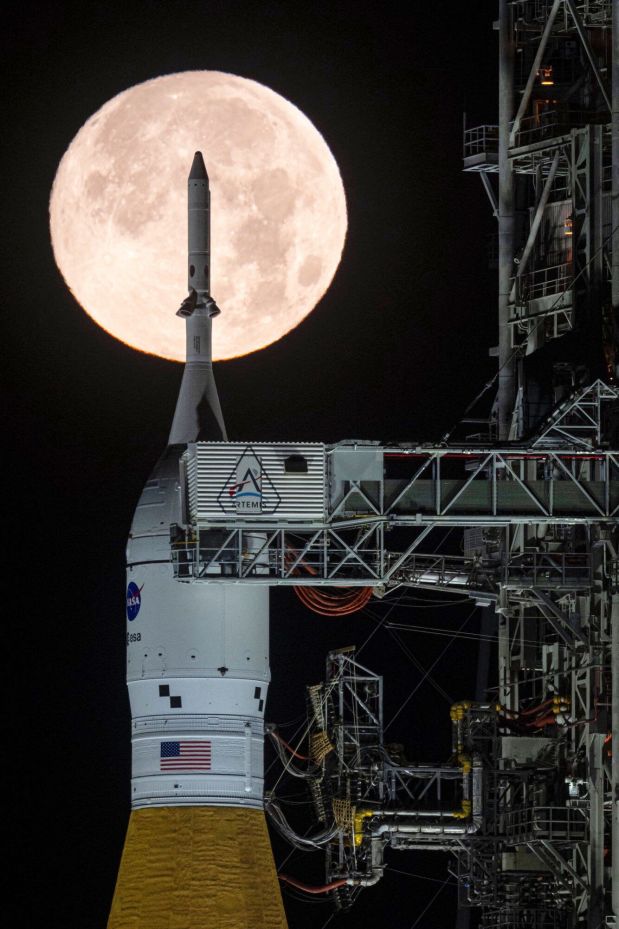 A full moon is seen shining over NASA’s SLS (Space Launch System) and Orion spacecraft, atop the mobile launcher in the early hours of Sunday, Feb. 1, 2026, at NASA’s Kennedy Space Center in Florida. (Sam Lott/NASA via AP)
In-article EndAdvertisement