
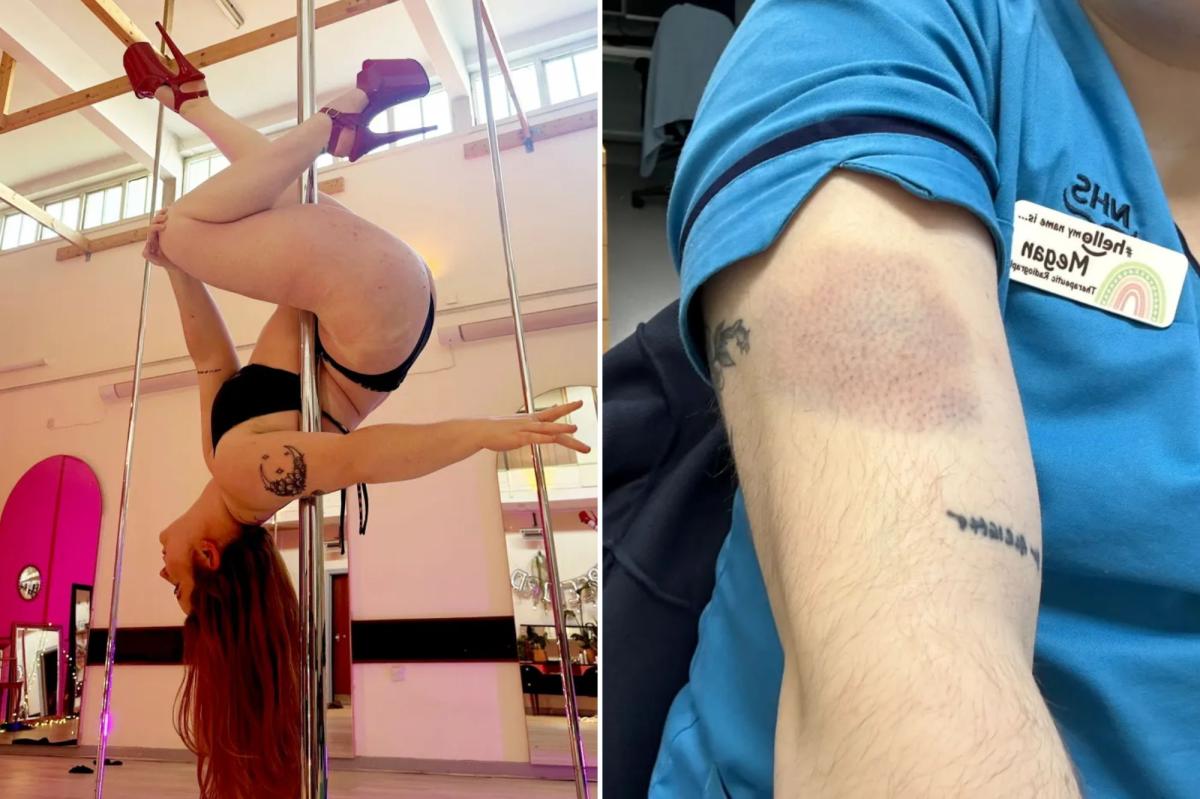

A radiographer discovered she had leukemia after brushing off her unexplained bruises as pole dancing injuries.
Megan Wright, 28, lived a normal active life until earlier this year when she noticed large bruises on her arms which took up to a month to disappear.
Megan, from Dundee, Scotland, visited her GP for an ongoing knee injury in February and casually mentioned the bruising as well as tiredness she thought might be a sign of anemia.
Bruising is pictured on Megan Wright’s arm. Leukaemia Care / SWNS
Megan is pictured pole dancing. Leukaemia Care / SWNS
Her GP arranged a blood test and hours later she was told she had either lymphoma or leukemia.
Megan underwent a bone marrow biopsy which confirmed acute lymphoblastic leukemia (ALL).
Megan said: “It was just a whirlwind.
Megan is pictured in a hospital. Leukaemia Care / SWNS
“I’d gone from just going to the GP for something completely different to being diagnosed with leukemia within days.
“I’ve still got quite a lot of treatment to go, but I’m in remission, which is obviously really good.
“I felt fit and healthy. I was doing pole fitness, going out with my friends and just living my normal life.
“I’ve still got quite a lot of treatment to go, but I’m in remission, which is obviously really good,” Megan said. Leukaemia Care / SWNS
“Then suddenly I was being told I had leukemia. You just don’t expect it to happen to you.”
Megan, who is sharing her story during Blood Cancer Awareness Month, initially put her tiredness down to slightly increased working hours.
After her blood test at the GP, she had a 20-minute-long nosebleed – another sign of ALL.
Start your day with all you need to know
Morning Report delivers the latest news, videos, photos and more.
Thanks for signing up!
Following her hospital admission, a consultant said she needed further tests to determine if she had lymphoma – cancer in the lymphatic system – or leukemia – cancer in the blood and bone marrow.
Three days later she was diagnosed with leukemia.
She said: “It was very hard to process because it all happened so quickly.
Megan, who is sharing her story during Blood Cancer Awareness Month, initially put her tiredness down to slightly increased working hours. Leukaemia Care / SWNS
“They couldn’t delay treatment, so they had to start me on chemotherapy straight away.”
Since her diagnosis in February, Megan has undergone two five-week cycles of chemotherapy.
A bone marrow biopsy following her second cycle showed no evidence of leukemia, meaning Megan is currently in remission and does not need a stem cell transplant.
Since her diagnosis in February, Megan has undergone two five-week cycles of chemotherapy. Leukaemia Care / SWNS
She still has further chemotherapy ahead, including additional rounds of treatment designed to reduce the risk of the disease returning.
At 28, she feels caught between the services aimed at teenagers and young adults and the predominantly older patients she sees on the hematology ward.
She said: “I feel like I’m in a weird age bracket. I’m too old for some of the teenage cancer support, but I’m also one of the youngest people on the hematology ward.”
At 28, Megan feels caught between the services aimed at teenagers and young adults and the predominantly older patients she sees on the hematology ward. Leukaemia Care / SWNS
Leukaemia Care has helped Megan navigate some of those gaps.
For Megan, the emotional impact of her diagnosis has been just as significant as the physical treatment.
Her job means she understands cancer from a professional perspective, but experiencing it herself has been very different.
For Megan, the emotional impact of her diagnosis has been just as significant as the physical treatment. Leukaemia Care / SWNS
She’s now starting to get back to the life she enjoyed before her diagnosis. She has returned to her pole fitness studio for the first time since her diagnosis.
And she has just got engaged – after several months dominated by hospital appointments and chemotherapy.
She said: “I’d love to get back to pole fitness properly and get back to work.
Megan’s now starting to get back to the life she enjoyed before her diagnosis. Leukaemia Care / SWNS
“I’m just very tired at the moment, so I can’t do the same amount as I used to. But hopefully once all this is over, I’ll get back to it.”
Now Megan is raising awareness of the symptoms of leukemia as it was only because she mentioned the changes during an appointment for something completely unrelated that a blood test was carried out.
She added: “I probably wouldn’t have thought anything of it if people at work hadn’t said I should mention it while at the GP. But I’m really glad I did.”
Now Megan is raising awareness of the symptoms of leukemia as it was only because she mentioned the changes during an appointment for something completely unrelated that a blood test was carried out. Leukaemia Care / SWNS
Colin Dyer, chief executive of Leukaemia Care, said: “It is so important to recognize changes in your health, even when you’re young, active and otherwise feel well – just like Megan did.
“Her symptoms could easily have been attributed to her lifestyle or other everyday explanations, but mentioning them to her GP led to further investigation and, ultimately, her diagnosis.”