
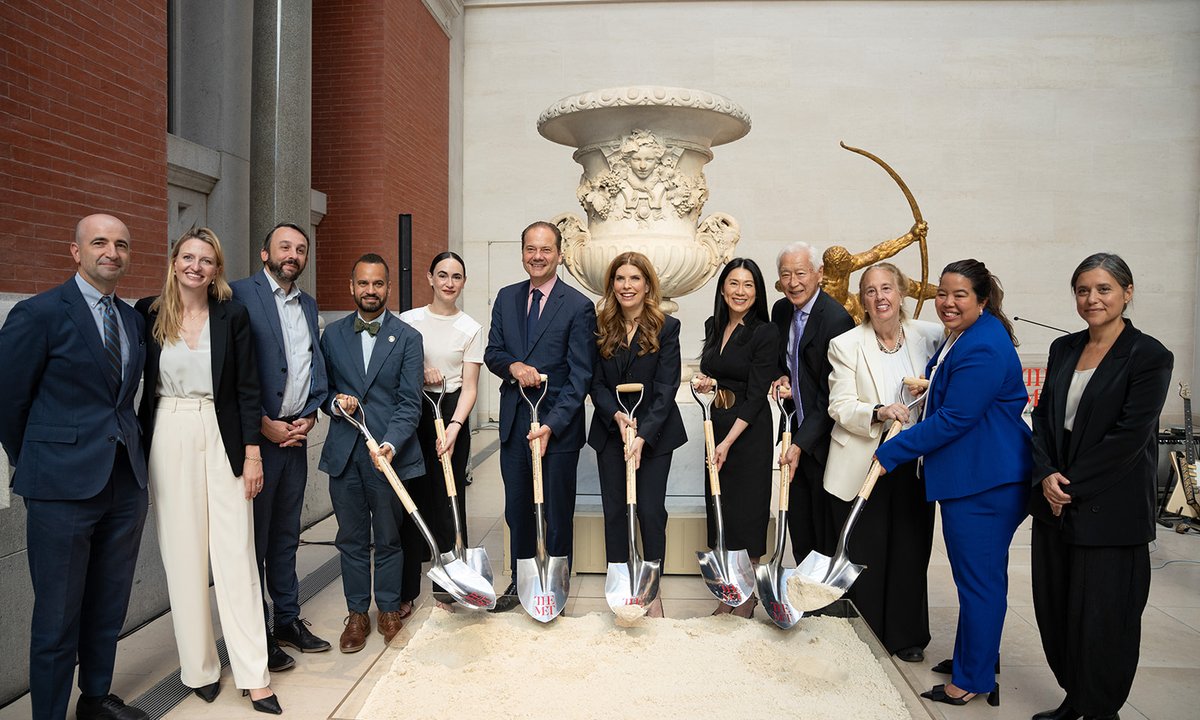
The Metropolitan Museum of Art hosted a groundbreaking ceremony Tuesday (15 September) for its Tang Wing for Modern and Contemporary Art, scheduled to open in 2030.
The five-storey, 126,000-sq.-ft space is designed by the Mexican architect Frida Escobedo, the first woman to create a wing for the museum in its 156-year history—a fact that came up often in the morning’s speeches. The Met has already raised $670m to fund building the wing and its operation; it is named for the financier Oscar Tang (a longtime Met trustee) and his wife, the archaeologist and art historian Agnes Hsu-Tang. The couple donated $125m towards the project, the largest cash gift in the museum’s history.
Following a breakfast reception in the museum’s Carroll and Milton Petrie European Sculpture Court, the Met’s staff and board joined Escobedo and her team of architects, together with local politicians and neighbours, to celebrate the official start of construction on the Tang Wing. In his introductory comments, the museum’s chief executive and director Max Hollein called it the beginning of “the next grand chapter in the history of the Metropolitan Museum of Art”.
“The Tang Wing is not simply more gallery space, but a new way of seeing the art of our time in dialogue with everything else we hold in our collections,” Hollein continued. “The Met is in a moment of great transformation, and the Tang Wing is certainly its most ambitious expression.”
Hollein also highlighted that Escobedo’s design was created to better connect the museum with its surroundings—namely, Central Park and the Upper East Side. “For the first time, the Met will open up to the park, open up to its neighbours,” he said, later adding that the reimagined landscaping around the wing will be “more open, fluid and accessible to the park”.
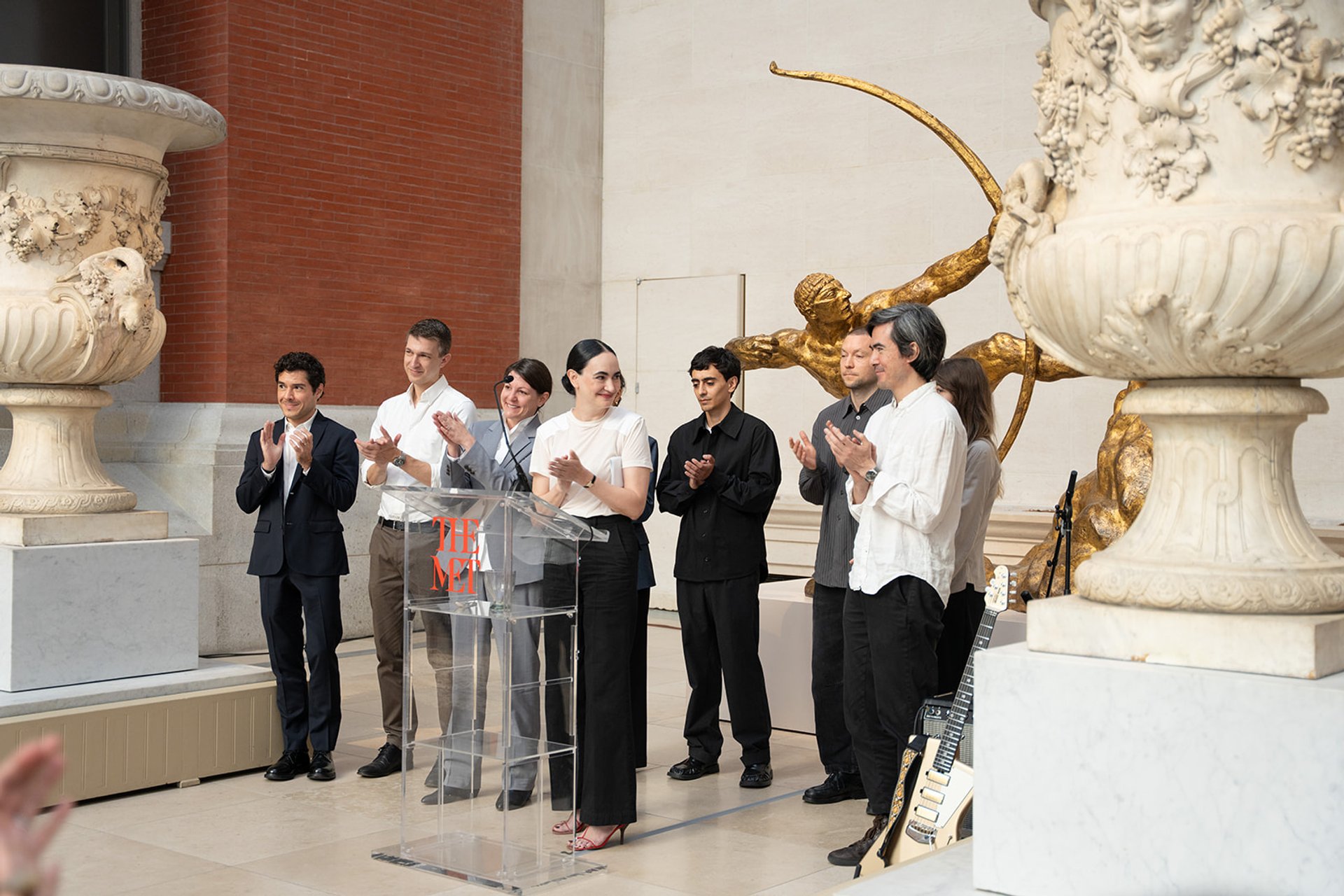
Frida Escobedo applauds her team of architects Courtesy the Metropolitan Museum of Art
Other speakers included Oscar Tang—who said that, as immigrants, he and his wife were proud to be part of the Met’s history—as well as a smattering of local and state politicians. These included Mark Levine (the city’s comptroller), Brad Hoylman-Sigal (the Manhattan borough president), José M. Serrano (a New York state senator), Keith Powers (a state assemblymember) and several city councilmembers.
Many of the elected officials shared stories of their own experiences at the Met, while echoing Hollein’s sentiments that the new wing will better connect the museum to its surroundings. “Continued change and transformation doesn’t have to come at the expense of your neighbours,” said Tricia Shimamura, the city parks commissioner. A number of people also praised the Tangs’ commitment to the arts in the city, which has recently included $40m for the New York Philharmonic and $20m for the New York Historical’s new democracy wing. “The Tangs have redefined philanthropy in the city,” said city council speaker Julie Menin.
Escobedo, for her part, named and brought to the podium her colleagues at her namesake architecture firm who are working on the project. She called the Tang Wing “the most ambitious project our studio has ever undertaken”. Escobedo also emphasised the all-important relationship of the museum to its neighbourhood. “The Tang Wing sits at the intersection of collections, creating new connections and extending towards Central Park and New York City,” she said.
Escobedo later told The Art Newspaper that the many design challenges she and her team faced “gave us a lot of opportunities. They provided for different scales and spaces—both intimate and grand galleries connecting to the exterior.” (As the city councilmember Gale Brewer noted in her remarks, the giant windows of the wing will be “bird-friendly”, tempered to avoid collisions.)
The event ended with a short performance by the Swinomish/Iñupiaq singer-songwriter Black Belt Eagle Scout. Her meditative song, accompanied by a live guitar loop, fittingly explored ideas of belonging.