
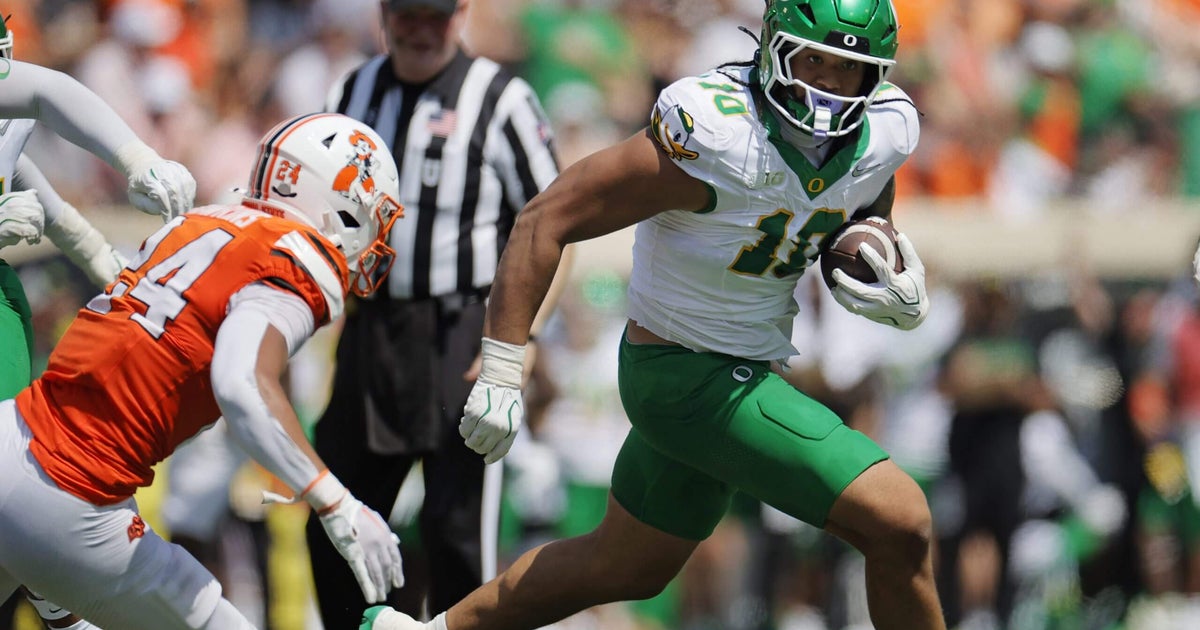
Before we begin our regular programming, I want to encourage all of you to peruse a special project that several colleagues and I debuted on Wednesday: The estimated roster budgets for every Power 4 school. While schools have little motivation to be perfectly transparent about their numbers, we spent months reporting until we had a reliably narrow range for each team — reaching as high as $49 million to $54 million (Ohio State) and as low as $8 million to $13 million (Boston College).
On Saturday night, evenly matched Ohio State and Texas ($45 million to $55 million) gave us an instant classic. But earlier that same day, lower-end Oklahoma State ($15 million to $19 million) stunned ultra-rich Oregon ($48 million to $54 million).
What’s more likely: that Week 1 was Oklahoma State’s aberration, or is Oregon in trouble? Like big trouble? — Jody
I feel like everyone is talking about how Oregon got upset and not how Oklahoma State dominated the game for four quarters. In fact, this game could’ve been an OSU blowout if it wasn’t for two fluky tipped interceptions. What is the ceiling and the floor for Oklahoma State this year? — Josh A.
I’m open to the possibility that Tulsa — which beat Oklahoma State 24-10 in Week 1 — will turn out to be the new Group of 6 juggernaut, which would better explain the Cowboys’ jarring turnaround. More likely, it will turn into this year’s version of the annual Unexplainable Early Result. Like Florida State whipping Alabama last season, only to finish 5-7, or Northern Illinois over Notre Dame the year before. With 91 new players, perhaps it was inevitable that Eric Morris’ team would take a minute to find itself.
But like Oregon coach Dan Lanning himself said, “The score was closer than it really was.” It’s one thing for Drew Mestemaker to go out and wreak havoc just like he did at North Texas; it’s another for Oklahoma State’s defense to shut down a quarterback as talented as Dante Moore. If the Cowboys are capable of that, they’re capable of contending for the Big 12 title. The question is whether they can maintain consistency, or whether they’re going to keep swinging wildly from one week to the next.
As for the Ducks — yep, they’ve got trouble.
I already wrote on Sunday about underestimating the loss of both coordinators, but I’d note two other glaring concerns. After fielding such a dominant pass-blocking offensive line early in Lanning’s tenure (Oregon led the nation in fewest sacks allowed in 2022 and ’23), last year’s unit got exposed in the two Indiana losses, and this year’s line had to replace both starting tackles. The new guys, redshirt freshman Ziyare Addison and third-year sophomore Fox Crader, got thoroughly whipped Saturday, with Pro Football Focus pass-blocking grades of 29.0 and 19.9, respectively.
And then there’s the defense, which did not look remotely like a veteran unit. It is currently tied for 113th in pass plays of 20-plus yards allowed with eight, and 89th in opponent passer rating (132.4). And a week from Saturday, they face USC’s Jayden Maiava, who, through three games, is completing 80.7 percent of his passes with 10 touchdowns and one INT.
But I won’t make any assumptions just yet. The Trojans have opened with three G6 lightweights while Oregon has faced possibly the top G6 team in Boise and what may turn out to be a pretty good P4 foe. The Ducks may have been the first national title contender to get exposed, but many of the others haven’t yet played someone capable of doing so.
Ohio State vs. Texas — do you put more stock in what happened in the first three quarters or what happened in the fourth quarter? — Matt C.
I put stock in all of it. First and foremost, I come away from the game with more confidence that Texas could win the national championship. We knew going in that the Horns had a loaded roster. The question was whether Steve Sarkisian could fully unleash it. In the fourth quarter, we saw the Horns fully formed.
On the other side, I’m not discounting Ohio State by any means for losing to a top-five team on the road, especially when a made 45-yard field goal would have swung the result the other way. But the Buckeyes’ collapse did raise some concerns.
For one thing, they don’t seem to have a Plan B at receiver behind Jeremiah Smith. Ohio State built its 23-3 lead largely because Texas simply couldn’t defend him. Smith caught eight passes for 164 yards and a TD. But once ex-Rutgers cornerback Bo Mascoe started jamming him up, the entire offense froze up. Julian Sayin targeted Smith 15 times on the night. No other receiver or tight end got more than three.
We’ve taken for granted for so long that Ohio State will always have a deep stable of receivers. Maybe they still will. Five-star freshman Chris Henry Jr., who looked like an instant-impact guy, played just eight snaps Saturday. I’m sure he and fellow freshman Brock Boyd will take on bigger roles eventually. But right now, there is no Emeka Egbuka or Carnell Tate lining up opposite Smith.
And then, of course, there was the defense’s fourth-quarter implosion. The low-hanging-fruit explanation would be that the Buckeyes just couldn’t handle the Austin heat. The temperature was still above 90 degrees deep into the game. If that’s the case, there’s less reason to worry going forward. But it’s also a defense full of guys stepping into bigger roles for the first time. They didn’t show it for three quarters, but inexperience may have reared its head once the pressure began building.
Again, Ohio State is hardly dealing with Oregon-level panic. In fact, if you’d said before the game they would lose by one point, no one would have blinked an eye. (That was the Vegas spread.) It was the nature of the collapse that had me dwelling on potential problems going forward.
Against Ohio State last year, Fernando Mendoza threw for 222 yards with one TD and one INT while scoring 13 points in the game. This year, Arch Manning threw for 197 yards with one TD and one INT against Ohio State while scoring 24 points. Mendoza won the Heisman Trophy and was the first pick in the NFL Draft. Yet you are still very skeptical about Manning. Why was Mendoza universally praised for his performance and not Manning when they put up nearly identical numbers? — Nick D.
I wouldn’t recommend comparing two players by picking one performance from each, even in the same season, let alone in different seasons. Mendoza faced a whole bunch of dudes from Ohio State who weren’t in Austin on Saturday night because they were preparing for their NFL games the next day.
As I said on “The Audible,” Manning deserves all the credit in the world for having now beaten four top-10 opponents in barely more than a season. And he was awesome on those three touchdown drives down the stretch on Saturday. But I remain perplexed as to why, for a purported Heisman contender and future No. 1 draft pick, he has so many games in which he struggles considerably for the first three quarters or so. “Overrated” is too simplistic. He’s an enigma.
Case in point: On Saturday night, Manning was off target on five of his 26 attempts through the first three quarters, per TruMedia. Then he was on target for all 11 attempts in the fourth quarter, finishing at 13.5 percent for the game, which, over the course of an entire season, would be considered middle-of-the-pack for FBS. Through two games, he is at 9.4 percent, which ranks 29th.
But for some reason, many of my colleagues and, of course, NFL Draft experts will latch on to one or two of his extremely accurate throws over the course of the game and say, “See, that’s what we’ve been talking about.” Which … OK. But what about all the others?
I’m curious to see whether that fourth quarter becomes a launch point for the rest of his season. It had to do wonders for his confidence. Or is this just who he is at this point: inconsistent, with flashes of greatness. A guy who, with any other last name, would be considered a good but hardly elite college quarterback.
Texas looked like crap for almost 3.5 quarters and managed to beat a team that would have won if they didn’t miss a field goal. I’m glad they came back. Great game. But hardly a case for Texas at No. 1. Why do we keep up the charade of polls when teams turn over 60 to 90 percent of the squad and bet on unproven high school talent? — Kraig B.
We keep up the charade of the polls because fans eat them up. It gives us something to debate and, even if the AP and USA Today ones didn’t exist, a thousand unofficial ones still would. Like Chris Vannini’s 138 ranking, which is fun and gives us something to debate.
I don’t know if Texas is the best team, but if the Longhorns didn’t make a case for No. 1 by beating No. 1, then who did? No. 2 Georgia for beating Western Kentucky? No. 3 Notre Dame for blanking Rice? If we want the top teams to actually play each other, then they need to be rewarded in the rankings, style points be damned.
Stew: In four years at Oklahoma, the first two in the Big 12, the second two in the SEC, Brent Venables has landed on the hot seat by going 6-7 in his debut in each league, before going 10-3 the following year and getting an extension. Now that the Sooners are 1-1 with a transitive loss to Western Michigan, can you please admonish OU for giving two (2) contract extensions to a coach? — Luigi M.
This is actually a very timely message. On Tuesday, the Senate voted 74-24 in a procedural vote to advance the Protect College Sports Act to the floor. That same day, one of the bill’s co-sponsors, Sen. Maria Cantwell (D-Wash.), put out a 14-page report full of fancy charts and numbers titled “Runaway Athletics Spending Threatens the Financial Health of America’s Colleges.”
As longtime readers know, I have very little sympathy for big-time football schools crying poverty, and it’s exactly because of self-created crises like this. No one was trying to hire Venables away from Oklahoma in either 2024 or 2026. And yet, Venables’ average salary has already increased by 42 percent in four years, from $7.25 million to $10.25 million. His contract now runs through 2031. And his buyout is now north of $50 million.
But of course, Cantwell’s solution to these runaway costs does nothing to address coaching compensation. Just the athletes.
I’m not going to throw Venables back on the hot seat after one loss. He just reached the Playoff last season. But I don’t get the sense OU’s fanbase is as all-in on the guy as his repeated raises and ever-increasing job security would indicate.
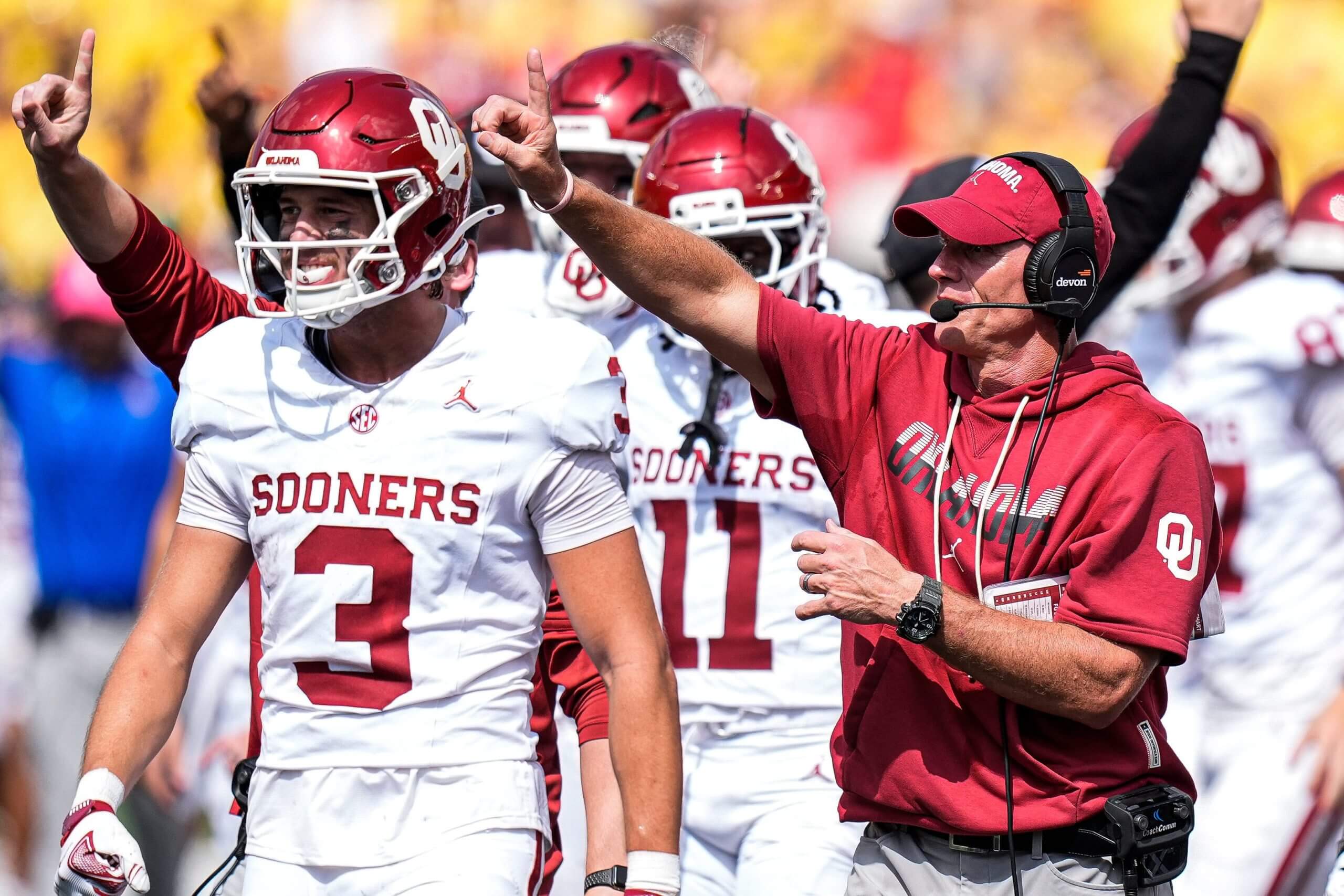
Brent Venables’ salary increased 42 percent in four years. (Junfu Han / USA Today Network via Reuters Connect)
Howdy Stew. We are into the fourth week of games. Which matchups pique your interest now that didn’t before? — Tom M.
Don’t laugh, but I am fascinated by Saturday’s North Carolina-Clemson game — a.k.a. the Trainwreck Bowl. Not so much because it’s a six-time Super Bowl champion coach vs. a two-time national championship coach, but because there’s a decent chance Dabo Swinney’s team will lose to Bill Belichick’s squad.
The Tigers followed up their 51-10 embarrassment at LSU by scoring one touchdown against Georgia Southern in a game it led 16-7 until adding two field goals in the last six minutes. It’s unclear whether starting QB Christopher Vizzina, who got hurt early in that game, or freshman Tait Reynolds will start Saturday. Meanwhile, UNC has shown improvement, making this an important swing game for both teams.
UNC looks like totally different team in win over TCU
David Ubben and Jayne Orenstein
I never thought I’d be marking my calendar for a Week 4 Boise State at Western Michigan game, but here we are. Boise State is clearly very good, following up its near-upset of Oregon by stomping Memphis, while WMU should have a top-25 win over Michigan on its resume right now. It’s a big, big game for the G6 Playoff derby.
And while Oregon-USC always figured to be one of the bigger games that weekend, the stakes have ratcheted up considerably from “Hey, that could be a tricky game for Oregon,” to “Wow, their Playoff hopes could be on life support before September is even up.”
I know I sound like a broken record when it comes to the 24-team CFP disaster, but think about that sentence I just wrote, then think about a world where it’s 24, not 12. The Ducks could take another loss soon and still not be eliminated, even if they turn around and lose to UCLA the next week. Heck, beat Ohio State but lose a fourth game and they’d at least be on the bubble.
Is that what you want the regular season to be? … No? … Email your school’s AD and president and let them know before it’s too late.
Stewart, I am trying to make sense of the Big Ten’s slow start. Do you think it’s possible that Big Ten teams are still exhausted from long Playoff runs? That could help explain why the SEC teams are so fresh. — Nathan
Touché.
If 3-0 North Dakota State runs the table in the Mountain West, will they go from FCS to CFP in a single season? Or is that new MWC schedule just too soft? — Mark M.
First, let me just clarify off the top that the Bison ARE eligible for the CFP in their first FBS season. In June, the NCAA eliminated its longstanding rule that said schools moving up from FCS couldn’t compete in the postseason for two years. Both NDSU and Sacramento State are eligible immediately.
It’s too soon to say whether the Bison are strong enough to run the table, but they’re off to a great start, winning 38-32 at Air Force last week. That, combined with preseason MWC favorite UNLV getting blown off the field by North Texas, has folks readjusting their expectations for both programs. New Mexico, which visits Oklahoma this weekend, should also be in the MWC mix.
But no doubt, NDSU’s schedule is weak, starting with the non-conference slate of Jacksonville State, Fordham, Sacramento State, and San Jose State (which was scheduled before they became members of the same conference). The new MWC, which lost Boise State, Fresno State, San Diego State, Colorado State and Utah State while adding deadweights UTEP and NIU, is likely going to finish the season far below the American and Pac-12 in schedule strength ratings.
But never underestimate the committee’s love of a “0” in the loss column. Remember, in the last year of the four-team CFP, the committee awarded 13-0 Liberty a New Year’s Six bowl berth, ranking it one spot higher than 11-2 American champ SMU. The American was considerably better than Conference USA. Didn’t matter.
So dare to dream, Fargo.
Stewart: Why are Fox, CBS, & NBC allowing the Big Ten to have an atrocious week of scheduling? Really, Kent State vs. Ohio State is your Big Noon Game of the Week? — Eric W.
And USC-Rutgers in the CBS 3:30 time slot. Where have you gone, Verne and Gary?
It shows that, as much power as we all assume the TV networks hold, to this point, they’ve largely refrained from trying to influence scheduling. It’s left to the schools and the conferences. If I were them, I’d be furious that the league office didn’t take steps to prevent something like this. Non-conference contracts are known years in advance, and they’re hardly impossible to change. If USC and Rutgers can meet in a conference game in Week 2, then so could most of the other schools. It just would have required swapping around some of those Western Kentucky/Buffalo/Akron games.
The bigger problem, of course, is that so few schools are even scheduling big nonconference games. We had two bangers last week, Oklahoma-Michigan and Ohio State-Texas, but this week the only P4 non-conference games are Michigan State-Notre Dame, Colorado-Northwestern and Virginia Tech-Maryland. And the most frustrating aspect of all is that Big Ten commissioner Tony Petitti is using his conference’s own weak scheduling as a selling point for the need for a 24-team Playoff. “Hey, SEC, just cave on the whole ‘regular season still matters’ thing, and THEN we’ll start playing you guys more.”
Again: Email your AD and president.