
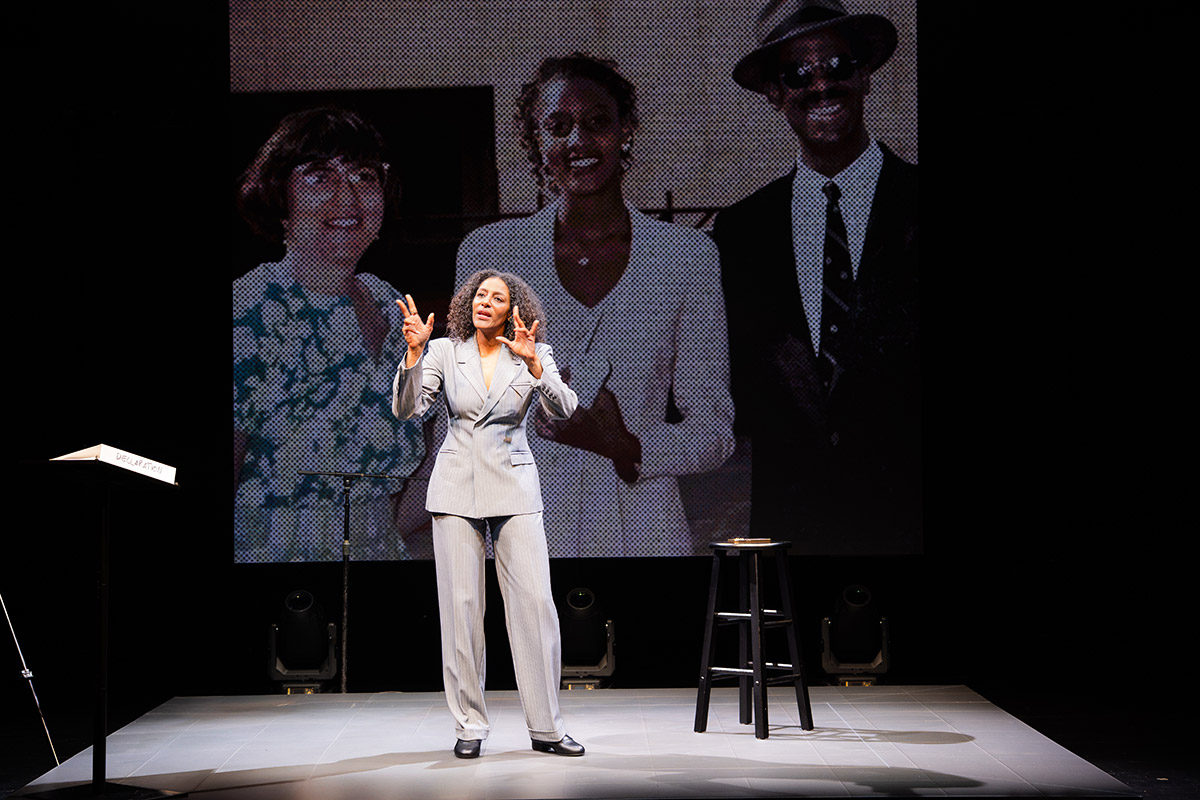
 Sarah Jones in America, Who Hurt You? Photo: HanJie Chow.
For anyone not keeping up with the Joneses—namely, Sarah Jones: She is a gifted performer and writer whose specialty is morphing vocally and physically into individuals of many ethnic and social backgrounds. Jones bubbled up through off-Broadway, creating solo shows mostly about urban people during the late 1990s, culminating in Bridge & Tunnel, which landed on Broadway and nabbed a special Tony Award in 2006. Since then, Jones has created similar shows and performed on TED main-stage events, Netflix, and podcasts.
Opening on Thursday at the Polonsky Shakespeare Center in Brooklyn, Jones’ latest solo stage work finds her in fine form at the center of a lively conversation among more than a dozen characters about the current mental state of the United States. Her new play, America, Who Hurt You?, boasts a pedigree including Oxford University (where the show originated last May), the National Black Theatre, and Theatre for a New Audience, among others. The Oxford influence is obvious at the show’s get-go when Jones strides onto the stage, looking fabulous in an elegant, pale gray pinstripe number designed by Toni-Leslie James, and briskly starts speaking to the audience in rawther fancy English accents. Who does this babe from Queens think she is, anyway?
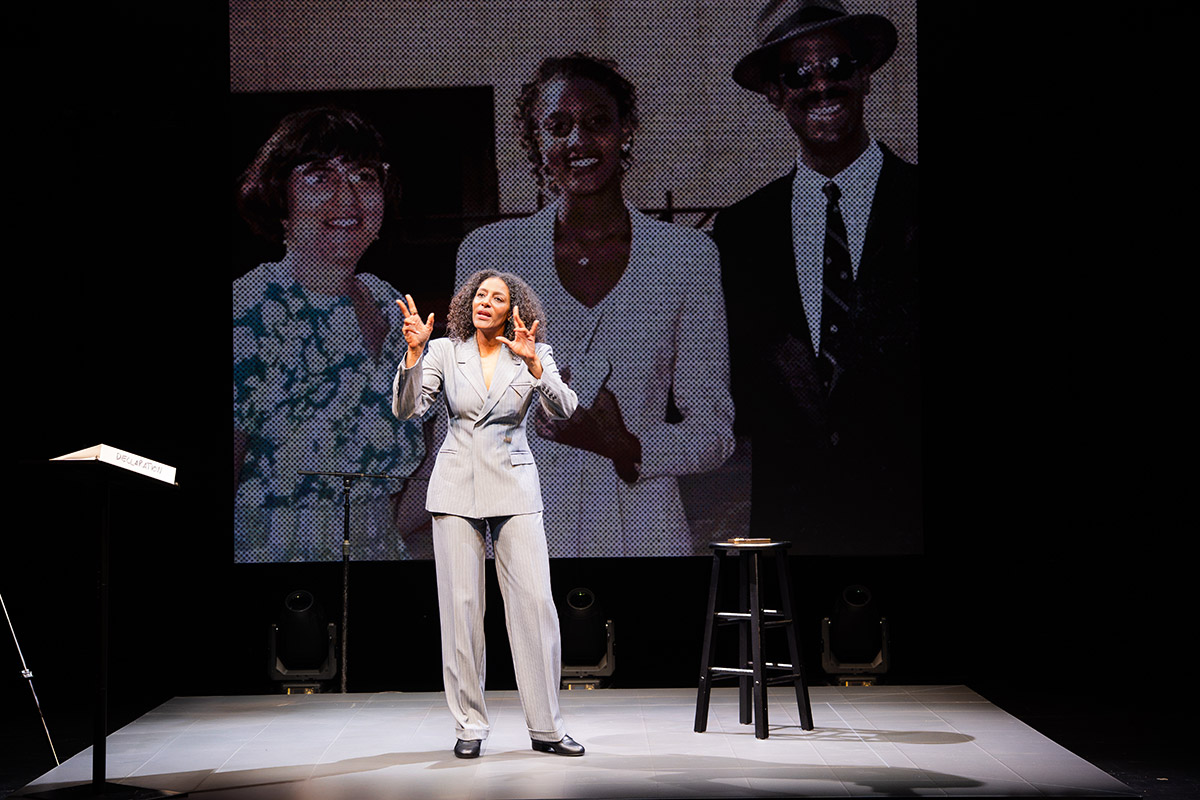
The accent is a goof, of course, and serves as Jones’ icebreaker so newcomers can understand how she creates her characters. “Basically,” Jones explains, “if your people have ever been persecuted, deported, or you’ve had your regime changed recently by the current administration, I’m probably related to you.” A vintage photo of Jones taken with her white Jewish mom and Black dad of Caribbean heritage pops up on a big screen behind the small platform where she performs, noting her characters are inspired by a multiracial, multi-religious, multicultural family and community.
Soon they start to appear. With hunched shoulders and trembling fingers, Jones assumes the identity of Lorraine, her grandma—or is it great-grandma?—of European origin. Then Jones becomes the assertive, fast-talking Nereida, a proudly half-Dominican, half-Puerto Rican cousin representing Latino relatives. Jones next turns into Rashid, a Black man with an eloquent vocabulary derived from AI. Then she provides a drawling presence for Hank, who trumpets himself as a proud, white Christian male from the state of Georgia. Immigrants from India, China, and Ireland pop up, as do others from generations long gone. These individuals—several returning from Jones’ previous works—do not simply come and go during the 100-minute show; more than a few stick around talking among themselves. In a delightful Pirandello-esque moment, the characters suddenly realize Jones appears to have vanished, and they’re relieved when she resumes her own identity.
“What is America if not one massive, multiracial, dysfunctional family?” remarks Jones, who then, most significantly, summons from within herself the contrasting characters of Britain and America as the personifications of the two nations. Admitting her own faults, the older, cooler, assured Britain contrasts with teen queen America, still an adolescent at age 250 by the standards of nation-states, who overreacts defensively to side-eye from other countries. Fiddling with her hair and phone, the hyperventilating America appears on the verge of a panic attack, feeling “all stress-y depress-y telling me the entire world low key hates me!” Britain, with insights provided by several among Jones’ other characters and her own voice, proceeds to educate whiny America about its development rather than the mythologized versions.
Much of this sad but true U.S. history—accompanied by TED talk–style timeline graphics presenting years such as 1776, 1619, and 1492—likely will prove familiar to the adult demographic who attend productions at TFANA. Trying not to wave an admonishing finger, Jones delivers platitudinous observations (“You can’t pretend that good is all that exists and ignore the rest”) with all the considerable talent and empathy she can muster as an artist, but stretches of her material are scarcely revelatory, let alone stirring or memorable.
Given a glossy bijou production by director Eric Ting, Jones’ lively performance is enhanced by live and animated video designed by Stefania Bulbarella and flattering lighting by Jiyoun Chang. It looks like a handsome vehicle for travel to other towns and countries.