
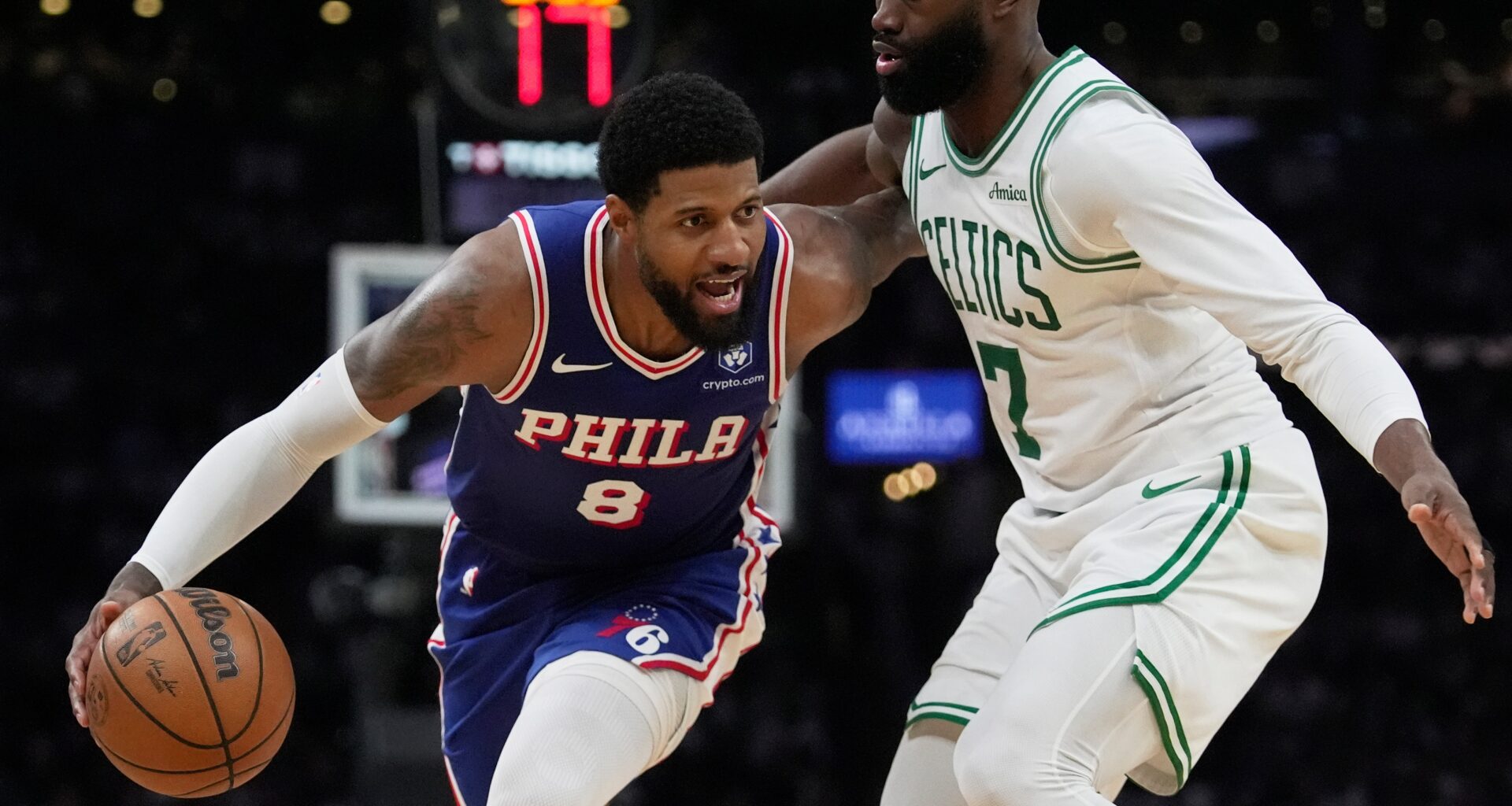
Paul George knows he’ll need to win over Celtics fans who are still salty about the trade that brought him to Boston.
The easiest way to do that: perform the way he did against his new team in the most recent NBA playoffs.
George, whom the Celtics acquired in the July blockbuster that sent franchise cornerstone Jaylen Brown to Philadelphia, was a surprise standout in the 76ers’ first-round upset this past spring.
A target of frequent criticism for his bloated contract and unreliability, the 36-year-old averaged 17.4 points per game in the seven-game series, made 55.0% of his 3-pointers and spearheaded Philly’s defensive efforts against Boston’s primary offensive threats.
George spent most of the series guarding either Brown (153.6 partial possessions, per NBA player tracking) or Jayson Tatum (114.2) and held the duo to 39.6% shooting (21-for-53), including 23.5% from 3-point range (4-for-17). Those matchups resulted in 11 turnovers (five by Brown, six by Tatum), two blocked shots and a slew of offensive fouls, with George drawing one in Games 3, 4, 5 and 6.
“It just felt like I was able to do things and, quite frankly, might have caught Boston off guard from an expectation that I could no longer move,” George said Tuesday in his introductory news conference, prompting a side-eyed stare from head coach Joe Mazzulla.
“Not to say Joe didn’t see it coming or wasn’t prepared for it,” George later added in an interview with NBC Sports Boston. “But trust me, I would have shocked myself too if I was the coach on the other end and had (seen) Paul George play throughout the whole season. You could see that, ‘Oh, he’s definitely — this is a different Paul George in this playoffs.’ ”
In the fourth quarter of Game 6, George hit a go-ahead 3-pointer at one end, then drew a Brown charge on the ensuing possession. He did the same in the third quarter of Game 5. Over the seven games, he led all players on either team in steals (10) and deflections (22), and trailed only Celtics center Neemias Queta in contested shots (47).
The Sixers outscored the Celtics by 39 points with George on the floor over the final three contests, winning each to overcome a 3-1 series deficit and hand Boston its earliest playoff exit in five years.
Two months later, the Celtics executed arguably their most significant roster move since the Paul Pierce/Kevin Garnett trade in 2013, swapping Brown for George and four future draft picks. Brown believed George’s postseason play helped grease the wheels for that stunning deal.
“PG had a great series. PG looked like vintage PG,” Brown said in a live stream after the trade was finalized. “He definitely was hooping. I think that was part of the reason why the deal for me went down, because PG’s got a lot left in the tank. So don’t sleep on my dog.”
Celtics president of basketball operations Brad Stevens also has referenced George’s first-round renaissance — which came after he missed 20 games with injuries and another 25 for a drug policy suspension during the regular season — multiple times this summer. It wasn’t a return to George’s All-NBA peak in the late 2010s, when he was a perennial All-Star, a four-time All-Defensive selection and an NBA MVP finalist, but it was proof that he still can, as Stevens put it, “carry you for portions of a quarter or a half, but also play a complementary role on both ends of the floor at the highest of levels.”
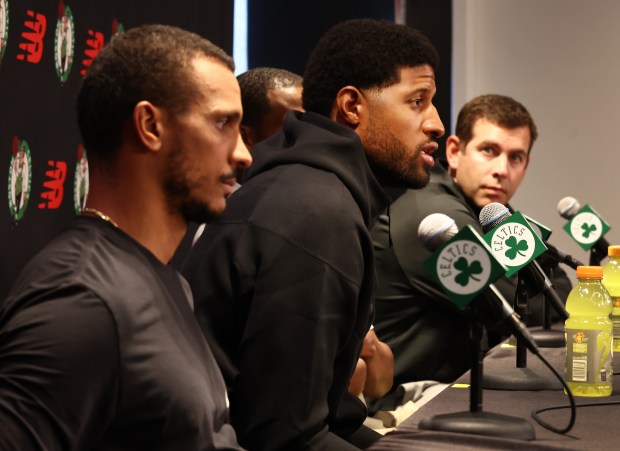 Celtics head coach Joe Mazzulla, left, and President of Basketball Operations Brad Stevens, right, listen to Paul George during a press conference Tuesday. Nancy Lane/Boston Herald
That’s the version of George the Celtics are hoping to get this season, and the role he envisions for himself. He said this week that his job is to be a supportive running mate for Boston’s “superstar,” Tatum.
To do that, George will need to avoid the injury issues that have plagued him since the start of this decade. He’s played more than 56 games just once in the last seven seasons and was limited to 41 and 37 in his two Sixers campaigns.
He was able to start the final 21 games for Philadelphia last season, including playoffs, but only after serving a midseason suspension that sidelined him for all of February and most of March. That long layoff, he said, helped him perform at his best down the stretch and into the postseason — and enter the offseason healthy.
George said he currently feels “amazing” after a rehab-free summer.
“Really, it was that time that I had off. It was almost like a dog being let off the leash, right?” he said when asked about the Celtics series. “Like, you’ve been chained up for so long, and the analogy there is just the limitations again, physically, and then to be healthy again. … But I was feeling good. I felt that I was able to do all the things out there to gain an advantage or be a weapon.”
Since George won’t, the Celtics hope, have a 25-game break in the middle of this season, the onus will be on their coaching and training staffs to ensure he’s fit and available for the most important games next April and May. It would not be surprising to see Mazzulla manage George’s workload like he did with the similarly seasoned Al Horford, who did not play on back-to-back nights in the final years of his Celtics tenure.
“I kind of just want to look at it from a (standpoint of) what makes sense, what doesn’t, how my body feels,” George told NBC Sports Boston’s Chris Forsberg. “Obviously, it’s been unacceptable to me from a personal level to not be able to play at least 50 games, 60 games in a season. And so that’s kind of a benchmark obviously I want for myself, to be on the upper end of games played.
“But obviously, the big picture is being ready and being at my full self come postseason. We’ve had early conversations (about) that. I’m not sure what it will look like once the season starts, but I think it’s great to kind of have that relationship. And just from a mental standpoint, that the long game is the objective.”