
Quantum computing promises computational advantages that would smoke classical computing, but the rapidly advancing technology still faces formidable barriers. Among these obstacles are limitations in hardware, software, and error correction, which stand in the way of developing commercially viable applications.
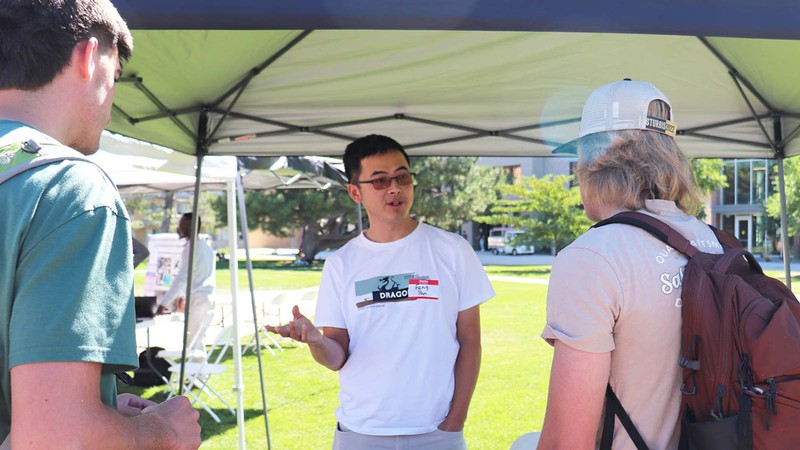
“Quantum bits, or qubits — the basic units of information in quantum computing — are incredibly fragile,” said USU physicist Feng Pan. “Tiny fluctuations in temperature can disturb them and cause computing errors.”
Pan, who studies nanophotonics, believes light may hold the key to solving these challenges.
The assistant professor in USU’s Department of Physics was the recipient of the top research paper award at Lawrence Berkeley National Laboratory’s 2026 Molecular Foundry Annual User Meeting on Aug. 20-21 in Berkeley, California. Pan delivered an invited talk during the plenary session about his research on how sculpted light interacts with materials at the nanoscale.
“Light is relatively inexpensive and operates at room temperature,” Pan said. “By learning how to use light to interconnect quantum processor units via optoelectronic materials, we aim to make a quantum supercomputer reachable.”
Among his research interests are creating bright, controllable sources of quantum light, and using this light to study quantum materials.
“Our computational design could enable the creation of a variety of nanophotonic platforms for these applications,” said Pan, who is currently teaching Physics Lab 3870 — Intermediate Physics Laboratory.
“We have to invent some of our own tools,” he said. “And I’m recruiting undergraduates and graduate students in physics, chemistry, engineering, and other disciplines to join my team as we build our lab from the ground up.”
Through his association with Molecular Foundry, Pan has garnered contacts with researchers at multiple national labs and plans to help students pursue internships and fellowships funded by the U.S. Department of Energy, NASA, the National Science Foundation, and other entities.
“Nanophotonics, quantum computing, and computational design are fascinating research fields with exciting career opportunities,” he said. “I’m excited to work with USU students and introduce them to top-level, national learning opportunities.”