
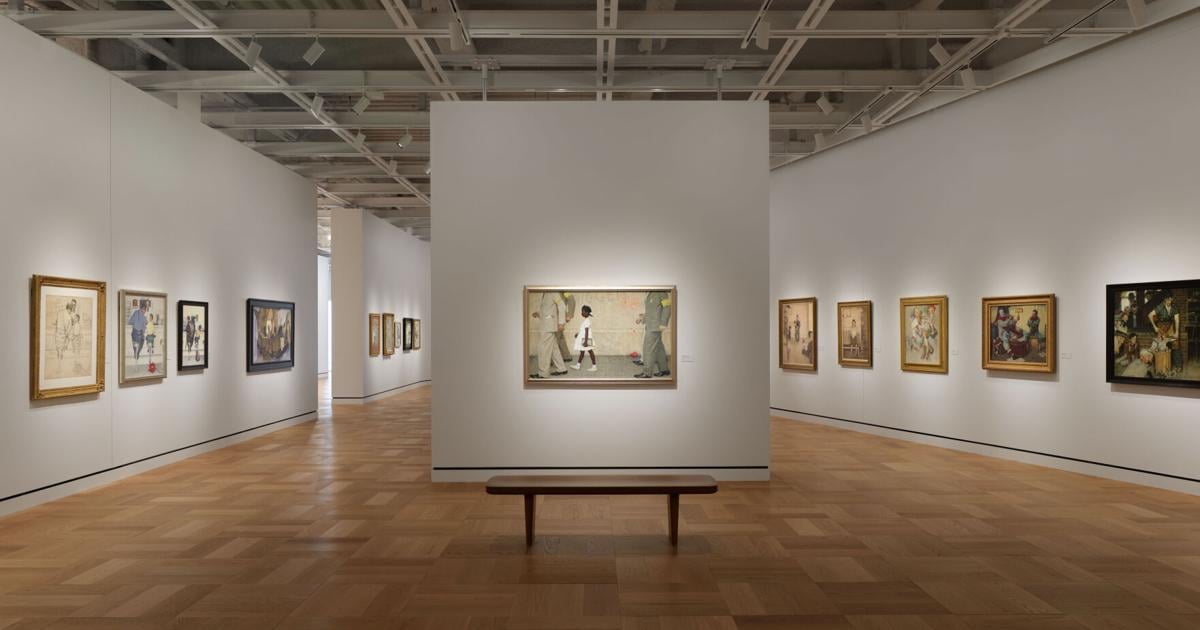
LOS ANGELES — Norman Rockwell’s “Shuffleton’s Barbershop” and “Horseshoe Forging Contest” are back on public view. The only caveat? You’ll have to travel more than 2,800 miles to see them.
The paintings, sold by the Berkshire Museum in 2018, are now California residents, part of the permanent collection of the Lucas Museum of Narrative Art, which officially opens Tuesday. The pair are prominently displayed in a gallery dedicated solely to Rockwell, one of only six artists with dedicated spaces in the new museum. The others include N.C. Wyeth, Frank Frazetta, Jessie Willcox Smith, Thomas Hart Benton and Maxfield Parrish.
“Shuffleton’s Barbershop,” painted for the cover of The Saturday Evening Post (April 29, 1950), was bought in a private transaction from the Berkshire Museum in 2018.
LUCAS MUSEUM OF NARRATIVE ART
“Shuffleton’s Barbershop” and “Horseshoe Forging Contest (or Blacksmith’s Boy — Heel and Toe)” were donated to the Berkshire Museum in Pittsfield by Rockwell in 1958 and 1960, respectively. More than 60 years later, the paintings were among the works sold by the museum in an effort to address its financial problems. Rockwell’s donated paintings, along with works by Alexander Calder and Albert Bierstadt, among others, raised $53.25 million.
In an effort to stop the sale, Rockwell’s sons — Jarvis, Peter and Thomas — along with concerned museum members and donors filed a lawsuit in 2017. However, in April 2018, the Massachusetts Supreme Judicial Court cleared the way for the museum to sell up to 40 select artworks under specific conditions.
“Horseshoe Forging Competition” sold for $8.1 million at auction, while “Shuffleton’s” sold for an undisclosed price of between $20 and $30 million in a private transaction.
The barbershop and its slightly out-of-view musicians remained on view in the Berkshires for two years at the Norman Rockwell Museum, a requirement of the purchase per an agreement between the Massachusetts Attorney General’s office and the Berkshire Museum.
When “Shuffleton’s” left in 2020, the public was aware that it would re-emerge at the Lucas Museum, but the whereabouts of “Horseshoe Forging Competition” remained a mystery. Only a select few knew the unnamed buyer was the Lucas Museum.
“Horseshoe Forging Contest (or Blacksmith’s Boy — Heel and Toe),” sold at action by the Berkshire Museum for $8.1 million in 2018, will remain on public view in its new home at the Lucas Museum of Narrative Art.
JENNIFER HUBERDEAU — THE BERKSHIRE EAGLE
“We were very relieved to know they would be in the Lucas Collection and on view and available to the public. That was very meaningful,” said Stephanie Haboush Plunkett, deputy director and chief curator of the Norman Rockwell Museum, after previewing the Lucas Museum during the first week of September. “They are basically two masterpieces of Rockwell’s work, and to know they will be accessible is really great. The [Lucas Museum] collection in and of itself is pretty extraordinary.”
The two museums have had a longstanding relationship, Plunkett said. The Lucas Museum has loaned parts of its collections, including many non-Rockwell works, that have appeared in exhibitions such as “Enchanted: A History of Fantasy Illustration” and “Eloise and More: The Life and Art of Hilary Knight.” In turn, the Rockwell Museum loaned “The Problem We All Live With” and “The Runaway” to the California museum for its inaugural exhibition.
“We look forward to continuing that collaboration going forward,” Plunkett said. “It’s kind of a nice East Coast-West Coast balance.”
From left to right, “The Runaway, (Study),” “The Runaway,” on loan from the Norman Rockwell Museum, both by Norman Rockwell, and “The Militarization of the Police Dept. — Deadly Force,” by Richard Williams, hand side-by-side at the Lucas Museum of Narrative Art.
PAUL SALVESON — LUCAS MUSEUM OF NARRATIVE ART
TWO MASTERPIECES
“Shuffleton’s Barbershop,” the cover of the Saturday Evening Post’s April 29, 1950, edition, is painted from the perspective of someone peeping through a window into the darkened interior of a barbershop. A warm light illuminates a backroom, where a quartet of musicians plays. The painting is one of Rockwell’s most celebrated works — beloved by fans for capturing the essence of small-town America in the mid-20th century and praised by art historians for its unusual perspective, soft lighting and technical brilliance.
“Horseshoe Forging Contest,” created as an interior illustration for a November 1940 issue of the Saturday Evening Post, depicts a 10-hour competition between an experienced blacksmith and a rival. Rockwell photographed 23 individuals for the painting, asking each to react as if they were witnessing the actual events.
For George Lucas, who co-founded the Lucas Museum with his wife, Mellody Hobson, president and CEO of Ariel Investments, the paintings are important not only as examples of Rockwell’s work but because of the way they tell stories.
Ryan Linkof, senior curator and head of film programs, told The Eagle during an interview at the museum’s Sept. 2 press preview that Rockwell is the quintessential narrative artist. He went on to say that Rockwell’s work helped him understand the way Lucas talks about narrative art, which is “the art that surrounds us.”
“It is the art and the visual culture we consume every day, often without realizing it,” he said. “Newspaper photographs, advertisements, book covers, comic books, posters, street art, movies — they are all examples of visual storytelling. Put most simply, art that illustrates stories.”
The museum, Linkof said, is interested in the work of “illustrators that have brought stories to life; illustrators that excel in translating words into images.”
Rockwell, who worked primarily as a magazine illustrator, of course, meets all of the museum’s definitions.
“These were images that were really accessible. They were distributed widely. They were seen by millions of people. They also helped to consolidate and create a vision of mid-century America that still resonates and still endures,” Linkof said of Rockwell’s work. “They also spoke on an emotional register … George often talks about how narrative art really works well when it connects emotionally; you remember something more when you feel it rather than if you think it. And so I think for those reasons, Rockwell is kind of the perfect image maker because his images shaped the world.”
Although both pieces entered the Lucas Museum’s collection prior to Linkof joining its staff eight years ago, he said there is no question as to why they were acquired.
“Long before the museum, George was collecting Rockwell’s works and thinking about narrative art in a way that makes a lot of sense for Rockwell to be a collecting priority,” Linkof said. “Both images are just spectacular. If you’re going to build a Rockwell collection, they are really important.”
The two former Berkshire Museum pieces are in good company. Among the Lucas Museum collection’s works on display are: “Saying Grace,” “Missing Tooth (The Checkup), “Roadblock (Bulldog Blocking Truck),” “The Gossips,” and “The Connoisseur.”
HOMAGE TO ILLUSTRATORS
Lucas Museum of Narrative Arts co-founders Mellody Hobson and George Lucas speak onstage during the Lucas Museum of Narrative Art Opening Preview on Sept. 2.
STEFANIE KEENAN — GETTY IMAGES FOR LUCAS MUSEUM OF NARRATIVE ART
The reportedly $1 billion Lucas museum project, funded by Lucas and Hobson, was expected to open in 2022, but COVID-related construction delays and changes in staff, pushed the opening to this year.
Hobson — standing side-by-side with Lucas at the Sept. 2 press event — said Lucas had been working for decades to create the museum, first pursuing locations in San Francisco and Chicago before settling in Los Angeles. While Lucas personally envisioned and curated the collection, she said bringing the museum to life was a large undertaking that required the work of a dedicated team.
“George started by aspiring to have a building so unique that 8-year-olds and 80-year-olds would equally want to come inside,” she said. “Inside, he wanted to celebrate the illustrators who are often underappreciated for their efforts. Those who have narrated our lives in pictures, often using a single frame to tell the story.”
She continued, “When I am asked, I tell people, ‘The Lucas Museum is a museum by the people, for the people.’ When George is asked, he tells people, ‘The Lucas Museum is dedicated to the people’s art.'”
Lucas called the creation of the museum a “long haul,” which was well worth the celebration.
“It’s something that I felt very, very strongly about in terms of honoring illustrators — artists who illustrate stories that are already written, most of them are myths — the illustrations make them real,” he said.
The filmmaker has long lamented the “elitism” of the art world. In an interview with Vogue magazine, Lucas said he had “to do something” about that.
“I’ve worked with hundreds of illustrators and they never get credit for anything,” he said. “They’re not going to end up in museums, because the art world is elitist and illustrators are seen as lowly.”
The elevation of illustrators isn’t a new concept, it’s one the Norman Rockwell Museum has been at the forefront of for decades.
“The impact of illustration has been something we’ve talked about from the museum’s inception,” Plunkett said. “We all, here, are really so pleased that George Lucas is also making a commitment to showcasing this work and that it will reach many, many people.”
The 300,000-square-foot Lucas Museum of Narrative Art floats above Exposition Park in South Los Angeles.
Hufton+Crow.
MUSEUM OF NARRATIVE ART
Soaring above the Exposition Park neighborhood of South Los Angeles, the 300,000-square-foot white, cloud-shaped Lucas Museum is in itself a work of art. Its 11-acre campus replaces a parking lot, with a Park and Gardens, designed by Mia Lehrer of Studio-MLA, filled with more than 300 newly planted trees, a hanging garden, an amphitheater, a meadow and fountain.
During the press briefing, designer Ma Yansong, of MAD Architects with Stantec said the landscaping was created to make the building appear to be floating.
His inspiration, he said, came from the canopy trees and the moving clouds he observed during his first site visit.
“We wanted to make architecture that makes people curious, to attract young people … Some people say it’s a spaceship, that’s fine,” he said. “Some say it’s a cloud. We want you to form your own opinion when you come here.”
The museum’s inaugural exhibition of some 1,300 works from its collection of 40,000 pieces (only six pieces in the show are on loan — all Rockwells) unfolds across 30 galleries on three of its five floors. The museum also hosts two dedicated, state-of-the-art theaters for its film programming, and has a dedicated education space with a research library on its second floor.
Original works by Banksy, purchased directly from his studio, are on display at the Lucas Museum of Narrative Art.
STEFANIE KEENAN — GETTY IMAGES FOR LUCAS MUSEUM OF NARRATIVE ART
A first floor exhibition, “The History of Narrative Art: Heroes, Myths, The Sacred,” explores how humans have used images to tell stories, from the first cave paintings to present day. It brings together works from the collection and faithful reproductions using innovative technology in collaboration with institutions, historical sites and governments around the world. Using high-resolution images and 3D scans, the museum is able to bring the Sistine Chapel ceilings and the ancient cave paintings of Spain to Los Angeles.
“Star Wars” fans will find original concept art, costumes and other works in the cinema section of the Lucas Museum.
PAUL SALVESON — LUCAS MUSEUM OF NARRATIVE ART
Themed gallery spaces — architecture, children’s stories, cinema, civic life, comics, everyday life, motherhood, play, school, history, manga, murals, fantasy, romance, science fiction, photography, sports and western stories — offer no narrative structure or artistic hierarchy.
But the galleries are filled with treasure — Frida Kahlo’s self-portraits, Margaret Keane’s big-eyed children, Mary Cassatt’s intimate scenes, Mike Mignola’s “Hellboy” and original works by Banksy purchased directly from his studio are just a few.
And of course, there is a section of “Star Wars” works, from original concept drawings to Luke Skywalker’s land speeder and Princess Leia’s costume.
The works combined showcase Lucas’ vision for giving artists who have often been excluded from conventional histories of art a space to be celebrated, Linkof said.
“By centering the work of artists circulated widely, the museum shows how images have a massive influence on the world. It is this aspect of narrative art that our founder, George Lucas, has spoken about for many years,” Linkof said. “His vision for this project has been remarkably consistent, rooted in that visual storytelling helps create the myths that structure our society.”