
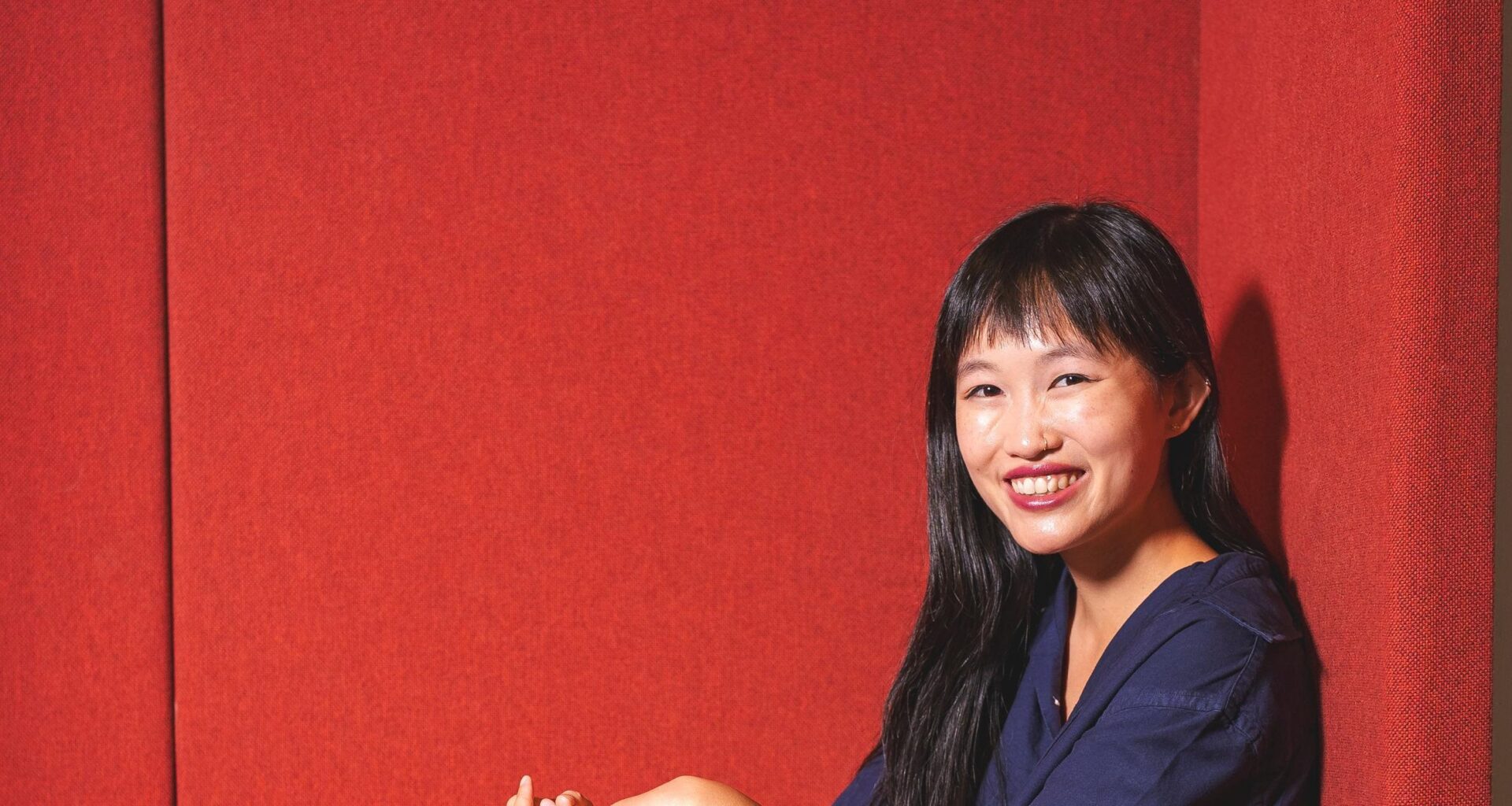
NEW YORK – Bestselling author R.F. Kuang has grown up on the page.
HarperCollins bought her debut novel, “The Poppy War,” on her 20th birthday. Just before her 27th, with four bestsellers under her belt, she published “Yellowface,” a scathing satire of the publishing industry. Her last novel, “Katabasis,” followed two PhD students as Kuang herself pursued a PhD at Yale.
Now 30, it would seem logical that Kuang’s next book would tackle this new decade. But the death of her grandfather and a new chapter as a professor at College of the Holy Cross in Massachusetts prompted Kuang to instead look back.
“Taipei Story” (out now from William Morrow) follows Lily Chen, a Chinese American college student studying at a rigorous summer language intensive in Taipei. She’s already struggling with her grueling coursework, roommate tension, campus gossip and cultural connection when her grandfather dies. It’s deeply personal material to Kuang. It’s also the first time there’s been this large of an age gap between her and her protagonist.
“Going back and writing a coming-of-age is my experiment in having an extremely flawed, blinkered, immature main character who has so many wrong assumptions – assumptions that I once held about language and identity and her relationship with her family,” Kuang tells USA Today.
Mining grief
for ‘Taipei Story’
Kuang was much closer to her grandfather than the strained relationship in the book. But like Lily, she was studying Chinese at the time in an effort to reconnect with her extended family. The outline took shape during a “strange, sad summer in Taipei,” mourning and wandering tourist attractions feeling “so alienated” from everything.
Months later, she made sense of that grief in fiction. What if she had experienced this when she was younger? She asked how would someone who is “more unsure about her relationship with her family, her relationship with Chineseness and where she belongs in the world” cope with the loss?
Lily’s “good student” mentality is her coping mechanism to avoid emotional turmoil at home, whether that be her sister’s mental health crises, her grandfather’s death or social exile on campus.
“You also have to face your demons head-on, and for a while when I was grieving, I was also like, ‘If I can just have enough mental discipline not to think about it and do my life, I’m going to be OK,’ ” Kuang says. “I just felt worse and worse until I also had to face it head-on.”
Ever the language scholar, she also couldn’t stop thinking about how weird people can be when they talk about grief.
“Everybody is reduced to these really perfectly phrased sentiments of care: I’m thinking of you; I’m so sorry for your loss; Please let me know if there’s anything we can do for you in this time. Words that mean nothing,” Kuang says. “When I was grieving, I was like, I wish somebody would say something offensive to me. I wish somebody would crack a joke because then it lets you see the absurdity and ridiculousness of it all.”
That’s why even though “Taipei Story” is Kuang’s most raw writing yet, it’s ultimately a satire. Even when she’s bleeding onto the page, she says she grounds it with “absurdist, silly, humorous undertone,” poking fun at study abroad students and tourists.
Satirizing the study abroad experience
I had a teacher who started the first day of 10th grade telling us the word “sophomore” meant “wise fool.” Lily heads to her language immersion program as a rising sophomore – ignorant, immature and a little arrogant. On one particularly frustrating afternoon, Lily laments to her teacher that she’s just not getting it. She sounds like an idiot. Her teacher responds, “You have always sounded like an idiot. It is considerable progress that you can now hear it.”
Looking back on her own career, Kuang sometimes feels like her weaknesses are forever crystallized in print. After all, she grew up in front of her readers. It’s cathartic to let her protagonist make mistakes, too.
“As I went through that emotional shift (of becoming a professor), I also got a lot more comfortable being wrong on the page. I think in a lot of my earlier work, there is this desperate need to prove I’ve learned about these issues, ‘I figured it out’ and ‘I’m right about this and here’s why,’ ” Kuang says. “But as a reader, I enjoy when there’s complexity and ambiguity on a page when the characters are flat out wrong or they have exaggerated or ridiculous interpretations of the world and the author is not trying to prove ‘Oh, but trust me, I know what’s going on’ but rather allow the characters to exist in their mess and to put their blind spots and their vulnerabilities all out there.”
Baked into poignant emotional observations are cringeworthy comments from the students, their mythologies about Taiwan, arrogance, immaturity and privilege. Lily has her own ignorant views on the China-Taiwan relationship. Kuang is content to let her protagonist be young and naive and says as much in an author’s note, with disclaimers about mistranslations (purposeful) and modern Taiwanese history and identity (reading recommendations for more nuanced learning).
“I do also find that satire is most effective when you’re not preaching from a place of superiority to everybody else and sort of establishing that I know better and the rest of you are idiots. Satire is most effective when it’s turned inward and really scrutinizing communities that you are a part of and behaviors that you’ve taken part in,” Kuang says. “So when I do my satire of Lily’s blinkered interpretations of the world, I’m reaching back to when I was a teenager and learning all of this for the first time.”
One political undertone sparked controversy in the months leading up to the book’s on-sale date. After early copies went out this spring, Kuang faced backlash on social media for including an Israeli character. Featured in two pages, the unnamed character is a “big deal” pianist invited to the National Concert Hall. Lily is moved by his performance. The mention of Israel led to calls for boycotts and Goodreads review bombing, criticizing Kuang for a “sympathetic” portrayal of an Israeli amid the war in Gaza.
Kuang is aware of the controversy, and though she typically doesn’t want to tell readers how to interpret her work, she says “that is just not how the scene functions” in the story.
“The depictions of the book are based on notes that I took when I was there. I was trying to give a realistic depiction of uncomfortable situations. There are many deeply uncomfortable and tough details in the book that Lily doesn’t really know what to do with. I think that’s what good art should do,” Kuang says. “The scene raises a lot of uncomfortable questions about nationalist interpolations and the geopolitics that underwrite even something that seems so simple in concerts and which musicians get invited, how they are received, how different people move through the world. The book is asking or inviting the readers in to notice what is going on for themselves.
“As I’ve gotten older as a writer, I’m also more comfortable moving away from a more didactic, desperate need to prove I know what’s going on … and rather lean into trusting my readers more and inviting them to be like, ‘This is a portrayal of something that I have noticed. What do you think about it?’ The risk of that is somebody runs away with the total opposite conclusion of what you’re putting on the page, but all you can do as an artist is do your best and trust readers to come to a scene with attention and care.”