
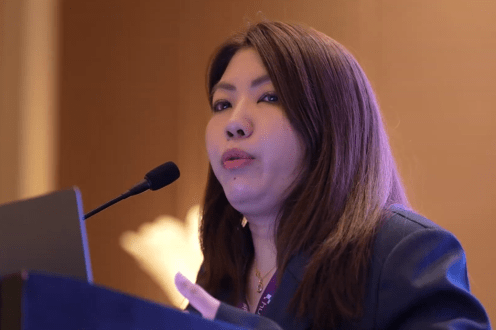
At the Hubbis High Net Worth (HNW) Insurance Summit – Singapore 2026, Edna Wong, Business Development Director at Swiss Life Singapore, explained how variable universal life (VUL) can add insurance and succession planning to an established investment portfolio.
She began with the scale of the coming wealth transfer and the commercial risk it creates. Much of the capital due to move between generations is already held in bankable assets, managed by advisers and custodied on existing platforms. For wealth firms, the harder task is keeping the family relationship and the assets when control passes to the next generation.
Her presentation covered the death-benefit floor, beneficiary nominations and possible tax deferral available through VUL. The results depend on the client’s residence, policy terms, ownership, investment governance and local rules.
Key Takeaways
The Opportunity Exists On The Platform: Much of the wealth expected to transfer across generations is already held in bankable assets – including equities, bonds, funds and cash – allowing succession planning to begin around assets that are already liquid, custodied and professionally managed.
Succession Puts Assets Under Management (AUM) At Risk: Death, incapacity, probate and family disagreement can fragment a portfolio and weaken the adviser’s relationship with the next generation.
VUL Can Work With An Existing Portfolio: Cash or eligible bankable assets may be used within a VUL arrangement, while an established custodian, asset manager or discretionary portfolio mandate may remain involved.
Death Cover Protects Against Bad Timing: A sum-assured floor can provide liquidity if the client dies while portfolio values are depressed.
Regional Tax Rules Are Shifting: Changes to reporting, controlled foreign company rules, remittances and offshore structures are forcing Asian families to review older arrangements.
Tax Treatment Depends On The Case: Residence, beneficial ownership, surrender mechanics, policy substance and local rules determine whether VUL provides tax deferral or another tax advantage.
Nominations May Speed Up Payment: A valid beneficiary nomination may allow policy proceeds to be paid directly, although the probate position depends on governing law, ownership and policy documentation.
Retention Is Possible, Not Guaranteed: VUL may help advisers, managers and custodians remain connected to family wealth after succession. The heirs can still choose to move the assets.
The Opportunity Exists on the Platform
Wong began with the rise of HNW propositions across banks, asset managers, securities firms and insurers. More wealth is being created at the top, and more of it is approaching transfer.
UBS estimated in 2025 that more than USD 83 trillion would transfer globally over the following 20 to 25 years. McKinsey separately projected that USD 5.8 trillion would move between generations in Asia-Pacific from 2023 to 2030, with ultra high net worth (UHNW) families accounting for around 60% of that total. Altrata’s 2026 research has since placed combined global UHNW wealth at USD 63.8 trillion.
Much of this wealth is already held in liquid, custodied investments. Rather than sourcing fresh cash or liquidating other assets; eligible bankable assets such as listed equities, bonds, funds, and cash may potentially be contributed directly as premium into a VUL structure, subject to the insurer’s investment rules. The client can continue participating in their preferred investment strategy through an approved custodian or asset manager, while adding insurance protection around assets that are already invested.
“The opportunity is already sitting on the platform,” Wong said. “Clients do not necessarily need fresh liquidity or a new investment strategy. VUL can potentially be built around eligible bankable assets they already hold, while preserving continuity in how those assets are managed.”
The Relationship Risk At Succession
To make the issue tangible, Wong asked delegates to imagine a long-standing client with USD 20 million under management, a complex cross-border balance sheet and a relationship built over a decade. If that client dies or encounters a sudden succession or tax event, the adviser’s work may no longer determine what happens next.
Assets can be frozen during administration, divided between heirs or moved to another institution. Family members may appoint different advisers, while lawyers, trustees and executors become central to the process. The vulnerability lies at the point of transfer, when a well-managed portfolio can lose both its cohesion and the relationship supporting it.
Wong cited one study in which 94% of advisory firms lacked essential succession-planning elements, and another that found 67% of wealth firms had no formal retention strategy. A separate comparison put retained client revenue at 63% without a succession plan and 92% with one.
“In wealth management, a succession is an AUM event as well as a family event,” Wong said. “The relationship has to remain relevant after the assets move.”
A VUL policy can carry death cover and a beneficiary nomination alongside the investments. With a valid nomination, proceeds may be paid directly to beneficiaries instead of waiting for the wider estate. The treatment depends on the policy, ownership structure and governing law; without an effective nomination, probate or letters of administration may still be required.
Regulation Raises The Cost Of Waiting
Tax and reporting rules are tightening across global wealth planning. CRS 2.0 is expanding transparency and reporting, China has introduced clearer rules around offshore trusts, and markets such as Indonesia, Thailand, Taiwan and Malaysia are increasing scrutiny of offshore income, CFC structures and capital gains. A common theme is emerging: older cross-border structures can no longer be assumed to remain efficient simply because they worked in the past.
The rules differ by market. Indonesian residents are generally taxed on worldwide income and can fall within controlled foreign company (CFC) rules where ownership thresholds are met. Taiwan’s CFC regime has applied since 2023, with later guidance extending reporting implications for certain offshore trusts. Thailand now taxes relevant foreign income earned from 1 January 2024 when it is remitted. Malaysia’s capital-gains rules for specified unlisted shares principally apply to companies and other defined entities; they do not automatically cover every individual investor.
There is no single regional tax treatment for policy gains or death benefits. VUL may provide benefits for an appropriate client, but residence, beneficial ownership, premium source, investor control, surrender mechanics and anti-avoidance provisions remain decisive.
Wong illustrated the point with an Indonesian portfolio. A USD 10 million portfolio rises to USD 11 million and the client realises USD 500,000 of the gain. The gain would generally attract personal income tax at rates of up to 35%, depending on the client’s individual circumstances. Within a suitable VUL structure, the gains may continue accumulating on a tax-deferred basis until surrender, with withdrawals planned around the client’s circumstances and the applicable progressive rates.
“Waiting can be expensive,” she said. “Yesterday’s structure can become tomorrow’s reporting or tax problem.” The calculation was illustrative, not a complete tax assessment.
Building VUL Around The Existing Portfolio
Wong contrasted VUL with traditional universal life (UL) and indexed universal life (IUL). In those arrangements, the client pays cash, the insurer manages the assets and policy returns are linked to crediting rates, bonuses or other terms set by the insurer.
Swiss Life’s VUL is an investment-linked policy built around a portfolio. Premium may be contributed in cash or eligible bankable assets, and the internal insurance fund or portfolio may operate on a self-managed basis or through a discretionary portfolio mandate (DPM). An existing manager and custodian may remain involved, subject to Swiss Life’s agreement, the policy terms and its investment rules.
The policyholder does not have unrestricted control or direct ownership of the underlying assets. The policyholder holds the contract and bears the investment risk, while the insurer and policy documentation govern eligible investments, managers, custodians, withdrawals and in-specie payments.
The policy can cover one or two lives, with sum assured of up to USD 100 million and eight major policy currencies. Other features include partial surrender, additional contributions, assignment and beneficiary nomination, subject to underwriting, contract terms and local rules.
Protection When Markets Move Against The Family
A conventional portfolio is designed primarily for accumulation. VUL adds an insured amount that can protect the family if death occurs before the assets have had time to recover or the investment plan has reached its intended horizon.
The presentation illustrated the effect using a 50-year-old non-smoker, a USD 5 million premium, USD 23.3 million of sum assured and an assumed 5% return. It compared an unwrapped portfolio with the VUL structure in flat, rising and falling markets. The numbers were illustrative and did not constitute a forecast, but they showed how the death-benefit floor could contribute more to the estate when the underlying portfolio was weak.
The death benefit does not improve investment performance. Policy charges, insurance costs, surrender terms and actual market returns still matter. Its value is the extra liquidity available at death, whenever that occurs in the market cycle.
Wong captured that timing risk in one line: “Markets can fall, but death does not wait for them to recover.”
What VUL Means For The Platform
For wealth managers, the commercial appeal lies in what can stay in place. The securities platform may continue to hold eligible investments, the asset manager may continue to run the DPM, and the adviser may remain responsible for the wider relationship.
The arrangement can preserve investment-fee income, add an insurance revenue line and give the next generation a reason to retain the same advisers. It cannot guarantee AUM retention. Heirs may change managers, and policy mechanics or estate circumstances may require a different outcome. Even so, it can remove some of the breaks that often cause a portfolio to fragment.
Swiss Life’s Asian Footprint
Swiss Life was founded in 1857 and, at the end of 2025, reported CHF 146 billion of third-party assets under management and CHF 1.26 billion of net profit. Swiss Life Ltd carries an A+ financial-strength rating with a stable outlook from S&P Global Ratings.
Swiss Life Singapore has operated since 2008 as a life insurer licensed and regulated by the Monetary Authority of Singapore (MAS). The presentation reported a capital adequacy ratio above 1,000% for the Singapore business and positioned its insurance offering specifically around HNW and accredited investors.
Its regional focus covers Singapore, Malaysia, Indonesia, Hong Kong, Taiwan and Thailand, alongside pre-immigration cases involving Australia. Families often have ties across several of these markets, so one policy may encounter different tax, nomination, reporting and estate rules as people move and beneficiaries disperse.
Scale does not settle whether VUL is appropriate. Advisers still need to test the client’s protection and succession needs, the limits on investment control, and the policy costs and surrender terms.
Wong’s message was simple: use VUL where it solves a defined client problem. If the structure works for the family, continuity for the adviser and platform may follow.