
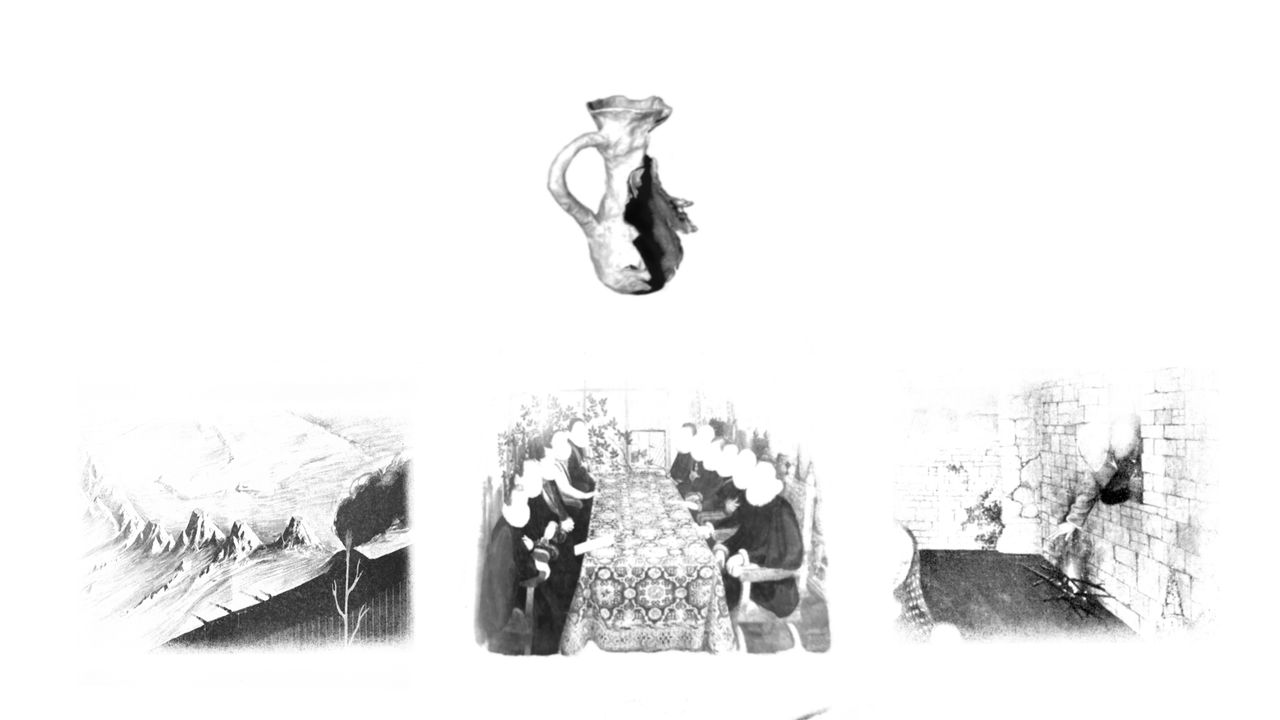
Perhaps it’s just a strange coincidence that the leader of the Drin bears a name that reads like a stage-alias mash-up of two of the most iconic artists of the 1960s. But while Dylan McCartney’s band deploys a brand of sinister, post-industrial psych-rock that doesn’t feel reverentially retro, his artistic ethos could best be described as a case of Dylan vs. McCartney: He’s both the ragged raconteur gazing wearily out at our cruel world, and the ambitious, console-savvy alchemist seeking to transcend it.
Since launching the Drin with a home-recorded cassette in the pandemic-clouded summer of 2020, McCartney has effectively built the project into a Buckeye State version of the Brian Jonestown Massacre. His prolific rate of output mirrors Anton Newcombe’s mid-’90s hot streak and occupies a similarly fluid position on the spectrum between jangle and drone, replacing BJM’s California-cult aura with a hardened Rust Belt resilience. McCartney has since surrounded himself with a proper six-piece band, simultaneously sustaining membership in fellow Cincinnati-scene pillars the Serfs and Crime of Passing. But all the while, the Drin have stayed true to his original mandate, tapping a deep well of record-collector touchstones (from classic and kosmiche rock to post-punk and dub to goth and neofolk) and reanimating them with a contemporary sense of unease—nostalgia as a gateway to dystopia.
No score yet, be the first to add.
For an industrious artist like McCartney, a double album is less a dramatic level-up than an inevitability. Clocking in at 23 songs and 75 minutes, I Lost My Way for Centuries is certainly the Drin’s most sprawling statement to date, but it’s also the most accessible on-ramp into McCartney’s psyche. And for such a wide-ranging record, there’s remarkably little fat. They don’t pad the tracklist with extended noise experiments or free-form jams; rather, each track functions as a challenge to work within compact pop-song parameters while still retaining the band’s improvisatory, wandering spirit. McCartney’s densely layered approach remains, but instead of plunging his melodies into a murky pool of doomy basslines, lo-tech electronics, and dubbed-out tape manipulations, he weaves thick tapestries from mostly organic instrumentation: guitars, drums, brass, shakers, and the occasional bouzouki.
No matter what form the Drin take—renaissance-faire folkies (“…And They All Strummed”), garage-quaking neanderthals (“Cannery Action”), harmonica-honking Harvest agrarians (“Moths to the Light”), motorik-powered space-rockers (“The Cell”)—McCartney’s voice serves as the band’s anchor, with a Sonic Boom-schooled sing-speak that oozes attitude and ennui in equal measure. But if McCartney is the omnipresent main character, saxophonist Eric Dietrich is the Drin’s resident scene stealer. In psych-punk contexts, the sax is often deployed as an agent of chaos, but Dietrich wields his more subtly and seductively, gradually changing the vibe of a song even when every other element stays the same. “The Sky Has Lost the Smile” may begin as an exercise in rock-history revisionism—what if CCR wrote “I Wanna Be Your Dog”?—but Dietrich’s heady horn lines launch it out of the swamp and toward the skies. And within the otherwise menacing fuzzed-out grind of “Prophets of Doom,” he slips in snake-charmer melodies that expedite McCartney’s Elias Rønnenfelt-like transformation from goth misanthrope to swaggering rock star. When McCartney shouts, “It’s not a mistake/I was born too late/It’s just my fate,” he conjures visions of Richard Ashcroft in his untamed, barefoot, storm-chasing days.