
A powerful union that already represents thousands of New York health care workers is seeking to add nearly 190,000 members in one of the biggest labor drives in decades in the United States.
But unlike efforts to enlist workers in hospitals or other institutions, the campaign by Local 1199 of the Service Employees International Union involves caregivers who often work alone in homes. They tend to aging parents, disabled adult children, or neighbors and friends with significant medical needs.
Labor leaders said that nearly 70,000 caregivers had signed union cards, a pivotal step in triggering a vote on whether to unionize. On Tuesday, Local 1199 petitioned the National Labor Relations Board to hold an election for workers to decide whether to join the union.
The caregivers in New York City — known as personal assistants — earn at least $20.65 an hour, with base pay elsewhere in the state ranging from $18.65 to $20.05. New York’s Medicaid program covers their wages with a combination of state and federal dollars.
“They are struggling to put food on their own tables,” Yvonne Armstrong, the president of Local 1199, said. “They are watching the cost of groceries, rent, gas and health care climb while their pay falls behind.”
The company that manages the caregiving program for the state, Public Partnerships, said in a statement that it “respects the right of every personal assistant to decide for themselves whether union representation is right for them.”
Local 1199 represents nearly 450,000 workers and is a powerful force in New York politics. If the majority of the 190,000 caregivers vote to join Local 1199, the union’s ranks could swell by about 40 percent.
“It’s historic because of the sheer volume of workers, caregivers, eligible to vote in this union election,” said Lystra Sawney, the union official who has been working to organize caregivers since 2019. “It hasn’t happened in American history, not since General Motors,” she added, referring to a vote in 1940 in which 130,000 workers decided whether to unionize.
It is also historic because it underscores a profound shift in how health care is provided in the United States. Increasingly, patients who are aging or beset with chronic medical conditions receive care in their homes, rather than in hospitals or long-term care centers.
In seeking to unionize the caregivers, labor leaders talk of building solidarity and a collective voice across thousands of homes.
“It would be a massive increase in their membership, their revenue and their clout,” said Bill Hammond, a health policy analyst at the Manhattan Institute, a conservative think tank.
The unionization vote would cover all caregivers enrolled in New York’s Consumer Directed Personal Assistance Program, which in 30 years has been transformed from a small program into a major — and expensive — part of the state’s safety net. It enables vulnerable New Yorkers to hire a friend or relative to provide help — putting toothpaste on a toothbrush, lifting them off the toilet, cooking meals and cleaning up — instead of having a home attendant supplied by a staffing agency.
The program has proved popular. A decade ago, it served about 12,000 people statewide. Today, it covers more than 200,000 New Yorkers at a yearly cost of about $11 billion. The program’s growth has sparked debate about whether it reflects waste or fraud, or indicates success and a model for how to promote independent living.
Gov. Kathy Hochul, in an interview with Bloomberg News in 2024, said that the program “has become one of the most abused programs in the entire history of the state of New York.” She called it “a racket,” noting that recruitment advertisements pitched the program as easy money in return for “sitting home with your grandma.” Prosecutors and investigators have found instances of no-show jobs, sometimes continuing for years.
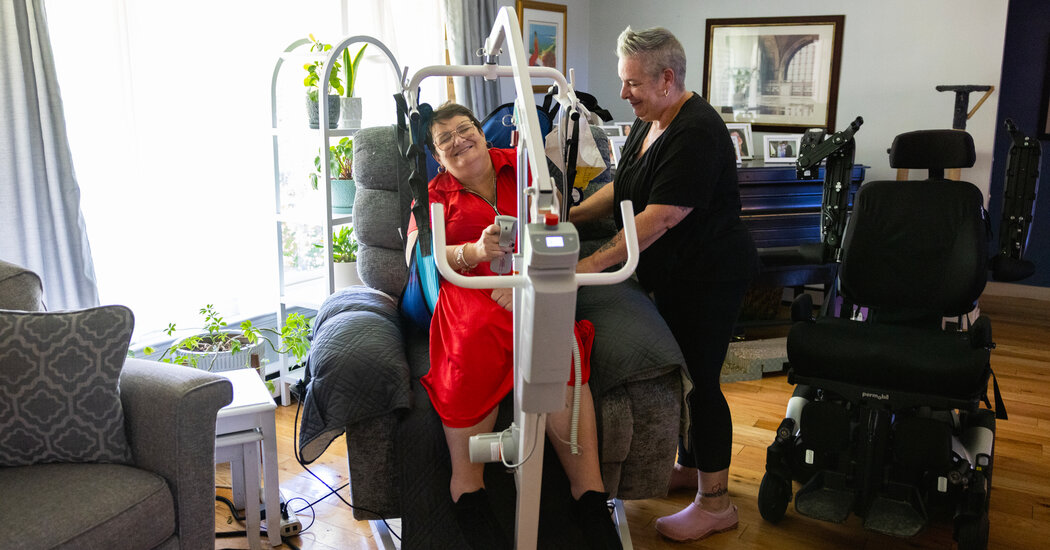
But for Andrea Rodriguez, who has been largely immobilized because of multiple sclerosis, the program has made life more manageable and less lonely. Before caregivers began coming to her Buffalo home, Ms. Rodriguez had to wait for help till the end of the day when her husband or a friend returned from work.
“You’re in a recliner all day long, in a diaper, watching TV, until someone comes home to assist you and freshen you up and sit you back in your chair,” said Ms. Rodriguez, 56, who can’t walk on her own and has lost use of her lower left arm. She now has several caregivers, including one of her closest friends dating to kindergarten, Ingeri Eaton.
Before becoming a caregiver, Ms. Eaton, also 56, had worked as a union steelworker and owned a chocolate shop. She had watched her friend go from using a cane to a walker, and then a wheelchair. In 2021, Ms. Rodriguez recruited her as one of her caregivers.
Now, Ms. Eaton works 52 hours a week helping Ms. Rodriguez with the tasks of daily living, starting with getting her out of bed.
“We need to roll her body, watch out for the catheter, move it out of the way, tuck the sling underneath her body, roll her back over it, and pull the sling even on all four sides,” Ms. Eaton said, describing the start of her shift. The sling attaches to a lift that Ms. Eaton operates to help Ms. Rodriguez transfer from her wheelchair in the bathroom.
Ms. Eaton handles her friend’s medication, helps her shower, cooks breakfast and assists with hand and arm stretches.
“Seeing what she goes through and knowing the help that she needs has really just changed me into so much more of a grateful person,” Ms. Eaton said.
She supports the effort to unionize but said some other caregivers seemed wary. “Most of them did not really understand what a union meant,” Ms. Eaton said.
Ms. Eaton said she hoped a union would make the job less isolating and provide an opportunity to gather with other caregivers and learn from them.
The state chose Public Partnerships — a single company—- to administer the vast caregiving program in hopes that doing so would cut costs and reduce fraud. In the past, about 700 firms operated as intermediaries, enrolling caregivers and handling payments.
The transition to a single company was a boon for the unionization effort. It meant one very large campaign, rather than myriad small drives.
The state Health Department has declared the transition a success, saying it has saved more than $1 billion so far and cut out “wasteful administrative middlemen.” But the U.S. Justice Department has sued New York over the transition, asserting that the contract was awarded through a “sham” selection process and that Public Partnerships had misled the state about its ability to cut costs and its monthly fees — allegations that the company has denied.
If the caregivers unionize, the work force would negotiate directly with Public Partnerships, according to state officials. But higher wages for caregivers might require the state to spend more through Medicaid.
The State Department of Health said it had no position on the push for unionization but “respects workers’ rights to make their own decisions regarding representation.”