
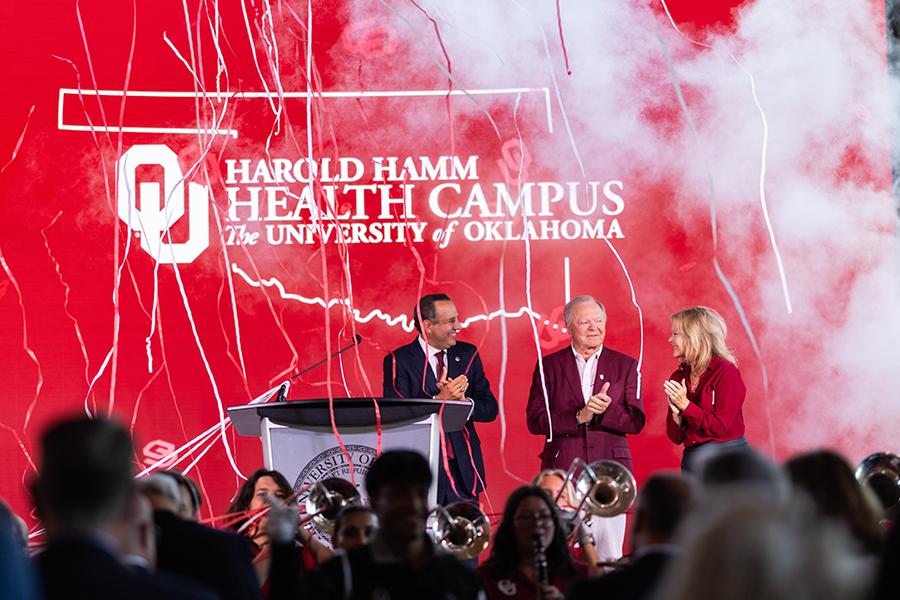
A Vision for Changing Lives
It is that convergence – profound need coupled with growing capacity to address it – that Hamm sees as an opportunity to change the game.
Throughout his career, Hamm has taken on consequential challenges where he believed bold action could make a meaningful difference in people’s lives. From his pioneering work in American energy to his advocacy for affordable insulin, his approach has remained consistent: recognize an opportunity others may not yet see, bring together the people and resources necessary to pursue it, and act.
His nearly two-decade commitment to fighting diabetes offers one of the clearest examples.
After being diagnosed with Type 2 diabetes in his 50s, Hamm turned his attention to a disease that affects hundreds of thousands of Oklahomans. In 2007, his lead gift helped establish the OU Health Harold Hamm Diabetes Center around an ambitious goal: improve the lives of people with diabetes while pursuing the discoveries that could ultimately lead to a cure.
Since then, Hamm has invested more than $50 million in that effort, helping OU recruit leading scientists and build the technology and infrastructure needed to pursue breakthrough research. NIH research dollars at OU associated with the diabetes center has grown from $5 million to $33 million since its founding, significantly expanding its research capacity.
Hamm also established the Harold Hamm International Prize for Biomedical Research in Diabetes, the world’s largest international prize of its kind and widely regarded as the “Nobel Prize” of diabetes research.
Beyond the laboratory, Hamm took his fight against diabetes to Washington, advocating for more affordable and accessible insulin and providing leadership and vision in support of the Affordable Insulin Now Act, which sought to cap patients’ out-of-pocket insulin costs at $35 per month.
His involvement has extended to recruiting the scientists who will lead the next phase of research and healing.
This month, world-renowned translational scientist John P. Kirwan, Ph.D., joined OU as executive director of the Harold Hamm Diabetes Center, vice provost for diabetes programs and Chickasaw Nation Endowed Chair in Diabetes Research. Kirwan’s recruitment through Project 200 reflects the scale of OU’s ambitions: bringing leading researchers to Oklahoma who can build teams, attract additional research investment and move discoveries toward new treatments and cures.
“The Harold Hamm Diabetes Center was built on the belief that bringing together the best minds and giving them the resources to pursue bold ideas can change lives and ultimately cure diabetes,” Hamm said earlier this year in announcing Kirwan’s recruitment. “We’ve come a long way in our fight against diabetes, but I believe our most important discoveries are still ahead of us.”
Of Hamm’s new $50 million investment in the center, $30 million will support Dr. Kirwan and his priorities in advancing the HHDC, while $20 million will support capital improvements and research infrastructure. Together, those investments are intended to accelerate research aimed at preventing and treating diabetes, reducing its devastating complications and ultimately finding a cure.
“The greatest things this country has ever accomplished started with people willing to believe something better was possible — and then willing to do the work to make it happen. I’ve spent my life believing that when you see an opportunity to change the future, you don’t stand on the sidelines — you act. Oklahoma has given me more than I could ever repay, and I can think of no greater investment than in the health and lives of its people,” Hamm said. “We have an extraordinary opportunity right now to bring the very best minds in medicine and science to Oklahoma, give them the resources to pursue discoveries that once seemed impossible, and build something here that can change lives far beyond our state. My hope is that this gift will help make Oklahoma a place where the next great medical breakthrough happens — where diseases are prevented, lives are saved and, one day, diseases like diabetes are cured. That is a legacy worth building.”