
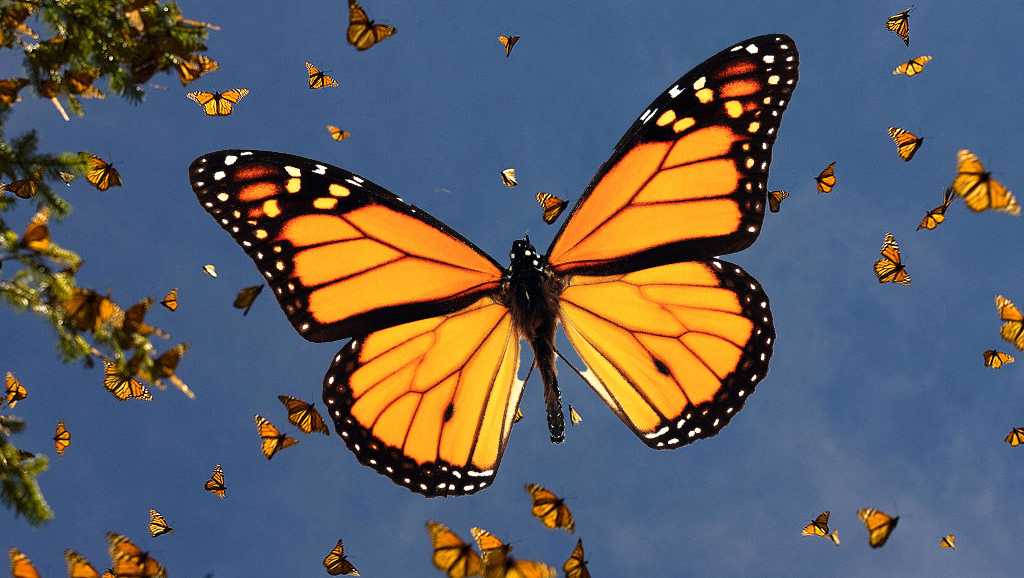
Monarch butterflies are heading south: What to know and when they’ll pass over you


The monarch butterfly migration is one of the world’s most remarkable natural phenomena.
Each fall, millions of monarchs travel thousands of miles to escape freezing temperatures in the northern United States and Canada.
Most eastern monarchs overwinter in the high-elevation forests of central Mexico, while western monarchs typically gather along the California coast.
Monarchs are the only butterflies known to migrate in both directions, as birds do. Their round trip spans several generations: no single butterfly makes the entire journey.
In spring, monarchs travel north, laying eggs along the way. The eggs hatch into caterpillars, which become the next generation of butterflies. Each generation continues farther north through the summer.
Here’s when monarchs travel south, where they go, and when you might see them in your backyard.
When do they travel south?
Using environmental cues, the monarchs know when it’s time to travel south for the winter. For many monarch butterflies, the time is now.
Use the map to see when peak migration is where you live. The estimates were calculated by Monarch Watch using submitted data.
Monarchs use a combination of air currents and thermals to travel long distances. Some fly as far as 3,000 miles to reach their winter home.
Where do they go?
Monarchs in Eastern North America have a second home in the Sierra Madre Mountains of Mexico.
Monarchs in Western North America overwinter in California.
When do they come back?
As temperatures rise and days lengthen, monarchs begin moving north, stopping to feed and lay eggs on milkweed.
Because breeding-season monarchs live only a few weeks, several generations complete the journey north. The late-summer generation lives much longer and returns south for the winter.
How do they navigate?
Researchers are still investigating how monarchs find their overwintering sites.
The U.S. Department of Agriculture says they may rely on several cues, including Earth’s magnetic field and the sun’s position, rather than any single one.
Clustering in colonies
Monarchs cluster together to stay warm. Tens of thousands of monarchs can cluster on a single tree. Although monarchs alone weigh less than a gram, tens of thousands of them weigh a lot. Oyamel trees are generally able to support the clustering butterflies, but sometimes branches break.
It’s all about the milkweed
Milkweed is essential to monarchs: females lay their eggs on it, and it’s the only plant monarch caterpillars can eat. Monarchs also depend on nectar-producing flowers for food.
Habitat loss, pesticide use, extreme weather and climate change have contributed to declining monarch populations. Because migration isn’t learned from older butterflies, how monarchs navigate remains especially intriguing to researchers. Conservation groups, scientists and communities are working to protect breeding, feeding and overwintering sites along the butterflies’ route.
Conservation efforts
Monarch butterflies are not federally protected since they are not listed as endangered under the U.S. Endangered Species Act, but their population has declined over several decades.
Organizations that support the conservation of monarch butterflies recommend that people who want to help the migrating insects:
Plant milkweed plants to house monarch caterpillars.Plant native nectar flowers.Reduce the use of pesticides.