

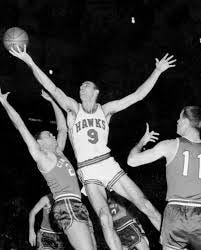
 Bob Pettit
A few hours after Bob Pettit died on Friday, Stephen Curry agreed to a 2-year extension with Golden State. It will pay Curry $116 million over two years. The NBA is celebrating Curry’s altruism because, after all, he could have signed for $137 million but declined, in order to give the Warriors more roster flexibility. Oh, and there’s this: The second year is a player option. Wonder how long he’ll take to check that $60.2 million box?
Pettit, 93, lived to see the great players become their own fiefdoms. When he finished his All-America career at LSU in 1954, he was drafted second overall by the Milwaukee Hawks. The owner, Ben Kerner, snorted at Pettit’s $11,000 rookie contract demand and gave him $9,000 instead. Kerner, like most NBA owners, liked to pinch pennies but tasered them and waterboarded them first.
But Kerner still had to persuade Pettit to play. Pettit had a good solid offer from a Baton Rouge bank. Why take rickety planes across the country to play for middle-class wages when he could raise a family and go home at 5? Pettit eventually decided he hadn’t played enough basketball yet, and he was right. He was the leading scorer in NBA history when he retired, and in 1958 the Hawks, then in St. Louis, rode Pettit’s relentless nature to a Finals victory over the Boston Celtics. They were the only team to deny Boston a championship between 1957 and 1967.
NBA fans, writers and some players and coaches are bound by recency bias in a way no one else is. Most baseball fans learn about Babe Ruth before they read the Brothers Grimm, and no golf fans try to minimize what Ben Hogan did. Basketball folks think the game began with Inside The NBA, or maybe the day when Larry Bird and Magic Johnson made basketball safe for the networks. A whole hunk of black-and-white history, with the shot clock sitting incongruously in a corner, is treated like a fairy tale.
Lakers coach JJ Redick, who should know better, mocked the credibility of Pettit’s generation. He said the stars of yesteryear played against plumbers and firemen. But how many times have you read somebody’s pointless “list” of the Five Or Ten Or Twenty Greatest Lakers that didn’t mention George Mikan? Players should only be judged by how they handled the competition in front of them. Nobody knew Oscar Robertson averaged a triple-double for a season merely because no announcer had coined the phrase.
For the record, Pettit was not underrated. He, Mikan, Bill Russell and Bob Cousy are the only players included on the 25th, 35th, 50th and 75th anniversary All-NBA teams. But he is forgotten. How many players, really, had 11 years to compare with Pettit, who was a 2-time MVP, a two-time MVP runnerup, and a two-time scoring champion who didn’t win that title when he had a career-high 31.1 point average in 1962?
How many averaged a double-double in every one of his seasons and wound up with 26.4 points and 16.2 rebounds a game for his career? Pettit was Rookie of the Year when he showed up and first team All-NBA in each of his first 10 seasons. And in seven of those years he went to the free-throw line at least 10 times a game.
The only player to make 11 consecutive first teams is LeBron James. The only other player to average 26-16 is Wilt Chamberlain. Judging by all that, you might have to take a sandblaster to your personal, irrelevant Rushmore, and you might have to add a feeding trough to your personal, irrelevant GOAT pen.
Had Pettit been playing during free agency, he might not have retired at 32, and might have put this alltime-best cacophony to rest. But his knees were hurting, and he had a chance for a cushier position at that local bank. As he said, he knew he would have to work anyway. Two years before he left, Pettit told Kerner to “get ready.” He said every year he played basketball was “wasting time that I could have spent learning the banking business.” Besides, he didn’t grow up with swooshes in his eyes. He was the only child of a businessman, and at the dinner table they discussed “interest rates, real estate, points, that kind of thing.”
So Pettit wound up with his own, very large bank, and he stayed in Louisiana until he died. LSU put up a statue for him and named a street for him. There’s no evidence he spent any spare time following Shams Charania’s injury reports or monitoring Draymond Green’s tweets.
Pettit had been a center at LSU under the coaching of Harry Rabenhorst. When he got to the Hawks, coach Red Holzman took one look at him and said, “You’re moving outside.” The 6-foot-9 Pettit perfected a fake-and-go move that was universally known and rarely stopped. There weren’t “power forwards” then.
The Celtics weren’t at their best when they got to the ‘58 Finals. Bill Russell was playing on a faulty ankle. Still, the series was 2-2, and then Pettit scored 33 in Game 5 for a 2–point win, and 50 in Game 6 for a 1-point win and the championship. He shot 19 for 34 in that clincher, with 19 boards and one foul. He also scored 19 of the Hawks’ final 21 points.
Tom Heinsohn was the unfortunate Celtic who had to guard Pettit. Later, Heinsohn mentioned the Celtics’ nine-championship streak. “It would have been ten,” coach Red Auerbach snorted, “if you’d held Pettit to 48.”
Around the league Pettit was known as Big Blue, because of a high-mileage, full-length blue coat that he wore everywhere. In St. Louis he was nearly the heroic equivalent of Stan Musial. Then the football Cardinals moved in, and then the Blues’ hockey club, and the fans quit coming. A group in Atlanta took the Hawks off Kerner’s hands and out of St. Louis, ,yet the club is still an afterthought, with no trips to the NBA Finals that did not involve Pettit. Although Pettit put no human highlights on film, he remains the best player in franchise history.
And to think that Pettit couldn’t even make his teams, in any sport, when he started high school. He was 5-foot-11 as a freshman, and until the end he remembers being left behind because the high school bus broke down and the replacement bus didn’t have enough room. He worked on his game at the backyard hoop, rearranging the lamps so they could illuminate the court at night, and one day he woke up and was 6-foot-4. He discovered Alvin Roy, a Baton Rouge weightlifting guru who eventually became the NFL’s first strength coach. It came together, and the recruiting process consisted of LSU coach Harry Rabenhorst saying, “Bob, we’ve got a scholarship available and you can have it if you want it.”
Auerbach and Russell were properly respectful of the way Pettit worked, and the unassuming personality that never let Pettit cut a corner. When Pettit was introduced to Russell’s grandfather he called him “Mr. Russell.” That, Russell said, was the first time a white man had ever done that. As for Pettit, he said his two favorite experiences were beating the Celtics in 1958 and then accompanying a Celtic-heavy NBA All-Star team on a trip behind the Iron Curtain, where he deepened his friendships, and his sense of geopolitics.
Someday Bird and Magic and the rest will fade into the shadows of Victor Wembanyama and the ones who follow. It’s important to realize that there are always precedents, that Magic’s 1980 cameo at center that beat Philadelphia was not the greatest Finals-clinching performance ever, not for those on hand in 19. And it’s a shame that Pettit has to die before somebody actually fishes out the footage and the numbers. But to hear the stories is to realize that Pettit and Curry were really the same dedicated guy, with championship ambitions, and the lust to spend hours upon hours redeeming those dreams. And, of course, they had their own bank shots.