
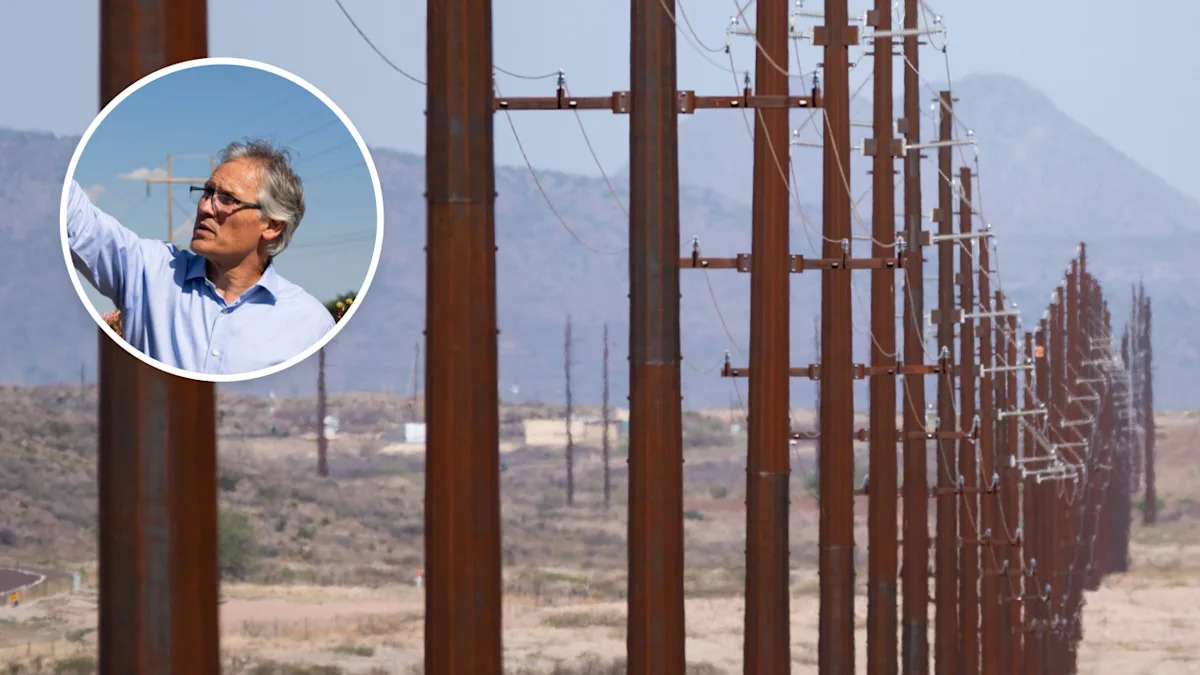
 Bill Clark/Getty Images/Phoebe Terry/WSJ
For most people, a utility pole is invisible infrastructure — something you drive past without a second thought. For Salem Abraham, it has become a fixation bordering on crusade.
In February 2024, high winds caused a deteriorating pole to snap, about 60 miles from his ranch near Canadian, Texas. That sparked what grew into the largest wildfire in Texas history: the Smokehouse Creek Fire burned more than one million acres, according to the Federation of American Scientists.
Must Read
Two people died, ome 15,000 head of cattle perished and Abraham lost approximately 3 to 4 million trees on his ranch, the Wall Street Journal reports.
“I can’t get my trees back,” he told the Journal. “We’ve got a bigger problem, which is this is everywhere. The world needs to know this is dangerous, and it’s going to get worse.”
The data obsession, theory and lawsuits
Abraham, a “self-described data junkie,” responded the way he knows best: by studying the problem systematically. He proactively went looking for patterns, traversing the region for two years, photographing the metal inspection tags on utility poles along back alleys and highways to assess their condition.
He also pursued Xcel Energy in court, seeking inspection records for poles across more than 200,000 miles of distribution lines in eight states the Minnesota-based utility serves.
“I’m just trying to figure out a puzzle here,” he told the Journal. “And when there’s data involved, I’m pretty good at figuring out the puzzle.”
His central argument: Xcel had fallen behind in pole inspections before the Smokehouse Creek Fire and was negligent in maintaining its infrastructure. Xcel has conceded its equipment was likely involved in the ignition but contests the negligence claim, the Journal notes.
Xcel shared this statement with Moneywise: “We disagree with several of the assertions Salem Abraham made to the Wall Street Journal. What was not specifically mentioned is that Abraham has filed several lawsuits against the company, seeking damages in the billions of dollars and well in excess of established values for claims of this nature. We are unable to discuss pending litigation.”
Story Continues
Abraham isn’t the only person allegedly taking legal action. In December, Texas Attorney General Ken Paxton sued Xcel, pointing to pre-fire inspections that showed deteriorating poles — some dating to 1936.
Under a temporary injunction, Xcel agreed to inspect 35,000 Texas poles annually and replace the most damaged ones as soon as a day post-inspection, the Journal reports. The company has estimated its Texas fire-related losses at $460 million or more and paid nearly $400 million in settlements through June.
A national problem in plain sight
Abraham’s fight is a local version of a problem that extends across the country. According to a 2025 U.S. Department of Energy assessment cited by Idaho National Laboratory, approximately 70% of U.S. transmission lines are 25 years old or older.
According to the U.S. Department of Energy’s Loan Programs Office, over 70% of the country’s transmission lines and power transformers are more than 25 years old. That’s infrastructure built largely in the postwar era that, according to the Journal, is “ill-equipped to meet the soaring power demands of the AI era.”
A report from Stanford University’s Climate and Energy Policy Program found that many U.S. utilities are not adequately prepared for wildfire risk, warning that the cost of inaction is growing — and that wildfires can bankrupt utilities and ultimately increase rates for consumers.
Xcel’s executive vice president and chief delivery officer acknowledged the challenge: “It’s not a matter if we’re behind. It’s a matter of learning from a rapidly evolving risk that is new to the world and to our industry,” Michael Lamb told the Journal.
In response to that learning, Xcel has formed a 60-person mitigation team, deployed hundreds of cameras and weather stations and relocated more power lines underground over the past two years.
Government responses and what’s next
States are responding in varying ways. Michigan has directed utilities to develop plans for targeted power shutoffs during high-risk periods. Missouri is requiring wildfire mitigation plans. Kansas has capped punitive wildfire damages against electric utilities at $5 million per claim. Utah now caps some claim values and lets utilities create wildfire funds to manage liability risk.
California’s attempt to limit utility liability — the most aggressive effort — stalled in the legislature, with shares of PG&E and Southern California Edison’s parent company both dropping roughly 20% after the bill failed.
Abraham wants things to go further in Texas, including seeing Xcel removed from the region entirely, replaced by a local rural electric co-op or smaller utility. He has organized a coalition of 10 towns to push for safety improvements.
The mayor of Pampa, Texas, one of the coalition towns, told the Journal the pressure is working — replacement poles are showing up across the region. “I’m glad they’re doing it,” Mayor Mike Borger said, “but that also says, ‘Oh, wow. These guys are on to us. We better make a showing here.'”
Lamb’s warning to prepare applies well beyond Texas. “Get your house in order because it’s coming to you soon,” he directed to all North American utilities.
What To Read Next
Get Warren Buffett’s best investing lessons, free. Join 250,000 readers getting Moneywise’s sharpest money reporting every week. Subscribe and we’ll send you our guide to the ideas that built Buffett’s fortune as a welcome gift.
This article originally appeared on Moneywise.com under the title: ‘I can’t get my trees back’: Texas trader lost millions of trees on his ranch to wildfires — blames power line poles
This article provides information only and should not be construed as advice. It is provided without warranty of any kind.