
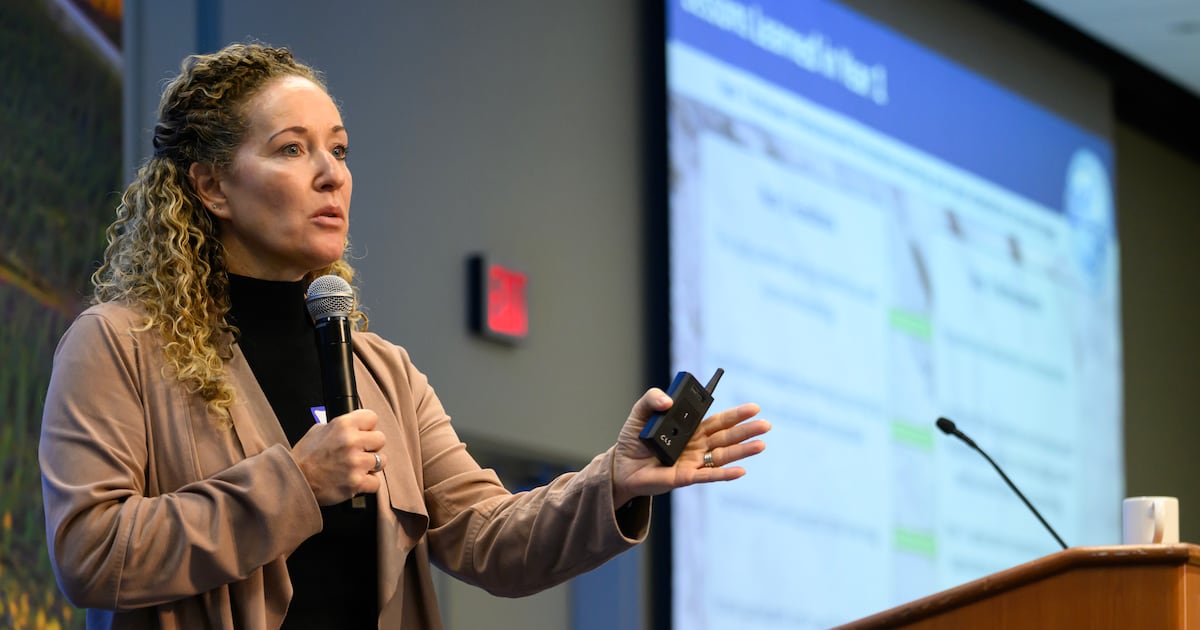
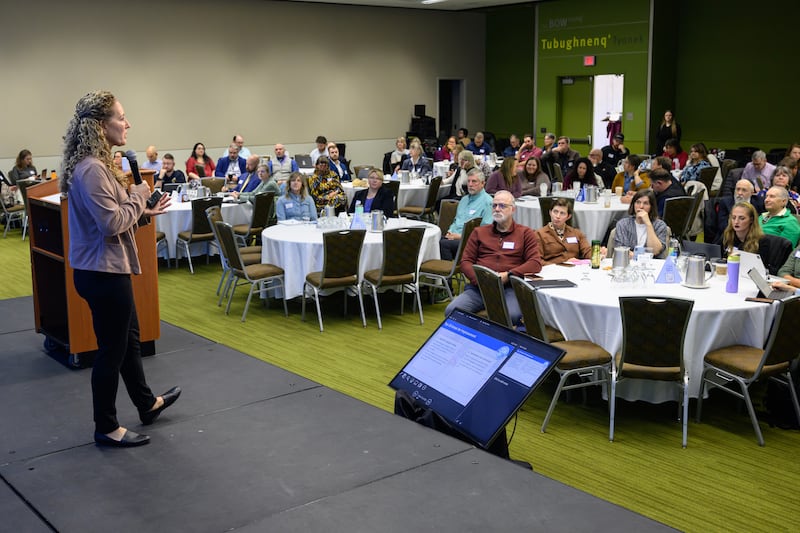
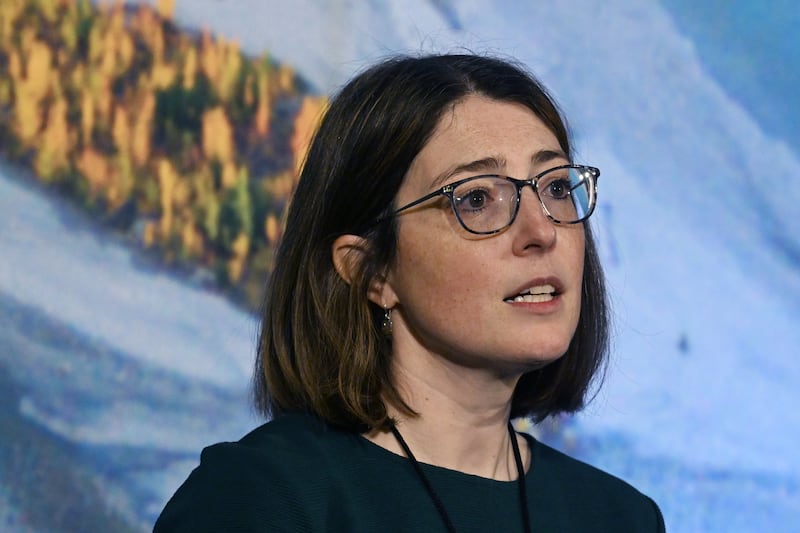
 Heidi Hedberg, commissioner of the Alaska Department of Health, speaks to attendees at an Alaska Rural Health Transformation Program Convening at the Dena’ina Convention Center in Anchorage on Wednesday, Sept. 23. (Marc Lester / ADN)
This story was produced through the USC Center for Health Journalism’s 2026 National Fellowship.
The Alaska Department of Health is preparing to accept applications for the second year of a federal program intended to transform rural healthcare, even as the state has yet to finish distributing the first round of funding it received.
The Rural Health Transformation Program, created last year through federal legislation, is intended to distribute $50 billion over five years across the U.S. Alaska’s $272 million award in the first year of the program was the largest per-capita amount given to any state.
The Alaska Department of Health received nearly 1,800 funding proposals in response to a callout earlier this year. Officials initially said they would distribute funding to applicants by mid-July. But the department has instead been announcing awards in weekly installments, leaving hospitals, clinics and providers waiting months to find out whether they will receive a share of the funding.
Health Commissioner Heidi Hedberg said this week that the first year of the program was “intended to be a stabilizer.”
“What we saw was a lot of need for stabilization. ‘I just need some funding to stabilize, to keep the lights on, so that I can position myself to become transformative,’” she said during a presentation hosted by the health department in Anchorage.
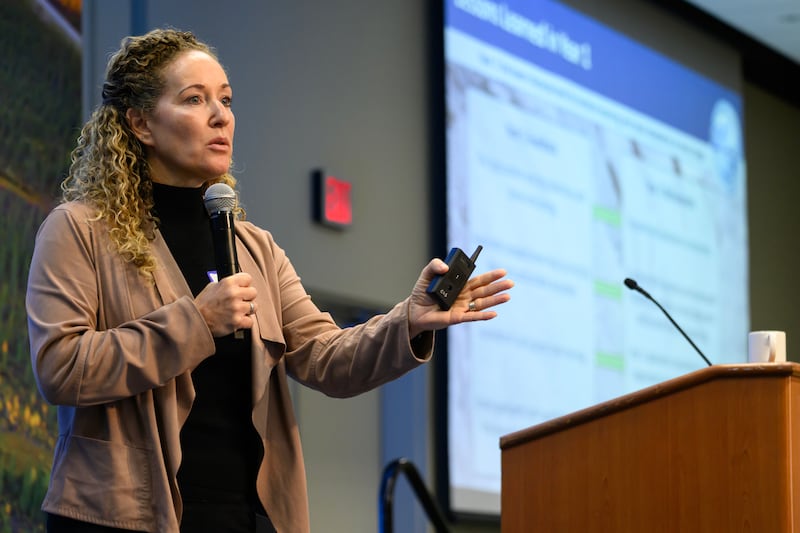 Heidi Hedberg, commissioner of the Alaska Department of Health, speaks to attendees at an Alaska Rural Health Transformation Program Convening at the Dena’ina Convention Center. (Marc Lester / ADN)
So far, $242.6 million of the state’s $272 million in federal funds has been awarded for 250 projects, with a median award size of $421,000. State officials say they will release the remaining funding by the end of October.
[Previous coverage: Alaska awards millions in rural healthcare funding, including to restart Presidential Fitness Test]
The state will begin seeking applications for the next year of the funding on Sept. 30. But the criteria for evaluating the applications have not been finalized. The department is accepting public feedback on the criteria until Oct. 9 — nine days after the portal for application submissions opens.
Jared Kosin, who leads the Alaska Hospital and Healthcare Association and sits on a rural health program advisory board, said this week that the overlap “is just an example of just how terrible these timelines are.”
Kosin is among several Alaska healthcare leaders who have criticized federal guidelines, which require the funding be disbursed within a matter of months. Both the state and the award recipients say they could be penalized if they fall behind on a schedule that demands all funding be allocated and spent in one-year increments.
“I just have a really hard time when the expectation is we’re transforming healthcare and we have to edit our framework for reviewing applications and open the window for applications to come in simultaneously. No one in their right mind would ever want to do it that way, but obviously your hands are tied,” Kosin said during an advisory meeting earlier this week. “It’s just frustrating.”
Alaska’s share of the federal funding is set to be divided among dozens of recipients, including hospitals, clinics, school districts, local governments, tribal organizations and pharmacies. Leaders of these organizations say that federal rules prohibit use of the funds for some of the most urgent needs facing the state, like building new facilities and paying providers.
Instead, much of the money is going toward buying new medical devices and software.
In a panel hosted by the Department of Health this week, some of this year’s funding recipients said the rules for the program dictated the proposals they submitted to the state.
Daniella Rossi, a nursing leader who works for the Cordova Community Medical Center, said it has “a huge laundry list of wants and needs.”
“So we were kind of working backwards the entire time, by looking at the allowable uses of funds, looking at the initiatives, and figuring out which of our laundry list could align best,” Rossi said. The center ultimately received $1.3 million to open an on-site chemotherapy and infusion center, and $155,000 to integrate its behavioral and primary care clinics.
Chugachmiut, which operates several rural clinics in the Prince William Sound and Kenai Peninsula areas, received $3 million for several projects, including more than $600,000 to purchase a portable X-ray machine for use in its clinics.
Kelley Baker, director of health services for Chugachmiut, said they understood “that we’d be under a microscope.”
“So the measurable outcomes are really important in our application. What could we show on what we did with the money, and how did it make a difference?” she said.
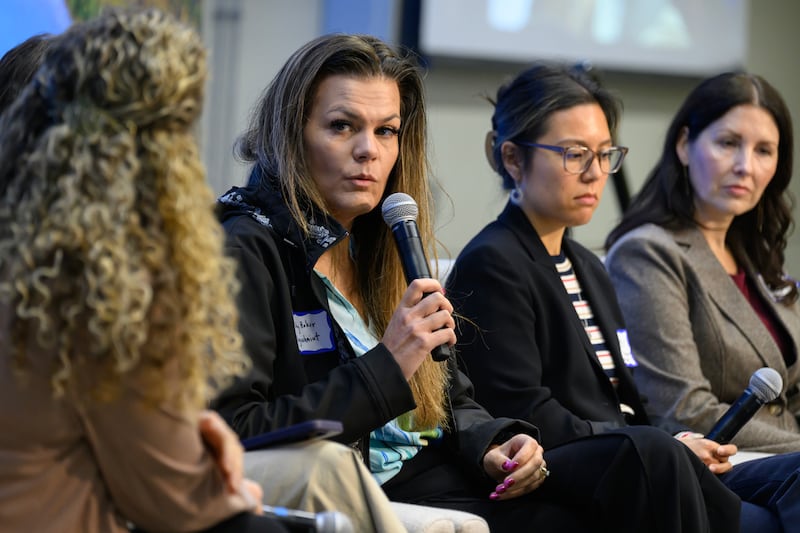 Kelley Baker of Chugachmiut Health Services talks about her funding application experience during a panel discussion at the Alaska Rural Health Transformation Program Convening at the Dena’ina Convention Center in Anchorage on Wednesday, Sept. 23. (Marc Lester / ADN)
After soliciting a wide range of funding proposals in the first year of the program, state officials said they would focus the second year of funding on three areas. The first is pay-for-value, referring to a reimbursement model that ties financial compensation to the quality and outcomes of care, rather than the volume of services provided. The second is care coordination, covering projects that integrate disparate healthcare services and providers. The third is emergency medical services.
Already, the state has awarded $31 million, divided among 13 organizations, for projects related to value-based care.
Healthcare experts say the change could improve health outcomes and reduce patient costs in the long run. But the five-year timeline of the federal program is not well-matched for this kind of paradigm shift, according to Kosin, with the Alaska Hospital and Healthcare Association.
It would take a minimum of five years, and “preferably 10 years,” to assess pay-for-value projects, Kosin said.
“If we judge sustainability on early years, it’s not going to work,” said Kosin. “It’s going to take investment up-front, and that investment is going to cost money, and it will take longer than probably three years to prove itself out.”
Kosin also questioned the decision to distribute funding to multiple organizations, rather than launch a centralized project.
“If we’re going to concentrate on pay-for-value, it’s got to be a consolidated effort. If you do a big scatter shot, I think it’s going to be really hard to build synergy from that,” Kosin said.
Deputy Health Commissioner Emily Ricci, who is leading the effort to distribute the funds while also serving as Alaska’s Medicaid director, said that the state had hoped to convene a series of meetings on a centralized pay-for-value effort, but the meetings did not materialize.
“We just have not had the capacity to do that in year one,” she said.
 Emily Ricci, deputy commissioner of the Alaska Department of Health, speaks Jan. 15 during a Rural Health Transformation Program Convening held at the Hilton Anchorage. (Bill Roth / ADN archive)
As the Department of Health is focused on distributing the federal funds, it is also working to implement changes to its Medicaid program — which serves one in three Alaskans — that could cause thousands of Alaskans to lose access to health insurance, while also hampering revenue streams for hospitals and clinics across the state.
New work requirements for Medicaid will go into effect on Jan. 1, along with a requirement that Alaskans prove their eligibility twice per year, rather than once.
[As work requirements kick in for Medicaid, some states are taking a tougher stance]