
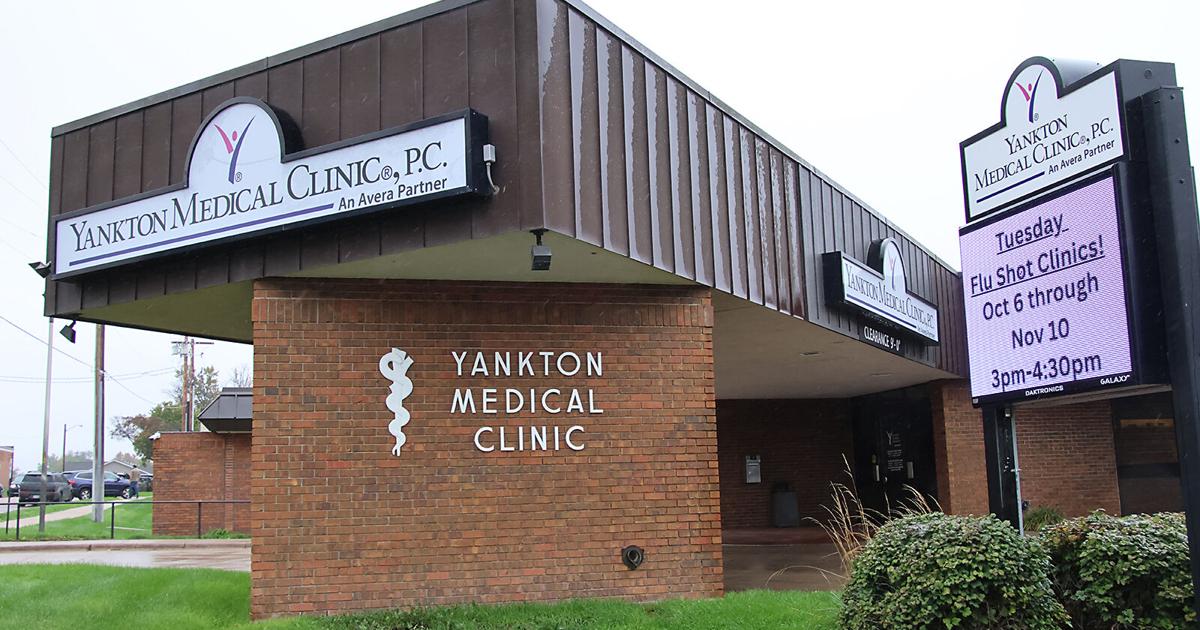
As South Dakota’s first multi-specialty clinic, the Yankton Medical Clinic, P.C. (YMC) continues to offer unique and noteworthy advantages to both its doctors and patients.
“There are just so few multi-specialty clinics around nowadays,” Dr. Byron Nielsen, YMC nephrologist, told the Press & Dakotan. “To have the breadth of specialists that the Yankton Medical Clinic has is relatively unheard of.”
That aspect of the physician-owned local clinic is one of his main selling points when interacting with prospective new doctors, said Nielsen, who has been practicing at YMC for the last 15 years.
“Having all of your healthcare needs under one roof has so many different advantages,” he said. “You can see a primary care provider and have imaging studies that same day. If they find something abnormal, they can literally walk down the hall and talk to a subspecialist, who can get you in, usually that same day, and get you moving through the healthcare system much faster than most other places.”
YMC opened its doors Jan. 1, 1982, following a merger of two earlier clinics, the Yankton Clinic and the Medical Clinic, established by local doctors in 1946. The Yankton Clinic was known more for its specialists and included doctors Chester McVay, Frank Abts, Theodore Sattler and Brooks Ranney. The Medical Clinic offered more family and internal medicine practitioners and included doctors R.F. Hubner, Merrit Auld, George Johnson, Clark Johnson and Duane Reaney.
Today, YMC has 53 providers in 21 specialties in Yankton alone, with more planning to practice there in the next few years. Also, YMC offers five additional full-time providers in Vermillion and five more in Norfolk, Nebraska.
“So, the Yankton community really has quite the advantage when it comes to healthcare,” Nielsen said. “A lot of folks grow up in this area and stay in this area, and this is the healthcare system they know. They don’t really understand what the Yankton Medical Clinic has until they step outside of our healthcare system and experience what healthcare is like in other parts of the country.”
Some of Nielsen’s patients who winter in other states have commented on how long it takes to schedule doctor appointments there, he said.
“They realize how good we have it in Yankton,” he said.
However, physicians also benefit from the arrangement, Nielsen said.
“We as physicians get to direct all the healthcare within the Yankton Medical Clinic,” he said. “Our CEO is actually underneath the board of directors, who are all physicians. So physicians direct and guide healthcare, and our CEO makes sure it gets implemented and done correctly.”
Dr. John Sternquist, a retired YMC General Surgeon, started his medical training at the University of South Dakota. He then left the state to complete his degree and training, finally to return to practice in Yankton.
“At that time, there was a two-year medical school in South Dakota, so you had to finish your last two years someplace else,” he told the Press & Dakotan. “I went to Minnesota for my last two years in medical school, and then I did my internship at the county hospital in Minneapolis and my surgery residency at the county hospital, Hennepin County Medical Center, as it was called at that time.”
Sternquist said his wife would have preferred to remain in Minneapolis where the couple had already begun to put down roots, but that presented logistical issues for a budding new practice.
“To stay in Minneapolis at that time, I would have had to have been on staff at several hospitals,” he said. “To have a practice where the patients would go to different hospitals, you really had to be on staff at least at a couple — maybe three — hospitals, where you’d then have to go make rounds.”
Practicing in Yankton, which only had one hospital, was much more convenient, said Sternquist, who joined the Medical Clinic in 1980 and transitioned to the newly formed YMC in 1982.
Both groups saw the merger as a way to address challenges related to recruiting new doctors, as well as deal with rising costs. But seeing the benefits took time, he said.
“There was a transition,” Sternquist said. “Even though everyone knew each other, it was not a season of love and joy. It was, more like, ‘We’ve got to do this, and it’s going to be better in the end,’ which it certainly has been.”
After about five years, the doctors at the new YMC had established working relationships, and the benefits of the new system were apparent, he said.
“(For example), any other town this size may have a general surgeon or two, but they don’t have the support,” Sternquist said. “That’s probably one of the really beautiful things about Yankton.”
Between 1980 and Sternquist’s retirement in 2009, the number of quality physicians at YMC grew, he said.
“(YMC has) great anesthesia and great pathology and subspecialists — pulmonology, cardiology — to help take care of people when they’re having more trouble,” Sternquist said.
Also, having University of South Dakota medical students rotate through YMC and Avera Sacred Heart Hospital is probably the best thing that’s happened to Yankton in terms of highlighting the benefits of working here to the next generation of doctors, he said.
“If you look through the guys and the ladies who are in the clinic now, there’s a huge number who were third-year med students with us,” Sternquist said.
It’s been a wonderful and positive place to practice, he said.
“Camaraderie and ability to take care of patients in a really timely fashion is one of the biggest reasons the vast majority of the doctors practice in Yankton,” added Nielsen. “Being a physician-owned local clinic, whose whole goal is to provide the absolute best healthcare possible, and all under one roof gives us that significant advantage that we can get it done.”