
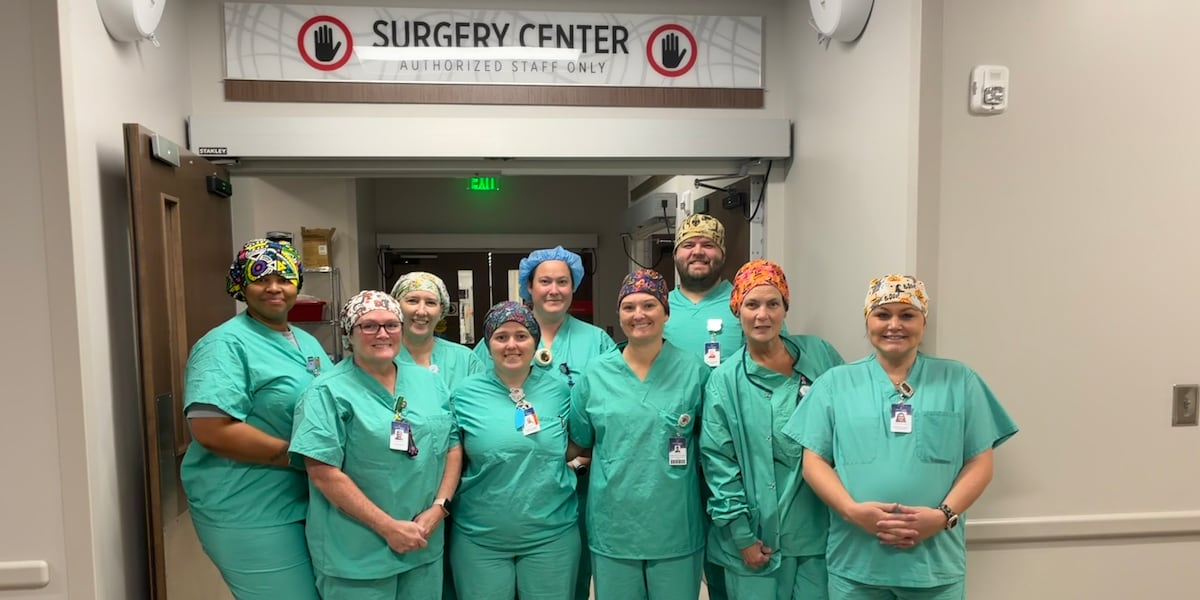
TIFTON, Ga. (WALB) — National Surgical Technologists Week is celebrated annually during the third full week of September, recognizing the professionals who work behind the scenes in the operating room.
Surgical technologists work alongside surgeons, nurses, anesthesiologists and other healthcare professionals to help ensure procedures are performed safely and efficiently. They prepare instruments, equipment and supplies before a procedure and are trained in sterile technique and maintaining the sterile field.
During surgery, they anticipate the needs of the surgeon and surgical team, pass instruments and supplies, and help keep procedures organized and moving efficiently.
Gina Chambers is the program director for the Surgical Technology program at Southern Regional Technical College. She teaches at the Tifton campus and currently also the Thomasville campus.
“A surgical technologist is one who actually protects the sterile field, creates the sterile field, is the right-hand person to our surgeons,” Chambers said. “We are actually the ones who wants to make sure that our surgeon has everything that they need, that we have everything is sterile, nothing’s going to get contaminated, that we’re going to make sure that we protect our patients at all costs. But we are the unseen person of the operating room.”
SRTC Surgical Technology students can go on to work at programs like Colquitt Regional, Tift Regional Medical Center, Southwell Medical, Tift Regional Urology and Georgia Sports Medicine surgery centers, and Coffee Regional.
SRTC offers the Surgical Technology Associate of Applied Science degree in both Thomasville and Tifton, preparing students for operating room positions at hospitals and surgery centers including Colquitt Regional, Tift Regional Medical Center, Southwell Medical, Tift Regional Urology and Georgia Sports Medicine surgery centers.
The college has 57 students declared in Surgical Technology for Fall 2026, including 28 in Thomasville and 29 in Tifton. Training includes surgical procedures, aseptic technique, anatomy, medical terminology and pharmacology, along with hands-on lab and clinical experience. Students must complete at least 120 surgical cases, including 30 in general surgery and 90 across surgical specialties, as part of their clinical education.
Accreditation standards require a student-to-instructor ratio of no more than 10:1 during lab instruction. The program is accredited by the Commission on Accreditation of Allied Health Education Programs upon recommendation of the Accreditation Review Council on Education in Surgical Technology and Surgical Assisting.
Daisy Camina, a student in the program, said she is looking forward to gaining new experience and eventually working in the operating room at Bainbridge Memorial, her local hospital.
Nikki Brandon, another student, said she has been in the program for a little over a year.
It’s been great. It’s been an experience. It’s been a lot of learning. It’s been difficult, but worth it. Helping people. Being a part of something bigger. And just being able to assist a surgeon. And save someone’s life is amazing to me.
Brandon said she plans to pursue a bachelor’s degree and become a physician assistant, with plans to work at a Level II trauma center in Albany.
SRTC also has nine students enrolled in the Central Sterile Supply Processing Technician Advanced Technical Certificate of Credit for Fall 2026. Those technicians clean, decontaminate, inspect, assemble, sterilize, store and distribute surgical instruments and equipment that surgical technologists also work with in the operating room.
All eight graduates from SRTC’s Thomasville and Tifton Surgical Technology cohorts passed the Certified Surgical Technologist examination in 2026, giving the graduating class a 100% pass rate on the national exam administered through the National Board of Surgical Technology and Surgical Assisting.
“Seeing all eight of our 2026 graduates pass their national certification exam was an incredibly proud moment,” Chambers said. “It speaks to their hard work and to the preparation they received throughout the program.”
According to the Association of Surgical Technologists, the profession faces a workforce shortage tied to a decrease in accredited surgical technology programs. AST Former President Kevin Craycraft said the number of programs accredited by CAAHEP and the Accreditation Bureau of Health Education Schools has dropped from more than 500 several years ago to 435 today, resulting in hundreds of fewer new Certified Surgical Technologists entering the workforce each year and an increase in non-accredited programs, apprenticeships and on-the-job training, which AST opposes.
The U.S. has about 117,500 working surgical technologists, but hospitals face a severe shortage driven by a shrinking educational pipeline and rising surgical demand, according to Becker’s Hospital Review.
“The best way to get into surgical technology is get with your local technical colleges,” Chambers said. “Southern Regional Technical College is awesome. We’re right here in Tifton and Thomasville, but we also work in so many different counties.”
As of Fall 2026, SRTC has experienced 14 consecutive semesters of enrollment growth, enrolling 6,022 students this fall across more than 150 degree, diploma and certificate programs. The college reports a 99% job placement rate and was the No. 1 technical college in Georgia for Associate of Science in Nursing graduates from 2022 through 2025.
You can find out more information on the Surgical Technology program here.
Have a news tip or see an error that needs correction? Let us know. Please include the article’s headline in your message.
To stay up to date on all the latest news as it develops, follow WALB on Facebook, TikTok, Instagram, and X. For more south Georgia news, download the WALB News app and add WALB as a preferred source on Google.
Copyright 2026 WALB. All rights reserved.