
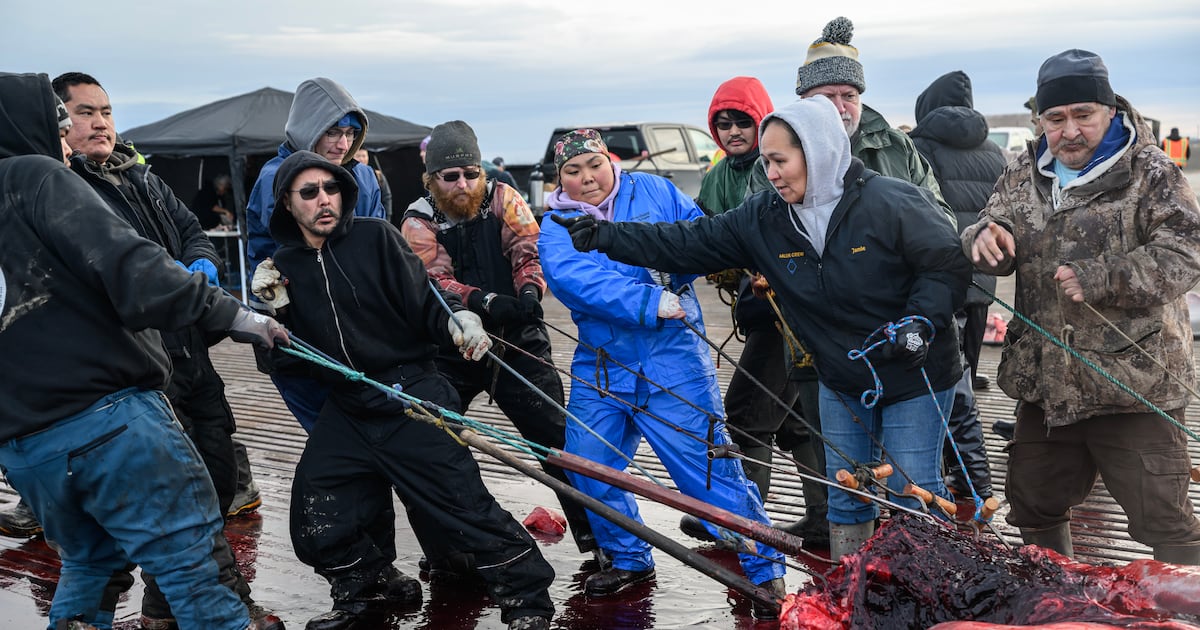
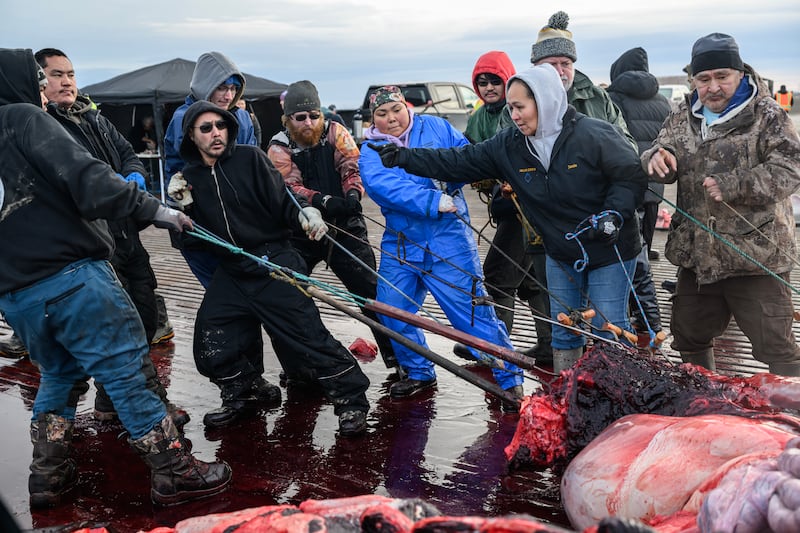
 A group works together to remove meat from a bowhead whale hunted by the Anaġi Crew in Utqiaġvik on Saturday, Sept. 26. (Marc Lester / ADN)
UTQIAĠVIK — Three whaling crews returned to the Arctic Ocean shoreline northeast of North America’s northernmost city with bowheads in tow Saturday. Cars lined the sandy roadway to shine headlights on the fruits of the fall whaling season and honk horns in celebration as darkness fell. Shouts of “Yay hey hey” came from up and down the beach as heavy equipment winched the massive animals ashore.
Bowhead whales have been considered crucial to the subsistence life of the region’s Iñupiat people for millennia, leaders here say. Once the whales were relocated to a defunct runway for processing, captains, crews and family members gathered for hugs and pictures. Then butchering began, work that lasted until early Sunday morning.
Three whales in one day is not unusual for a good-weather day during the fall hunt, whalers said. But it’s special every time.
“I don’t know how to explain it,” said Bernadette Adams as she unloaded tools for the job ahead. She serves as whaling co-captain of the Aaluk Crew. “It’s very joyful times.”
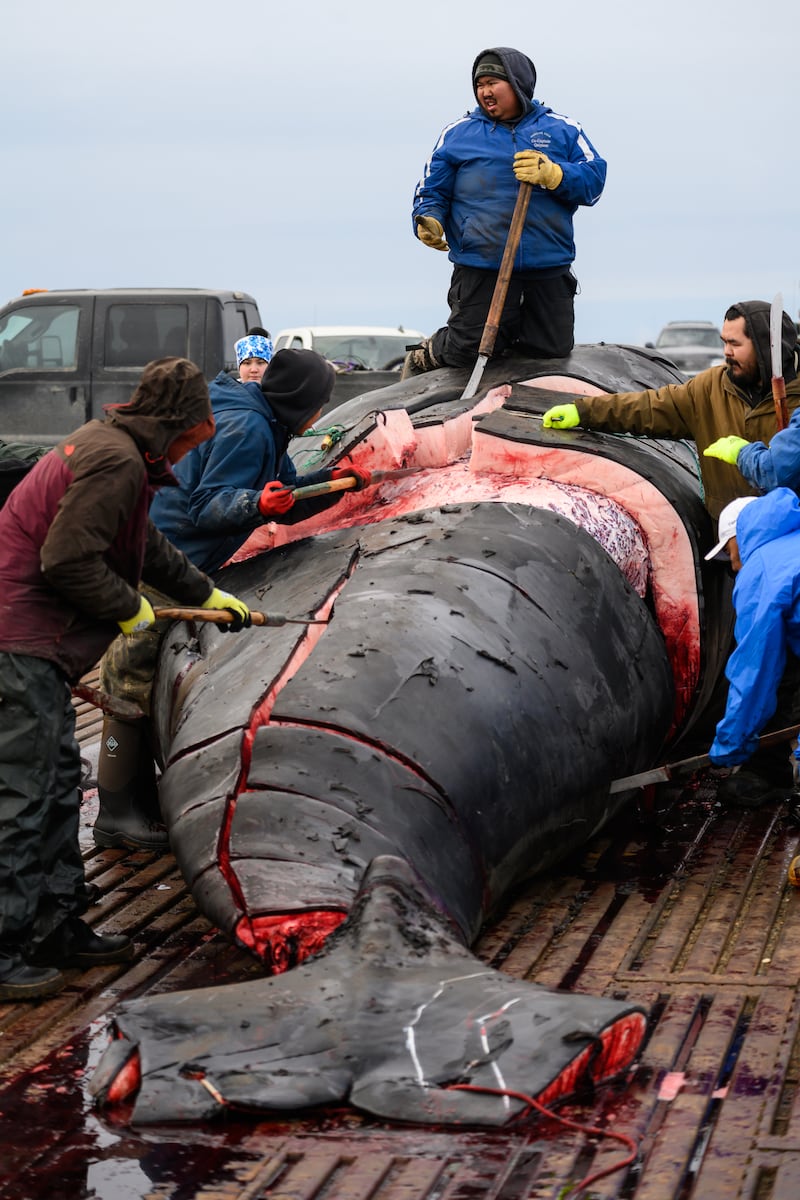 Qaiyaan Leavitt, co-captain of the Anaġi Crew, works with others to begin butchering a bowhead whale in Utqiaġvik. (Marc Lester / ADN)
 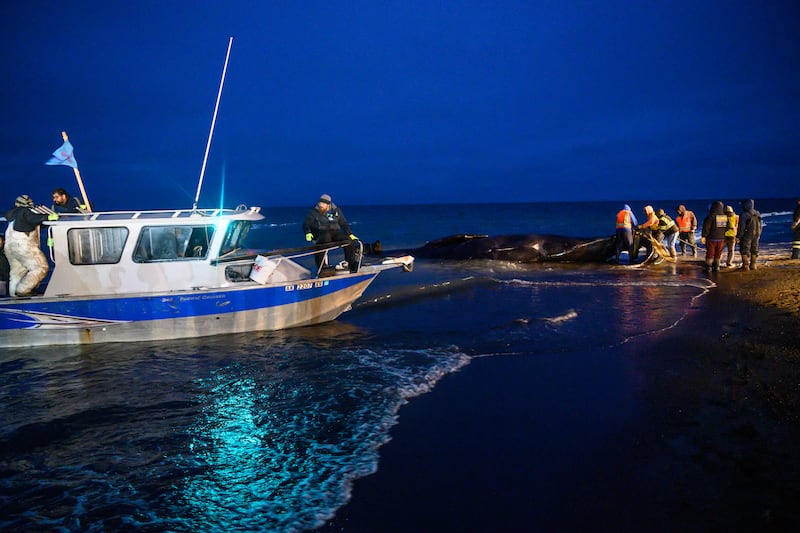 The Aaŋa Crew brings its bowhead whale to the shore of Utqiaġvik, where heavy equipment helps bring it out of the water. (Marc Lester / ADN)
 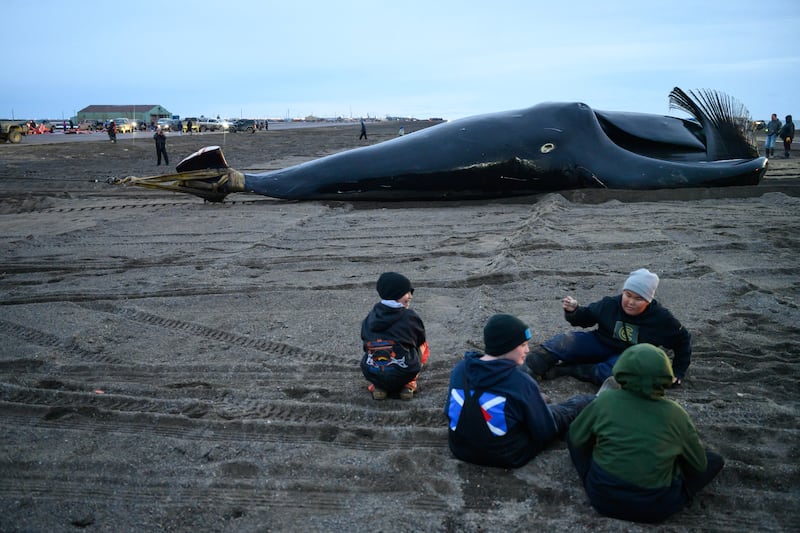 Children play as a bowhead whale is slowly brought to an old runway surface for butchering. (Marc Lester / ADN)
 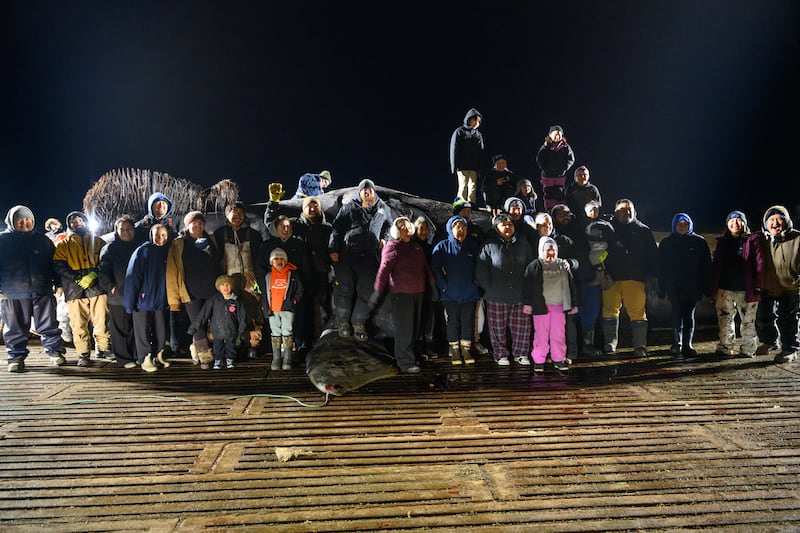 The Aaŋa Crew gathers with family members for a photo in front of its bowhead whale before butchering begins. (Marc Lester / ADN)
The Anaġi Crew brought a 31-foot, 10-inch whale in before the sun set. Co-captain Qaiyaan Leavitt said they loaded the boat a day prior to prepare for an early-morning start. The nine-person boat had to go uncommonly far, 26 miles east of Point Barrow, before they spotted bowheads. After the strike, they had to tow the whale 33 miles, a 4 1/2-hour run.
On the runway, cutting began methodically with long-handled blades, working from largely from the top down. Skin and blubber was separated in long, thick, heavy strips and dragged into tidy rows by hand with assistance from grunting helpers pulling hooks and ropes. Meat, nearly black, was separated later. Shares of the whale will be divided among crew members, those on other boats who helped tow the whales in and others who helped with the work on land, as tradition prescribes.
The captain’s share, Leavitt said, will be distributed to the whole community this winter. “We’ll cut it all up and bring it to the churches so they can have a feast on Thanksgiving and Christmas Day,” he said. “Anybody can come.”
But residents wouldn’t need to wait that long for a taste. Pieces of skin and blubber, called unalik, were boiled on site Saturday and passed around to the assemblage. It’s never better than when it’s cooked fresh, many said. Leavitt said the crew’s captain would also distribute smaller portions of heart, intestines, tongue, meat and unalik the following day. Single-serving bags would be handed out with a dessert.
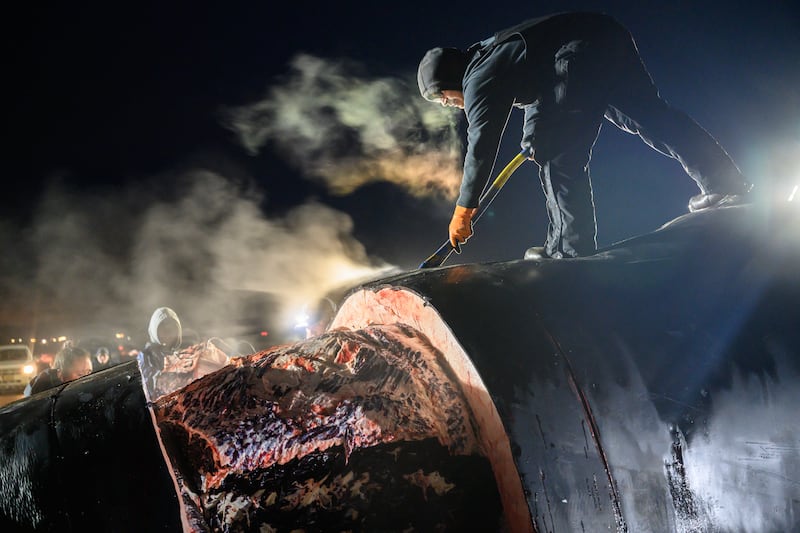 Donald “Button” Adams works to butcher a bowhead whale hunted by the Aaluk Crew. (Marc Lester / ADN)
 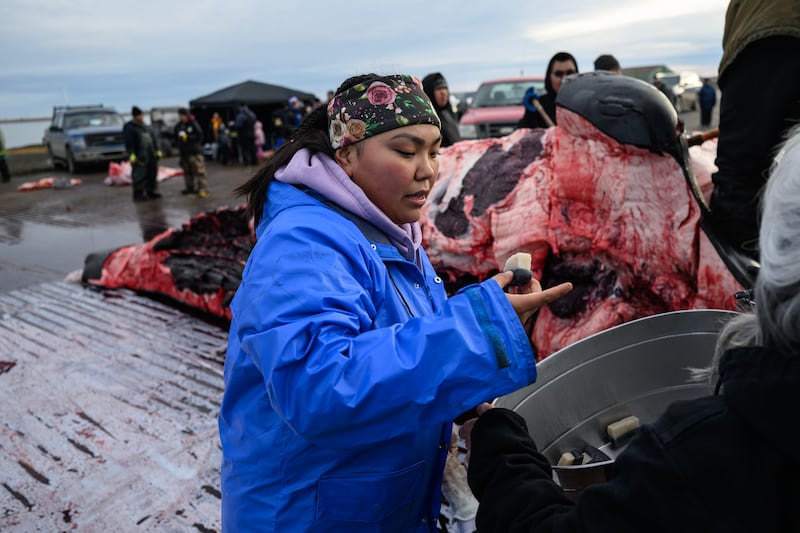 Raquel Rexford pauses work to take a portion of boiled skin and blubber. (Marc Lester / ADN)
 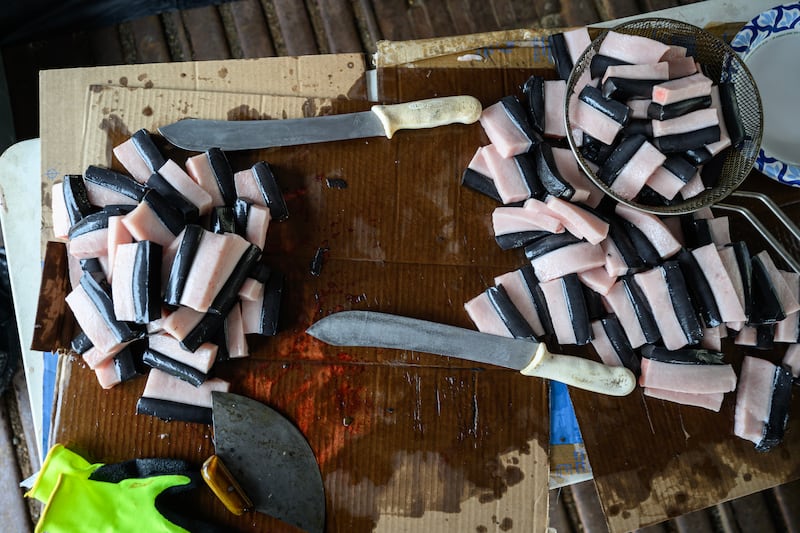 Unalik, portions of bowhead skin and blubber, is prepared for immediate distribution. (Marc Lester / ADN)
The day had been particularly special for the Aaluk Crew. Bernadette Adams said the 40-foot, 3-inch bowhead was harpooned by her 18-year-old son, John Adams. It was his first, she said. Upon arrival, John Adams ran down the beach holding a flag with the crew’s blue and yellow insignia. As per tradition, the crew flag is to be posted at the captain’s house once the whale is ashore, she said.
“He actually gave me a big hug on the beach, cried, and said, ‘OK, I’m going to bring the flag home,’ ” she said.
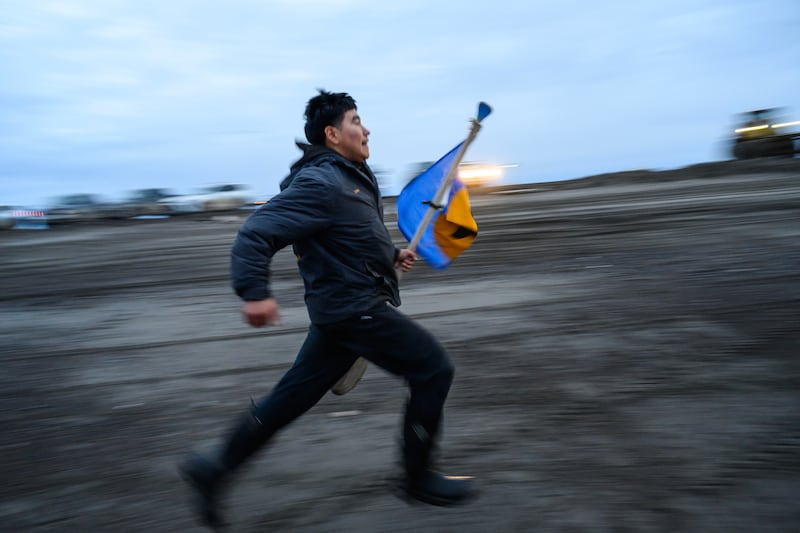 John Adams carries the flag of the Aaluk Crew after it brought a bowhead to the shores of Utqiaġvik. (Marc Lester / ADN)
 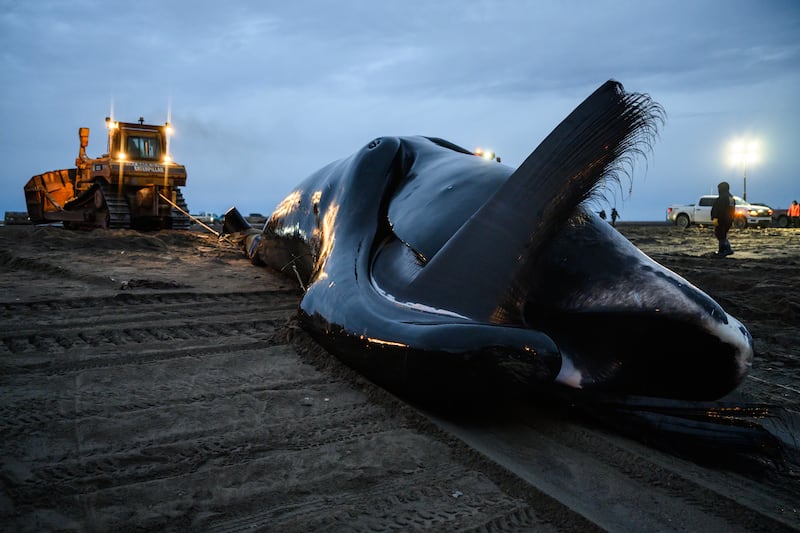 A bowhead whale hunted by the Aaluk Crew is slowly winched by a bulldozer across the beach. (Marc Lester / ADN)
 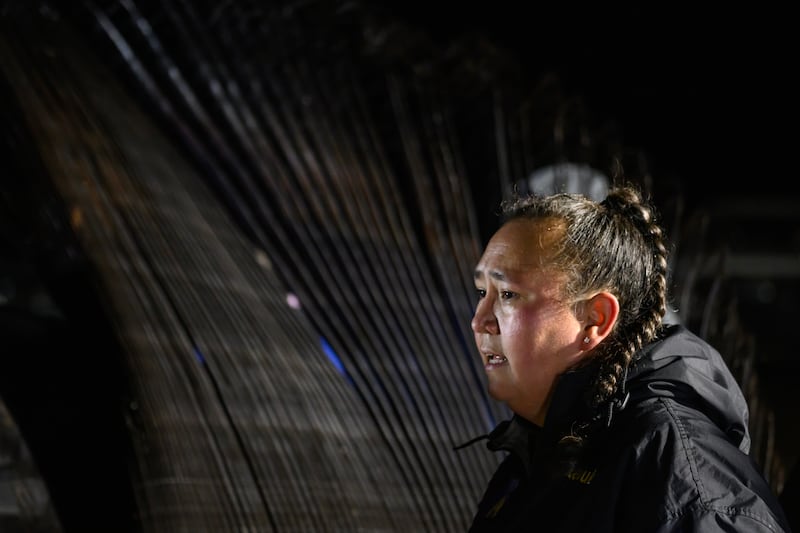 Aaluk Crew co-captain Bernadette Adams works to butcher a bowhead. (Marc Lester / ADN)
With permission from the captain, a team from the North Slope Borough’s Division of Wildlife Management generally works with whaling crews on each Utqiaġvik whale. Kendra Mack, the division’s outreach coordinator, said data collection includes length and girth, sex, reproductive status and several biological samples, including blubber, internal organs and a baleen plate. They also take an eyeball. “That’s the best way to age a whale,” she said.
The information is gathered for the Alaska Eskimo Whaling Commission to ensure the whales are healthy and safe to eat, Mack said. The commission was established in 1977 and advocates on behalf of 11 whaling villages to preserve the traditional food source and cultural activity that it says dates back more than 2,000 years.
The data also supports the reporting requirements to the international body that regulates whaling among its 89 member nations. “We’re responsible to the International Whaling Commission for tracking the population to make sure it’s still healthy and well and that whales are in good condition,” Mack said.
The IWC establishes quotas for aboriginal subsistence whaling. Whalers said the current annual limit for Utqiaġvik is 27 bowheads, though that number is not reached every year. These were the seventh, eighth and ninth bowhead whales hunted for Utqiaġvik this year.
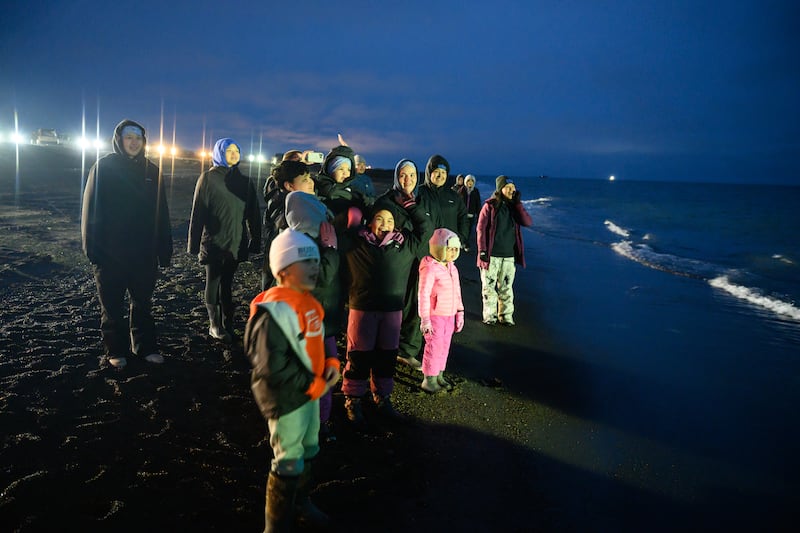 Crew family members and other supporters cheer from the beach as the Aaŋa Crew returns to Utqiaġvik with a bowhead whale. (Marc Lester / ADN)
 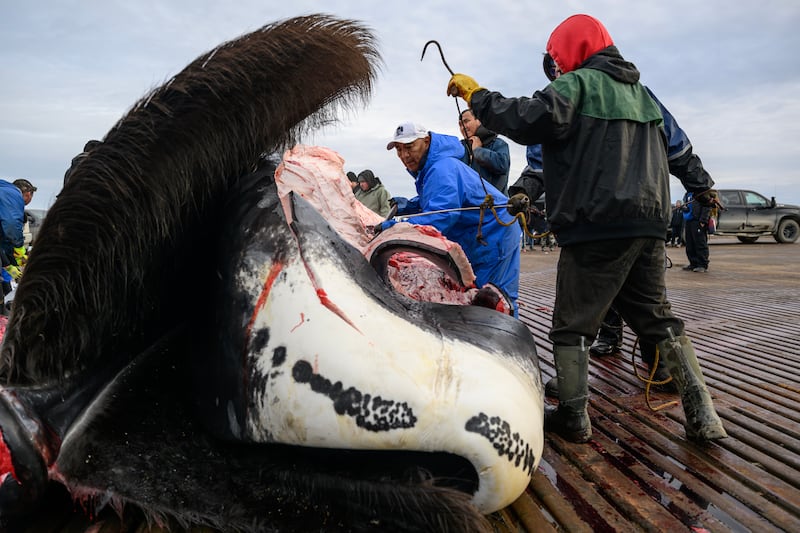 Herman Ahsoak, center, helps butcher a bowhead whale. (Marc Lester / ADN)
 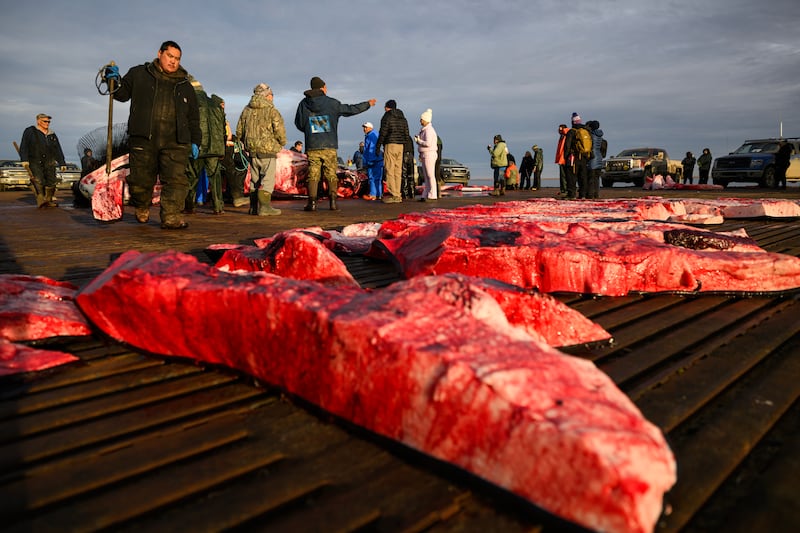 Shares of bowhead are arranged in rows. (Marc Lester / ADN)
 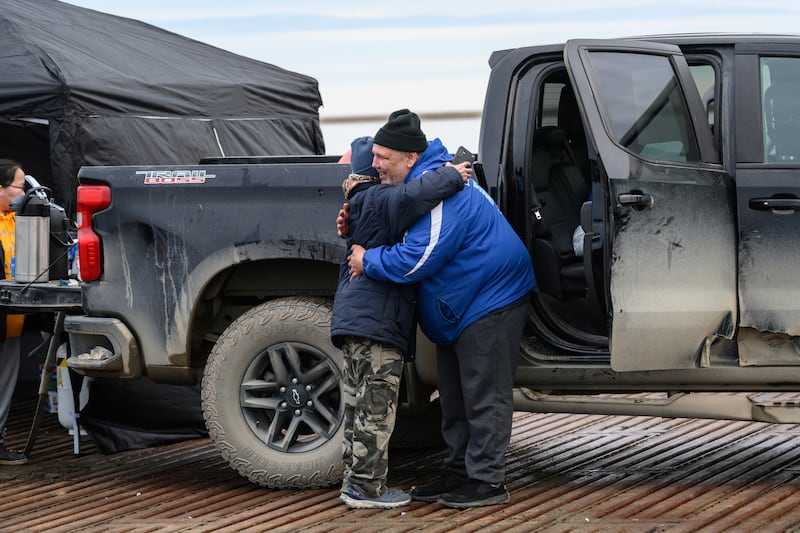 Carl Nayakik, right, captain of the Anaġi Crew, is congratulated. (Marc Lester / ADN)
Mack said the division’s effort also includes a survey to count bowhead whales every 10 years, which most recently happened in spring 2025. Statistical work is ongoing from that count, she said, but it indicated strong population numbers.
After nightfall Saturday, Avaiyak Burnell, co-captain of the Aaŋa Crew, noted that it was a great day in Utqiaġvik on multiple fronts. He said the high school’s volleyball and football teams, which hosted games here, also did well. “It’s a good day to be a Whaler and it’s a good day to be a whaler,” he said, gesturing to the 41-foot-plus bowhead before him.
Burnell didn’t join the crew that day, but listened to the excitement unfold on his VHF radio, a long-relied-on tool for community chatter in rural Alaska. “You hear it on the VHF, then you sit around and listen and pray you’re going to be successful.”
He hugged and laughed with Alex Kaleak, the Aaŋa Crew captain, when he arrived as others set up a tent to cook.
“This is the best time in the world, man,” Burnell said, taking a look around at the people who gathered around each of the three whales. “When you’re raised in this culture and in this tradition, it brings so many of us together.”
Kaleak, taking a break from the hard work of butchering, said that though he’s been whaling for 26 years, success is still a thrill. “This is going to feed a lot of people,” he said.
“I think I’m done after this one,” Kaleak said. “This is just enough to fill my grandpa’s cellar.”
Steam rose from the Aaluk whale into the cooling nighttime air as Bernadette Adams worked alongside her husband and co-captain, Quincy Adams. She said there was a lot left to do — that night, in days to come and in the fall whaling season before the sea freezes.
“We’ll probably take care of this one, put it away in the ice cellar and load back up and see if we’re blessed again,” she said.
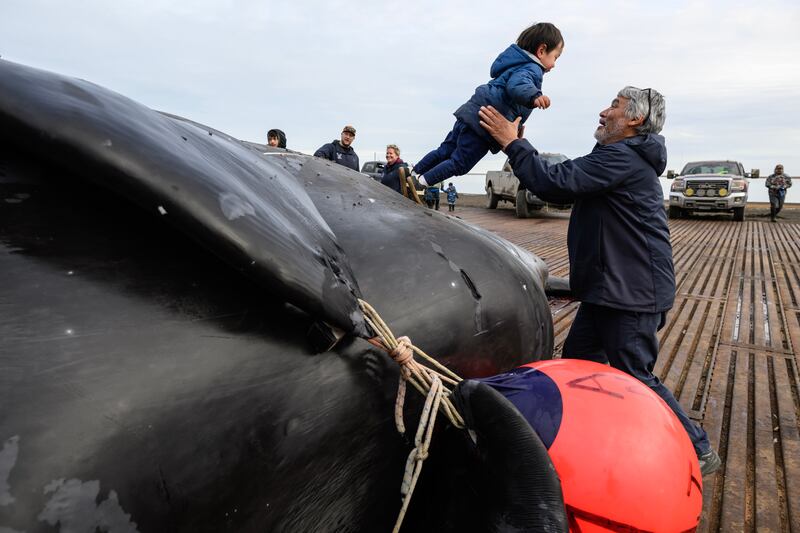 A youngster gets help coming down from a bowhead whale after it was brought ashore in Utqiaġvik. (Marc Lester / ADN)
 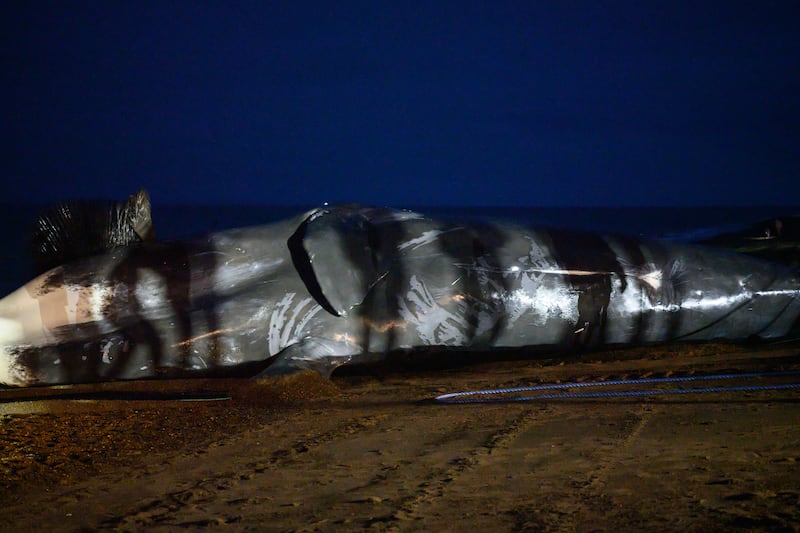 The shadows of onlookers fall on a bowhead whale brought to Utqiaġvik by the Aaŋa Crew on Saturday, Sept. 26. (Marc Lester / ADN)
 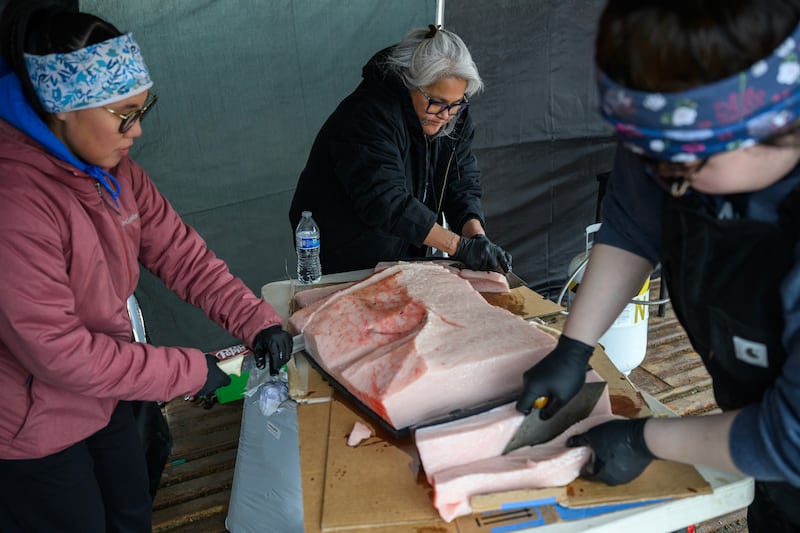 Portions of bowhead skin and fat are prepared for immediate boiling and serving. (Marc Lester / ADN)
 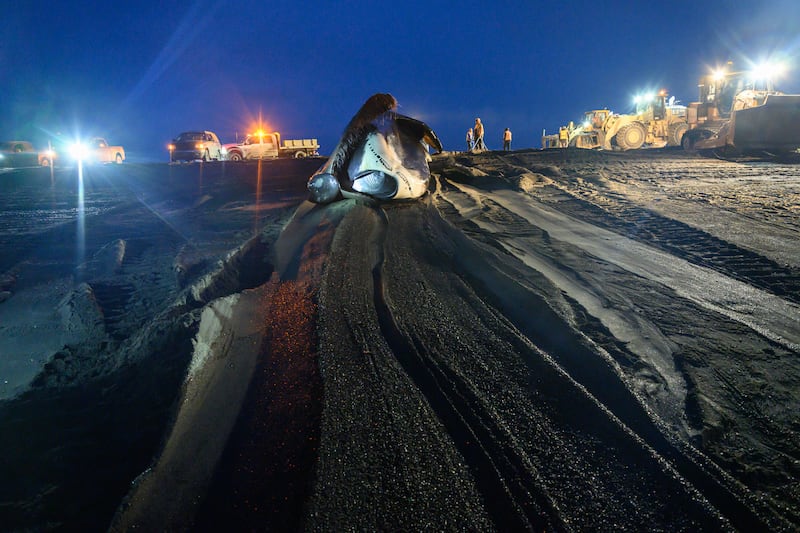 A bowhead whale is winched across a beach. (Marc Lester / ADN)
 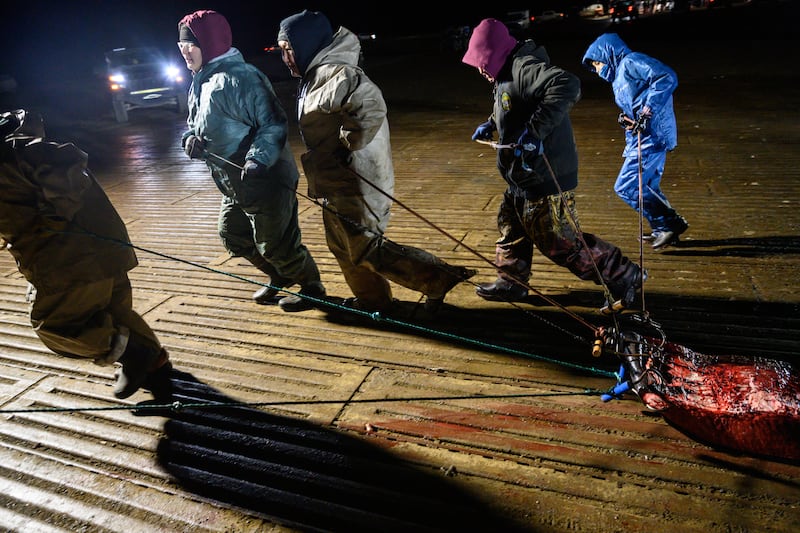 Teamwork helps move a portion of bowhead whale during the Aaluk Crew’s harvest. (Marc Lester / ADN)
 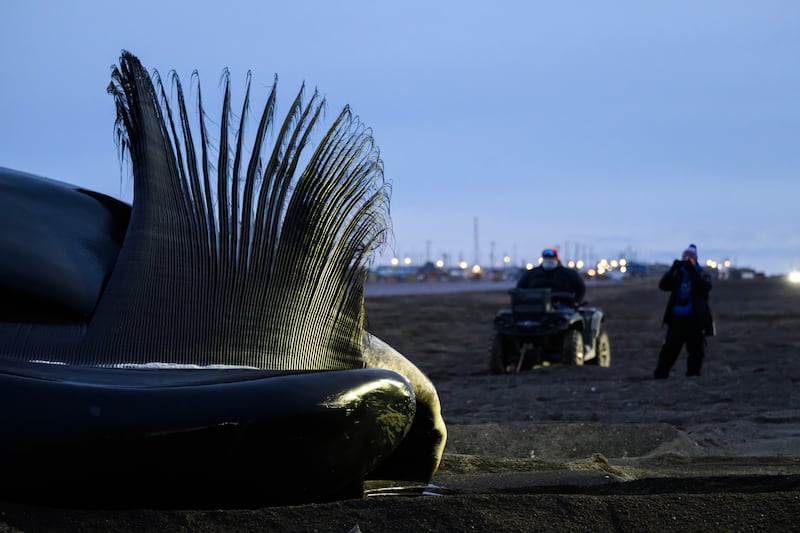 Headlights highlight baleen. (Marc Lester / ADN)
 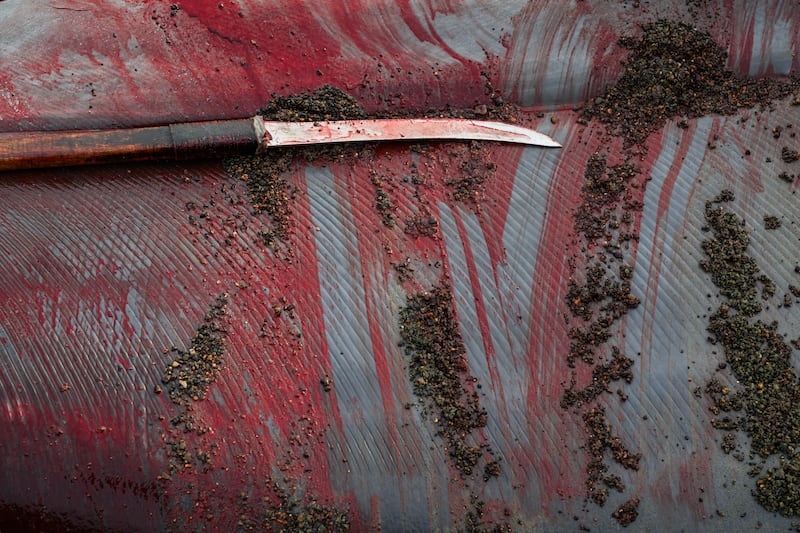 A long-handled knife is set aside during a subsistence bowhead whale harvest in Utqiaġvik. (Marc Lester / ADN)
 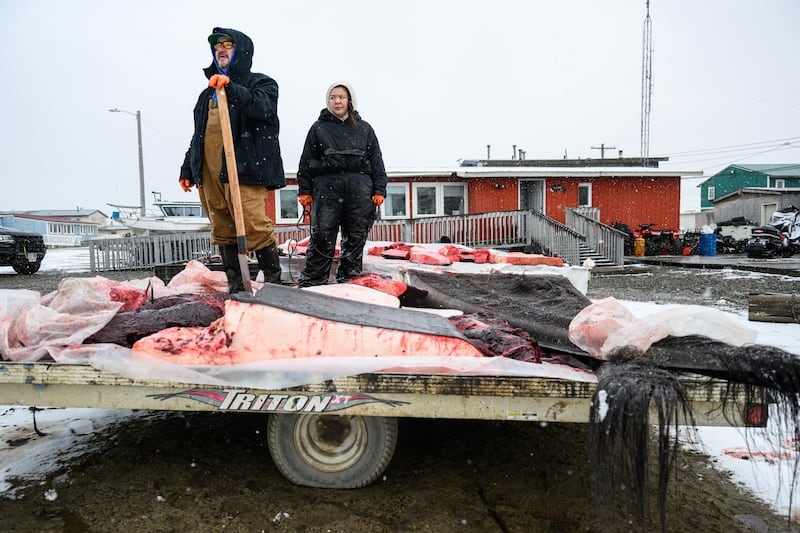 A light snow falls in Utqiaġvik as fourth-generation whaling captain Frederick Brower works to put away a share of bowhead whale with his daughter, Andrea, on Sunday, Sept. 27. Brower’s portion came from a whale hunted by the Aaŋa Crew, which he assisted in towing to Utqiaġvik. (Marc Lester / ADN)
 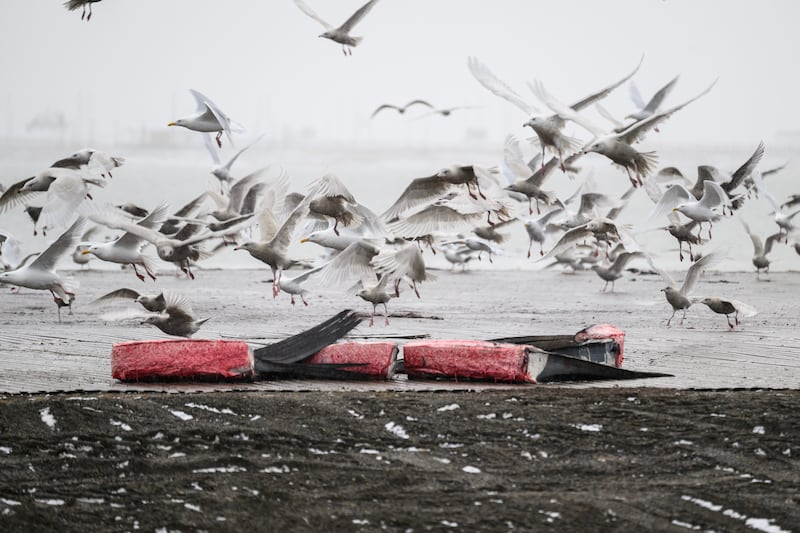 Gulls fill the air over bowhead baleen a day after the whale was hunted by a crew from Utqiaġvik. (Marc Lester / ADN)
• • •