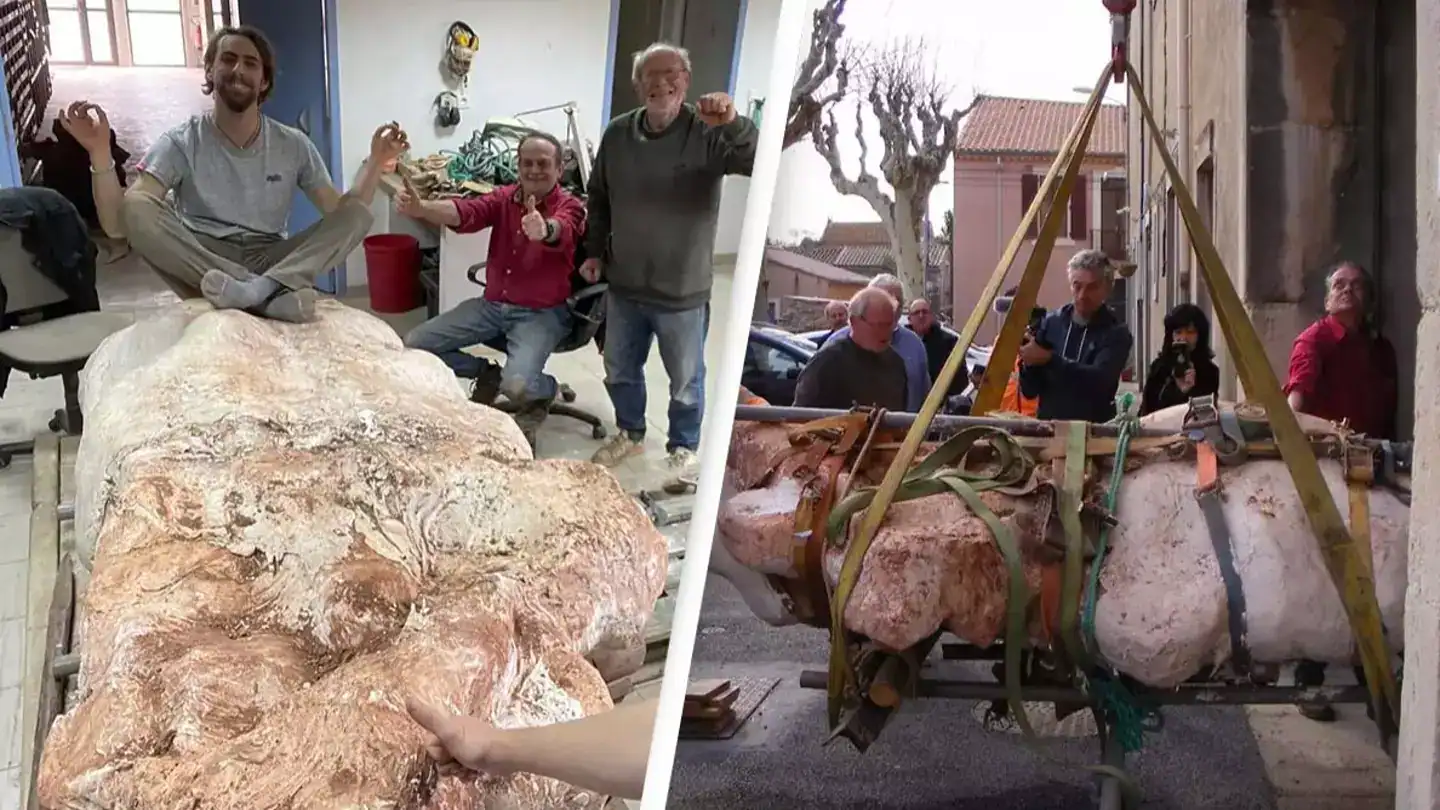
 Credit: Damien Boschetto.
It looked like any other day for 25-year-old Damien Boschetto, who was out and about walking his dog around the serene landscape of Montouliers, Hérault, France. But it’s not every day that you get to stumble across a 70-million-year-old piece of history.
The discovery happened in May 2022, after erosion and a partial collapse exposed part of a cliff. Boschetto, an amateur paleontologist, noticed large bones sticking out of the rock. His trained eye quickly allowed him to ascertain that these were dinosaur fossils.
After a few days of excavation with experts from a local museum, the researchers realized that these were the remains of a Titanosaur, one of the largest dinosaurs to have ever walked on Earth.
The find of a lifetime
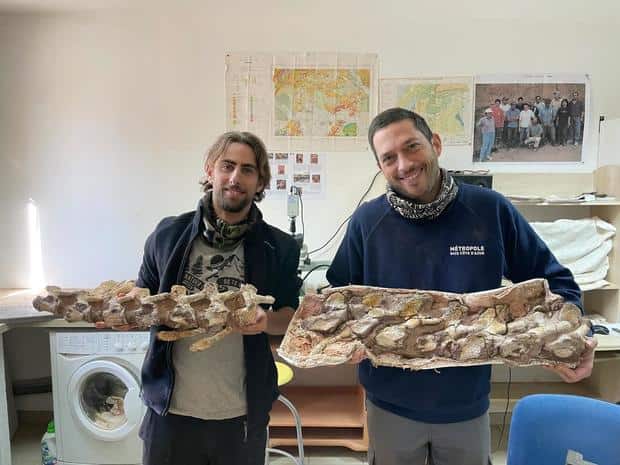 Damien Boschetto (left) holding some of the dinosaur bones he found. Credit: Damien Boschetto.
To make matters even more intriguing, when the fossils were arranged and put together, they formed a nearly complete roughly 10-meter-long, or 33-foot-long, skeleton. It’s exceedingly rare to find a dinosaur skeleton so well preserved and complete.
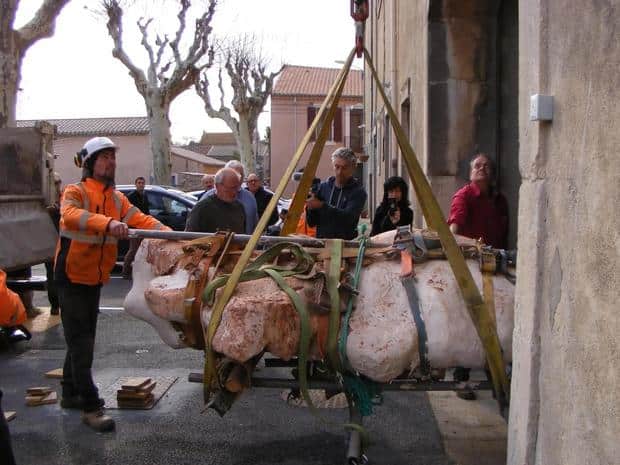 The huge fossils had to be hauled with a crane. Credit: Damien Boschetto.
Boschetto reported his findings to a local association dedicated to cultural, archaeological, and paleontological pursuits. Experts from the association determined the fossil to be approximately 70 million years old, offering a rare glimpse into the life of titanosaurs.
These plant-eating behemoths, famous for their elongated necks, roamed the Earth throughout much of the Cretaceous. Titanosaur fossils have been found on every continent.
And the original skeleton turned out to be only part of the story. The Département de l’Hérault now says work at Montouliers recovered four exceptionally rare dinosaur specimens in all: two titanosaurs and two rhabdodons, a group of smaller plant-eating dinosaurs. herault.fr
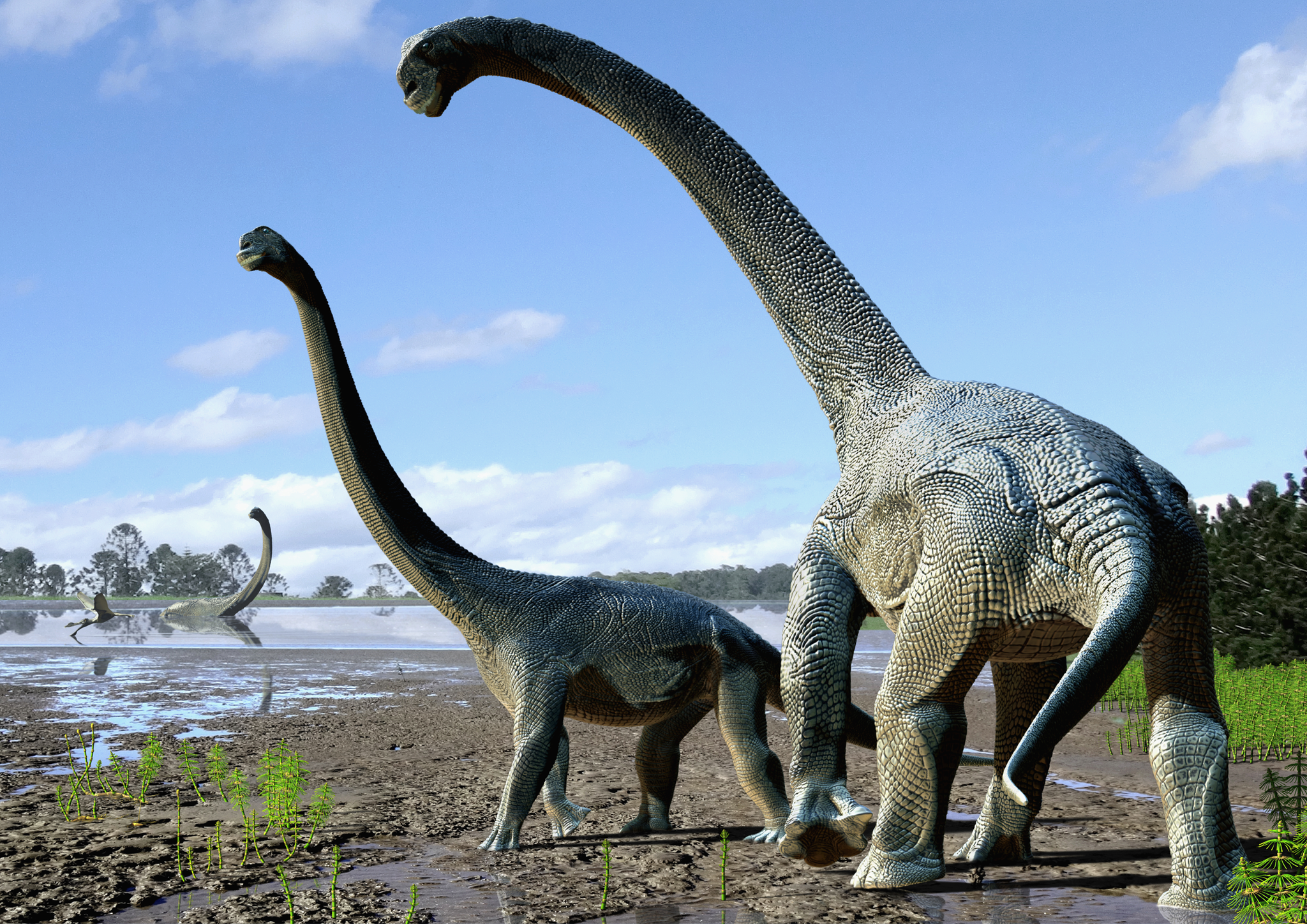 An artist’s rendering of what Savannasaurus elliottorum, a species of titanosaur discovered in 2016 in Australia, may have looked like. Credit: Travis Tischler/Australian Age of Dinosaurs Museum of Natural History.
Despite the many fossils and tens of thousands of excavations across the years, finding an almost intact dinosaur skeleton remains an extraordinary rarity. To put it into perspective, a previous study highlighted that, despite an estimated 1.7 billion Tyrannosaurus rex-es once living in the Cretaceous period, paleontologists have only uncovered fossils of fewer than 100 individuals. And most of these T. rexes are known from partial remains.
×
Thank you! One more thing…
Please check your inbox and confirm your subscription.
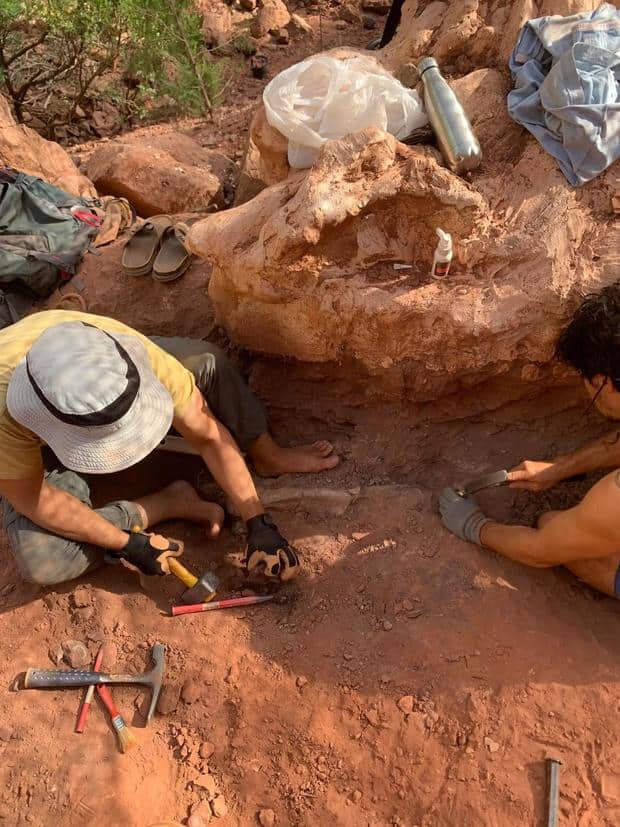 Researchers excavated the titanosaur fossils over several 10-day digging sessions. Credit: Damien Boschetto.
A find worth protecting
The most complete T. rex is a specimen called Sue at display at the Field Museum of Natural History in Chicago. Sue preserves roughly 90% of the animal by mass, although considerably fewer than 90% of the individual bones are present. The titanosaur discovered by Boschetto has been described as about 70% complete.
Presently, there’s still no published identification of which particular species of titanosaur we’re talking about here. As of September 2026, I could find no peer-reviewed anatomical description formally naming the Montouliers animal.
“The recent discovery of a new deposit in the neighboring town of Montouliers provides us with an assemblage of dinosaur skeletons in almost complete anatomical connections (the bones of the animal are still articulated to each other). This is a very rare and exceptional discovery in France and Europe,” Boschetto told Newsweek.
The discovery remained a closely guarded secret for roughly two years to protect the site from vandals and fossil hunters while the bones were being extracted.
The specimen is now part of the paleontological collections associated with the Cruzy museum, and regional authorities continue to highlight it as one of Hérault’s standout fossil discoveries. A departmental publication in late 2025 described the skeleton as nearly complete and exceptionally well preserved, with the bones still connected to one another.
As for Boschetto, the discovery also appears to have changed the course of his life. He left his job in the energy sector to pursue paleontology academically.
And he has moved beyond the “amateur” label pretty fast. In 2026, Boschetto was lead author of a peer-reviewed study in Geodiversitas examining an unusual bite mark on a predatory dinosaur tooth from the Upper Cretaceous deposits near Cruzy. The research is unrelated to the titanosaur itself, but it shows that he is now contributing directly to the scientific study of the region’s fossil fauna.
He was also still presenting the Montouliers discovery publicly in August 2026, giving a lecture in Narbonne on the discovery, preparation and study of the fossils.
Sometimes, a walk with the dog can really have a big impact on your career.
Transparency note: This article was originally published in March 2024 and updated in June 2025. It was reviewed again in September 2026 as part of our effort to revisit older science stories and check how the evidence and story have developed over time. We added new information about other dinosaur remains recovered from the Montouliers site and Damien Boschetto’s subsequent work in paleontology.