
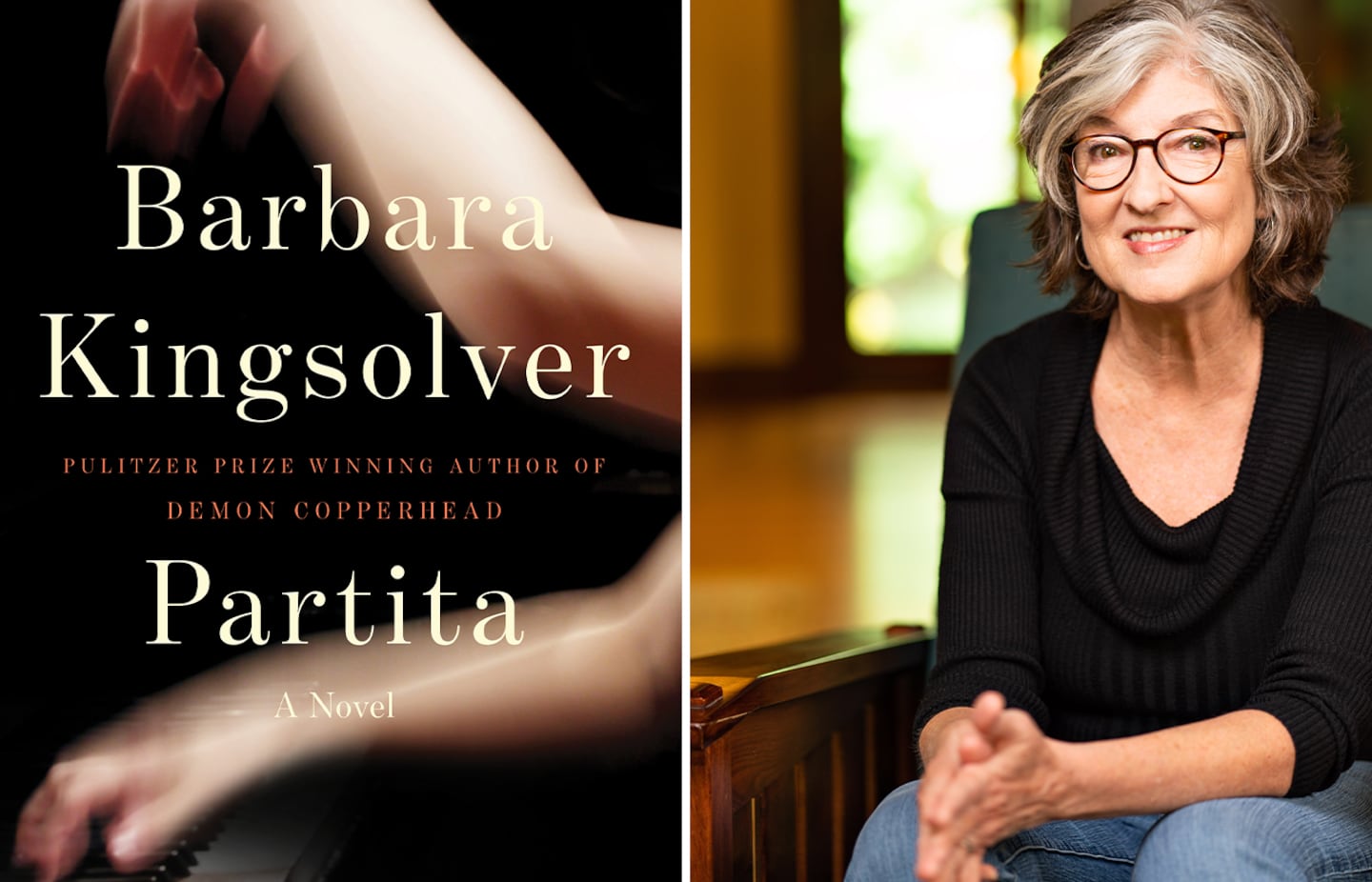
From an early age, the protagonist of Barbara Kingsolver’s sublime and sensual novel, “Partita,” has been a survivor. Livia Bohusz has weathered her mother’s resentment and abuse, her beloved brother’s suicide, life amid an eastern Tennessee farm family shredded by tragedy. What’s sustained Livia is her passion for the piano. At 9, when she could finally reach the instrument’s pedals, she became a church pianist; by 18, a prize-winning virtuoso, studying music on a prodigy’s scholarship at an elite university program in the Midwest. Bach, Ravel, Chopin, Beethoven — these were the men who preoccupied and obsessed her. When she plays, she “hears the melody in my head; then the alto, tenor, and bass lines would unfold themselves like a letter sent from the vibrations in my ears, holding me inside the music.” She has a lover — a fellow musician — but it’s her vocation that consumes her.
One day while walking across campus, she glimpses a man in a red shirt. She is transfixed, and can’t stop thinking about his sinewy arms, “shirtsleeves rolled to the elbow, well-fitting jeans that didn’t sit around thinking for a living — you couldn’t miss the muscles in the rear view.” Until then, little has distracted Livia from music: “it made no sense, then, to find myself bothered by intrusive thoughts of this handsome stranger.” The next time they meet, he introduces himself as Sigurd, a 26-year-old union organizer. He invites Livia to lunch. Their chemistry is instantaneous. Afterward, she doesn’t remember eating her burger and fries, only that she “stared him down, tongue between my teeth, holding his green eyes with mine. … Warmth flooded my lower body. I was going over some kind of edge.” In later years, Livia wonders: “Did I recognize the instrument of my destruction?”
Get Starting Point
A guide through the most important stories of the morning, delivered Monday through Friday.
Up to this point, the novel has unfolded slowly — a prelude — more reflection than urgency. Kingsolver, who won the 2023 Pulitzer Prize for Fiction for “Demon Copperhead,” titles the chapter when Sigurd enters Livia’s world “Toccata” — a piece of classical music that requires remarkable finger speed and technique. Here, it also stands for the author’s mastery of her craft, as well as her penchant for vivid similes and metaphors. Livia is normally reserved, but finds that in Sigurd’s company, “he drew out confessions like sap from a tree.” Their connection is visceral, sensual, and so is Kingsolver’s language: “Sigurd’s green eyes on mine made me feel touched, physically, before he reached across the table and moved his thumb across my cheek.” After their meal, together on the grounds of a nearby cemetery, Livia thinks “Oh this. … Inhaling the scent of tobacco and moss and clean damp granite, my body inhaling his body, believing whatever it wanted to tell me, taking in its nourishment. This is what it feels like to be happy.”
Kingsolver uses the vocabulary and even the architecture of music to structure the narrative and pace the emotional highs and lows of the story, a lexicon she first acquired as an aspiring concert pianist, like her main character. Sigurd comes to a practice room and tells Livia: “I want to watch you.” While she plays Ravel’s formidable Gaspard de la nuit — a piano suite she hopes to perfect before a jury of her professors — Sigurd “was stroking my shoulders lightly, a perfect legato.” Livia continues to play, and Sigurd to fondle and caress her: “My lower back arched and my head swam and I wanted to cry out and laugh and throw water on all the windows,” she recalls. Days later, in Sigurd’s bed, Livia observes that “Music is made of tension. Little tense moments, one after another, each one a building block of tightness or unease that makes your body lean toward something, want it, even long for it, until that yearning is answered with release.” Again and again Livia’s yearning for Sigurd is answered with release; she declares herself “lovestruck.”
This is the Livia of before. The Livia of the present is more than 20 years older. She teaches music to high school students in the Tennessee town where she grew up, and vowed to escape. She is married to her childhood friend, Charlie, and theirs is a union not of thunderclaps but of quiet contentment. Kingsolver deftly shifts back and forth in time, allowing this more mature version of her protagonist to consider past events with empathy and wisdom. “You want too much when you’re young, it’s just what you do,” she muses.
What happened to Livia after Sigrud left her heartbroken — what derailed all her plans — is a mystery that gradually unfolds. That reckoning is prompted by a phone call — ”like a bomb” — Livia receives from Sigurd after decades of silence. She’s never told Charlie, or her sister-in-law Mickie, the full story of what nearly broke her, forcing her to leave school and return home. Now his voice triggers a flood of memories. “How can he still be alive in the atoms of my body?” she asks herself.
The other event that has recently rocked Livia’s world is the death of her mother, who’s left behind a hoarder’s house filled with “black trash bags bulging mysteriously … all of it dusted with shame and the whispering business of mice.” It’s up to Livia to sort through the detritus of a woman so damaged she couldn’t love her daughter, as well as the secrets she’d concealed amid Simplicity patterns, vinyl records, and shoeboxes.
Livia “hated these goblins rising out of the grass, called up by a voice on the phone,” but Sigurd’s reappearance and the breadcrumb trail of clues she discovers within her mother’s house may afford her a chance for a resolution she thought she’d never find.
The epigraph that opens this powerful, poignant work quotes Toni Morrison: “Sometimes you don’t survive whole, you just survive in part. But the grandeur of life is that attempt.” This is Kingsolver’s 11th novel and her most intimate. Like life, “A partita will never be all happy rondos, or all andantes in a minor key.” With this novel, Kingsolver helps us make peace with that.
PARTITA
By Barbara Kingsolver
Harper, 352 pages, $32
Leigh Haber is a writer, editor, and publishing strategist who for the last 10 years ran Oprah’s Book Club and curated the Reading Room section of O, the Oprah Magazine.