
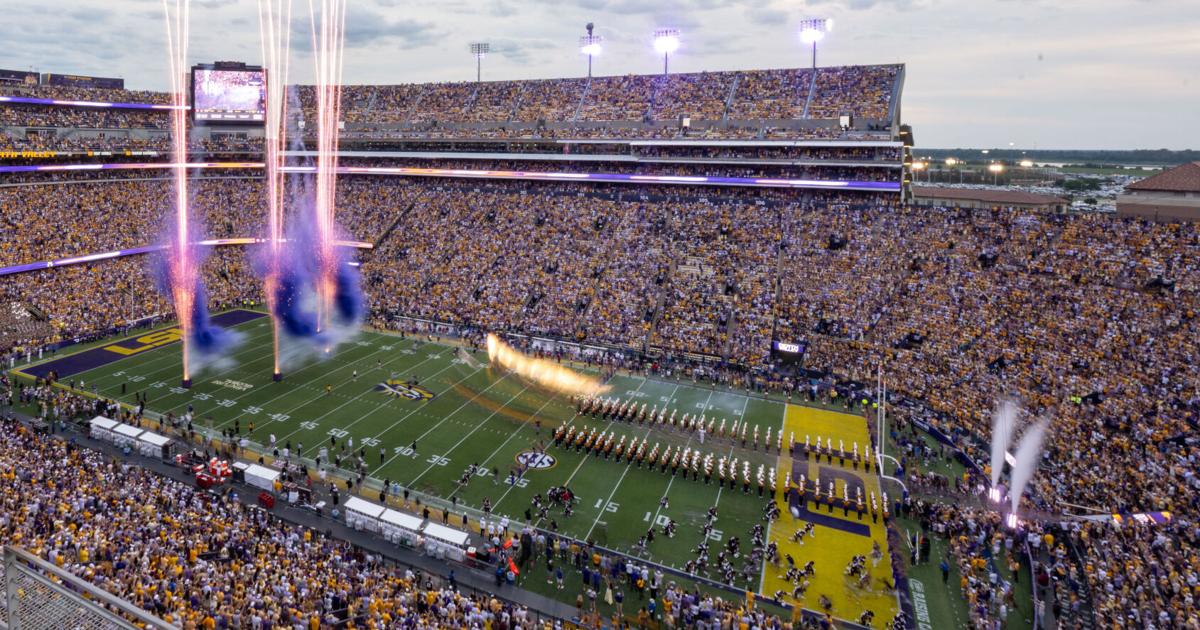
LSU versus McNeese State is called a “buy” game, which names an economic reality.
The expected purchase is an easy win. LSU, with its nearly $230 million athletics budget, will pay McNeese State, a relative runt with an $18.5 million balance sheet, about 4% of its yearly expenses, $750,000, to come on down to Baton Rouge.
The contest will draw another sellout of 102,000-plus fans, who will spend millions on tickets, food and parking. A broadcast network will air it, fulfilling the Southeastern Conference’s 10-year, $3 billion contract with ESPN and Disney.
In luxury boxes, LSU’s boosters, who pour tens of millions more dollars into the operation annually, will relish just how much bigger, stronger and faster their players are than their adversary. Their pocketbooks will remain open so it stays that way.
The money in college football seems infinite, which is why it was jarring when LSU president Wade Rousse came before the state’s board of regents last week and revealed the Tigers’ sports teams were far from self-sustaining.
“We’re gonna address the bleeding,” said Rousse, the former McNeese president, who projected a $26 million deficit for LSU’s athletic department this year.
It doesn’t take a sports economist to explain why LSU expects a loss. It used to cost nothing beyond a scholarship to reel in the athletes who drive a money-making machine, but, five years into NIL pay, the Tigers’ football roster is rumored to command $50 million.
Their coach, Lane Kiffin, is paid $13 million a year, and their former coach, Brian Kelly, was paid a $54 million contract buyout to leave. These big-ticket items forced the university to dig into the Tiger Athletic Foundation’s reserves to cover the shortfall.
What a sports economist will debate is whether the word “deficit” correctly describes LSU’s predicament as it puts on another football spectacle this weekend.
“Every time I order pizza, I’m running a deficit. I made zero money off the pizza,” said Andy Schwarz, an economist at the consulting firm OSKR. “The right question is not, ‘Why didn’t I make money buying pizza?’ The question is, ‘Did I get $25 of value out of that pizza?’”
LSU, undeniably, sees immense value in its football program. Otherwise, dorm funds wouldn’t have been used to prop up Tiger Stadium.
The state cherishes its SEC brand. Otherwise, politicians wouldn’t have rushed to the school’s defense when the conference threatened expulsion over recruiting ex-pros.
There is talk of “chaos” and “unsustainability” in an ecosystem where athletes are paid and they readily test their market value in the transfer portal, which spurred passage of the Protect College Sports Act, which LSU supports, through the U.S. Senate this week.
But the economists who really study college football are skeptical there’s a crisis.
“I think the ‘This is not sustainable’ is supposed to mean college sports will go away. That’s what it’s code for,” Schwarz said. “And that’s (bullcrap).”
‘Envelopes of Cash’
Schwarz has worked high-profile antitrust lawsuits against the NCAA and testified before Congress. But he also designs board games.
His most searingly humorous game might be the college football-themed “Envelopes of Cash,” created in 2020, which allowed players to “take on the roles of head coaches at major college football programs, earning high salaries to exploit unpaid labor.”
“Build the best facilities. Create a winning culture. Pay a lot of cash under the table,” reads the tutorial for the online version, which assigns the user a character, “Preacher in a Visor,” and a team, the “Yellow Tigers,” and a recruiting bus out of Texas prowling for recruits.
This was college football, through a cynical but not completely untrue lens, before Schwarz and others backed an NIL bill in California that touched off a landslide of legislation across states, forcing the NCAA in 2021 to no longer prohibit athlete pay.
The rapid rise in athlete earnings in the last five years, in Schwarz’s view, is a rebound from decades of price-fixing by an NCAA “cartel” that was breaking the law. It should be followed, in theory, by a period where coaching contracts reduce to find the right balance.
“I don’t think it’s a sustainability problem long-term,” said Joel Maxcy, a professor of sports business at Drexel who was elected president of the International Association of Sports Economists in 2015.
“We’ve had college football, in particular at the Power Four level, have coaching staffs earn a lot of money, proportionately more than NFL coaching staffs,” Maxcy added. “There’s this in-between period where the coaches are still paid a lot.”
The problem is wages are “sticky,” Schwarz said. And lawmakers have focused on capping athlete pay, which could make coaching contracts even stickier.
If athlete pay is capped, then schools will seek other differentiators after maxing out on a roster. A coach like Kiffin, who can pitch recruits on an innovative offensive scheme, is the next-best investment because he attracts talent.
“If there were no cap at all, and they could pay athletes whatever they wanted, what you’d see is, on the margins, schools would make decisions,” Schwarz said. “You know what? We should pay a little more for talent and a little less for a coach.”
A not-so-free ‘free market’
In the meantime, schools like LSU are trying to exist in a dual paradigm.
There is still a push for flashy facilities and schemes. But universities are also funneling as much money as possible to athletes through a capped $21.3 million in direct revenue-sharing, as well as an unlimited amount in outside NIL deals with third-party businesses.
Contributions from boosters, which used to count toward “revenue” in schools’ NCAA financial reports, have flowed into player pay, which leads to an accounting shortfall.
“No one donates to the Saints, right? Or the Pelicans. But you donate to LSU,” said Victor Matheson, president of the North American Association of Sports Economists and a professor at Holy Cross in Massachusetts. “Most people don’t count that as a deficit. That’s just a revenue stream.
“But to the extent that you’re taking more money out of the endowment than is a normal rate of return to cover those costs,” Matheson continued, “that’s a serious issue.”
It’s a serious issue, as well, if athletic departments become overly reliant on student fees or direct institutional support, including taxpayer funds, to stay afloat. LSU hasn’t reached that point, but its athletics donor base has been strained.
That’s why Rousse, who has a background in finance, has been working on a plan that could involve spinning off LSU’s broadcast revenues into a separate entity, which would allow investors a minority stake in a perpetual revenue-generator.
Somehow, LSU has to ride out a period of rising costs in an ecosystem that doesn’t experience the same market pressures as traditional businesses.
There aren’t “stockholders” in an athletic department, demanding profits. There are “stakeholders,” boosters, who are limited only by their ambition.
“The whole ‘raison d’être,’ the whole motivating force behind decision-making, doesn’t have to do with profitability, it has to do with victories,” said Andrew Zimbalist, a professor emeritus of economics at Smith College who has authored many books, including Unpaid Professionals: Commercialism and Conflict in Big-time College Sports.
“It’s silly, or certainly inaccurate, to call it a free market,” he added.
LSU boosters don’t want to fade into irrelevance. So they spent to fire Kelly, hire Kiffin, and pay the likes of quarterback Sam Leavitt, left tackle Jordan Seaton and edge rusher Princewill Umanmielen. They will likely buy more star transfers in 2027.
College teams consuming more money than they generate isn’t new. In fact, 94% of Division I athletic departments were in the red during the 2023-24 academic year, according to a report from the Government Accountability Office, even if Power 4 programs have typically landed closer to break-even.
Zimbalist would just ask a couple of philosophical questions amid this decade’s NIL spending spree: What if Power 4 football loses its “best-in-class” appeal as an amateur sports brand and becomes viewed as the NFL’s equivalent of Triple-A baseball?
What if the overt involvement of billionaire boosters, cutting checks over the table, feeds into fans’ perceptions of an uneven playing field?
“Just because college sports has been growing in popularity and revenue so handsomely over the last several decades doesn’t mean that happens forever and automatically,” Zimbalist said. “A lot of the people who are making decisions need to step back and take a close look at what’s actually happening.”
The power of a football brand
Rousse has had a look. But he’s also listened.
During the regents meeting where he bemoaned a $26 million shortfall, Rousse recalled being beckoned to the Supper Club restaurant by E.J. Kuiper, the head of FMOL Health, which is one of LSU’s biggest sponsors.
“Need 10 minutes,” Kuiper said.
“Donate as much money as he does,” Rousse told the regents, “you go for 10 minutes.”
Kuiper wanted Rousse to meet a young woman from Boston who was the daughter of Ohio State and Boston College graduates. But she “stumbled” into Tiger Stadium as a 10th grader while her family was on vacation and didn’t follow in her parents’ footsteps.
She came to LSU, became interested in studying the brain malady CTE in football players and is currently in medical school.
“Our brand matters,” Rousse said, “but we can’t get caught into a system that there’s no fiscal responsibility.”
Football wins can have payoffs off the field. There’s just mixed research on how much.
While there is some economic impact on Saturdays, Matheson said it’s marginal, around an additional $5 million per home game in cities like Tallahassee and Gainesville, Florida, because attendees tend to be from the area and they crowd out other visitors.
There is research to suggest people perceive an institution as better academically when it has a highly visible sports program, and applications rise, though Zimbalist said there are not “robust” findings to suggest the quality of the applicant pool improves.
“What the literature is suggesting is that, mostly, those additional applications are coming from people who are not academically well-equipped,” Zimbalist said.
They may be students hellbent on attending LSU football games.
But they are tuition-paying students, who are in demand.
Randy Grant, a professor at Linfield University who wrote the textbook The Economics of Intercollegiate Sports, points to a decline in birth rates during the Great Recession from 2007-09, which has led to a declining number of applicants.
“Combine that demographic cliff, as they call it, with fewer international students, because the environment’s not generally welcoming to international students these days,” Grant said, “and you just have fewer students to be spread among the schools.
“So anything they can do to attract students, they’re doing.”
Cutting checks or Chick-fil-A sandwiches
In this moment, schools have a choice.
If LSU wants to fuel its athletics marketing and entertainment vehicle with $26 million beyond what it draws in revenue, it can do that and probably survive.
“You think about a few years ago, CTE was a big issue and people were projecting the doom of college football,” Grant said, “and it seems to be thriving as much as ever.”
Schwarz doesn’t see it as a bad thing if the 40 highest-spending football schools in the country eventually break away from the rest, just as the FBS and FCS split in 1978.
There will be a “sorting out,” Schwarz said, where programs with shallower pockets will compete for championships that are still relatively meaningful.
“If you’re in this weird situation where essentially you were punching above your weight for a variety of reasons, including the fact that talent was artificially underpriced,” Schwarz said, “I don’t have a ton of sympathy if you don’t get to keep reaping those ill-gotten gains. But I don’t think LSU is one of those schools.”
Economists agree, LSU will spend to remain in college football’s top tier. The prestige matters too much to its stakeholders not to.
LSU’s opponent this weekend, McNeese State, has to be cautious for reasons that have nothing to do with NIL or revenue-sharing.
Rick Gallot, president of the University of Louisiana System, said “everything is on the table” as his board engages the management consulting firm Deloitte to review its strained athletics budgets, because everything from bussing to away games to feeding athletes on road trips has become more costly.
“You’ve got a 300-pound lineman, you can’t get them a combo meal from Chick-fil-A and think that’s appropriate,” Gallot said, adding it might be possible to figure out if opponents have the same food vendor so athletes can use their meal points on another campus.
Everything is on the table, whether it’s FCS schools in the UL System dropping to Division II or Division III or cutting sports altogether.
That’s not the world LSU lives in. Or the former McNeese president Rousse.
“He was one of ours before LSU stole him,” Gallot joked. “I would be more concerned if it were a president who didn’t have the same economist’s wiring … They’re going to be fine.”
LSU will have its “buy” game Saturday. Kiffin will continue to draw checks. LSU will attack the portal come January.
Where there is a will to spend in major college sports, there is a way.
“It comes down to, ‘Oh, we’re all losing money.’ It’s like, no, you’re all spending money and you’re doing it because you like what you get for the money. ‘Oh, we don’t really like what we get,’” Schwarz said, playing out a dialogue. “Then you should stop. ‘Oh, I can’t stop.’
“There’s only one thing creating demand for a freshman quarterback right now,” he added, “and it’s college programs that supposedly can’t afford them.”