
Quantum computing is moving beyond the research lab and becoming an important area of technology investment. Unlike conventional computers, quantum systems use principles of quantum mechanics, including superposition and entanglement, to approach certain types of calculations in fundamentally different ways. Building these systems requires advances in processors, hardware, software, error correction, and supporting infrastructure, leaving considerable room for companies operating throughout the field.
The technology is being developed for problems that are particularly difficult for conventional computers to handle efficiently. Potential applications range from cryptography and drug development to financial modeling, materials science, and optimization. AI has also added to interest in advanced computing technologies, although quantum computing remains at an early stage and is not yet a replacement for the high-performance systems used to train today’s AI models.
The commercial opportunity could expand substantially as the technology matures. According to Fortune Business Insights, the global quantum computing market was valued at $1.39 billion last year and is expected to reach $1.82 billion this year. By 2034, the market is projected to grow to $17.89 billion, representing a compound annual growth rate of about 33%.
Promotion
70% Off TipRanks
Learn more about TipRanks Premium
That growth outlook is also making quantum computing a compelling area for investors. With that in mind, we turned to the TipRanks database and found two quantum computing stocks that Wall Street rates as Strong Buys, with both offering solid upside from current levels. Let’s take a closer look.
IonQ (IONQ)
First up, IonQ takes a unique path to developing quantum computers. IonQ uses ‘trapped ion’ technology, encoding qubits in different energy states of trapped ytterbium ions to create high-fidelity quantum computing systems. The company, which is based in College Park, Maryland, is close to both the University of Maryland and the environs of Washington, DC – giving it easy access to both top-tier university research networks and the ring of research and government contract agencies that serve the Federal establishment. It’s a prime location for a tech leader in a cutting-edge field like quantum computing.
IonQ’s trapped-ion technology takes advantage of the highly consistent properties of individual atoms. The company uses ytterbium ions as physical qubits, trapping them in place with electromagnetic fields and using precisely controlled lasers to manipulate their quantum states and perform calculations. Because atoms of the same isotope are naturally identical, IonQ can build its systems around qubits that do not suffer from the manufacturing variations found in fabricated components.
The brass ring here is commercial-use quantum systems, and IonQ has several currently available. The company’s Forte and Forte Enterprise systems are both designed as 36-qubit quantum computers, and the Forte Enterprise is optimized for use in large-scale data centers. The Forte Enterprise system was built to fit into standard data center rack installations, allowing it to be quickly and easily integrated into the functioning of AI and cloud computing systems.
IonQ also has the 100-qubit Tempo computer. This machine is designed explicitly to be ‘commercial advantage capable.’ IonQ boasts that Tempo is faster than other publicly available, comparable quantum computers, by a notable margin.
In recent days, IonQ has made a number of announcements showing its commitment to growth. First was the September 21 reveal that it had entered into a partnership with South Korea’s SDT, the quantum tech and software company, to bring both quantum networking and computing to the larger Asia-Pacific region. IonQ will, under the agreement, supply SDT with a Superion 256 quantum computer and the company’s own silicon-vacancy (SiV) quantum memory module.
On September 23, IonQ revealed that it will be the first company to make an on-premise quantum deployment at the NVIDIA Accelerated Quantum Research Center (NVAQC), where its Superion 256 will be integrated with NVIDIA’s accelerated computing infrastructure to advance research into quantum-classical supercomputing. And, on September 24, IonQ announced that its Superion 256 platform was selected for installation at Florida International University.
Those announcements followed an already strong second quarter for IonQ. The company reported record Q2 revenue of $80.1 million, up 287% year-over-year and $13.6 million above the midpoint of its previous guidance. At the same time, its GAAP net loss widened substantially, with the loss per share reaching $5.08 compared with $0.70 in 2Q25.
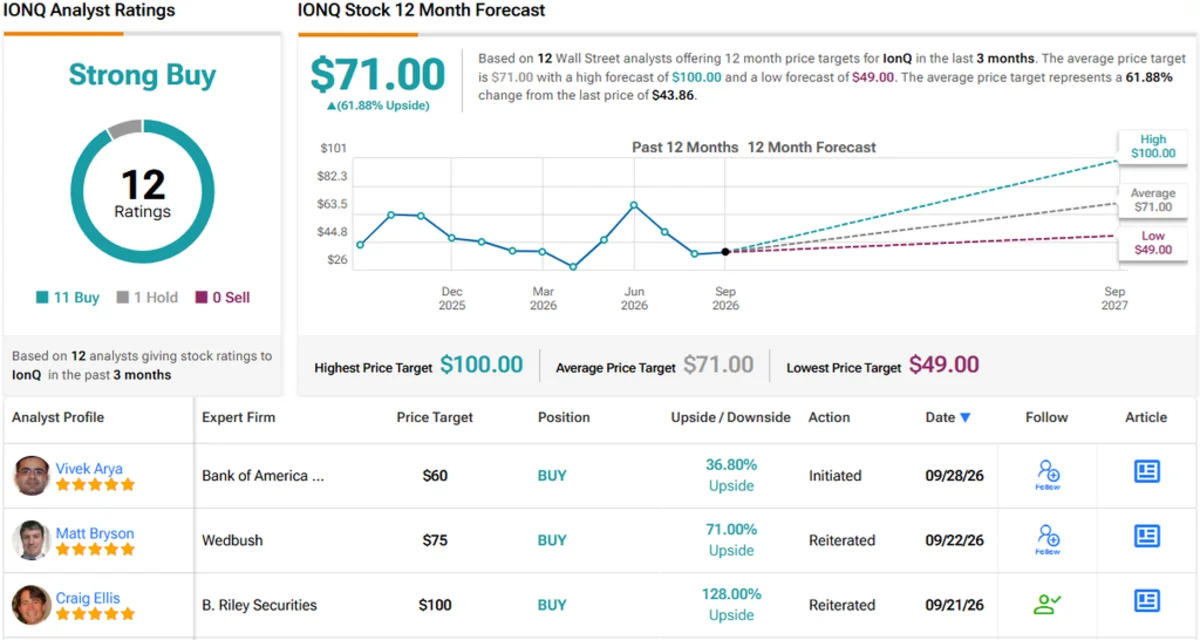
IonQ’s combination of commercial traction and technological capabilities is central to the bullish case laid out by Bank of America’s Vivek Arya, who ranks among the top 2% of Wall Street analysts.
“IonQ has the largest current revenue base in the public pure-play quantum comp set, with a trapped-ion architecture offering high fidelity, long coherence and flexible connectivity. Acquired electronic qubit control and SkyWater manufacturing provide a semiconductor-enabled path to scale, while cloud, dedicated and on-premises access and exposure across compute, networking, security, sensing, space and foundry provide multiple commercialization routes,” Arya noted.
But Arya’s case is not built on IonQ’s current position alone. The analyst points to the company’s next generation of systems and the engineering milestones ahead as potential drivers of much greater sales in the coming years.
“Next-gen Superion 256 system is the first to integrate electronic qubit control, a significant architecture shift that could support substantial logical-qubit scaling. Incremental engineering milestones through 2H26, ahead of targeted customer deliveries in 2Q27, are likely to be highly influential for the stock. We model a 69% sales CAGR from FY26E to FY30E and negative adjusted EBITDA and FCF through FY30E,” Arya explained.
Arya sees enough upside to start IonQ off with a Buy, setting a $60 price target that leaves the shares with another 37% to climb over the next 12 months. (To watch Arya’s track record, click here)
The rest of Wall Street is leaning further into the bull case. IonQ has collected 11 Buys against just one Hold over the past three months, earning the stock a Strong Buy consensus rating. And while Arya sees $60 as the destination, the Street’s $71 average target goes several stops farther. Against IonQ’s $45.63 share price, that works out to upside of ~62%. (See IONQ stock forecast)

Xanadu Quantum Technologies (XNDU)
The Canadian company Xanadu Quantum, based in Toronto, builds its quantum computers using photonic technology. This approach bypasses the most common bottleneck in quantum computer hardware, the need for high-end cryogenic equipment to cool the systems far below the freezing point of water.
Photonic quantum technology uses photons – the fundamental particles of light – rather than the matter-based approaches used by many competing quantum systems. One of its advantages is that photons can operate as qubits at room temperature, eliminating the need for the extreme cooling required by some other quantum architectures. For Xanadu, that can reduce energy requirements and simplify parts of the supporting hardware, while potentially making quantum systems easier to deploy outside highly specialized facilities.
Xanadu has also worked to bring its quantum technology online through cloud access. Its Borealis system was made publicly accessible through Xanadu Cloud and Amazon Braket, allowing users to experiment with photonic quantum computing without purchasing an in-house machine. Separately, Xanadu’s Aurora system is a 12-qubit quantum computer built from 35 photonic chips and four interconnected server racks. Xanadu has complemented its hardware with PennyLane, its open-source quantum software library.
This quantum company is relatively new to the public trading markets. Xanadu’s stock entered the NASDAQ back in March, through a SPAC transaction with Crane Harbor Acquisition Corp. Xanadu realized $302 million in gross proceeds from the SPAC, including $275 million in new PIPE financing.
The stock saw a spike in April but has been falling since then. XNDU shares are down over 39% in the last six months; pressures on the stock include the unlocking of insider shares, capital dilution, and the long projected timeline for real commercial revenue opportunities in the quantum computer industry.
That said, Xanadu did see an improvement in its bottom line in 2Q26. The company reported a loss of $0.14 per share, compared to a loss of $0.27 in the year-ago period, while beating consensus by $0.03. Revenue, at just $1.5 million, missed expectations by $493K and was down from the $2.8 million reported in 1Q26. As of June 30, Xanadu had $312.8 million in available cash and liquid assets.
RBC’s Paul Treiber, a 5-star analyst, sees Xanadu as a long-duration bet where the payoff could justify the wait. Commercial revenues may still be years out, but Treiber argues that the road between now and then contains enough technical and funding milestones to create value along the way.
“While meaningful commercialization remains several years away, we believe the shares of Xanadu offer compelling long-term capital appreciation potential as the company progresses toward key technical and funding milestones… An investment in Xanadu’s shares exists in two states simultaneously: it offers the potential for significant capital appreciation if fault tolerance is achieved on schedule, but also carries downside risk if technical or funding milestones are delayed or unmet. Investor sentiment may vary widely between these two states; we believe current valuation offers an attractive entry point and risk-reward in light of the likely volatility in the stock,” Treiber opined.
Treiber’s price target shows just how much he thinks those checkpoints could be worth. His Outperform (i.e., Buy) rating comes with a $16 target, leaving XNDU with a whopping 249% potential climb over the next 12 months.(To watch Treiber’s track record, click here)
Overall, the rest of the Street is even more bullish on XNDU than RBC is. The stock is priced at $4.58, but the $28.75 average price target implies steep upside potential of ~528% in the next 12 months. The shares have a unanimously Strong Buy consensus rating, based on 4 recent analyst reviews. (See XNDU stock forecast)

Disclaimer: The opinions expressed in this article are solely those of the featured analysts. The content is intended to be used for informational purposes only. It is very important to do your own analysis before making any investment.