
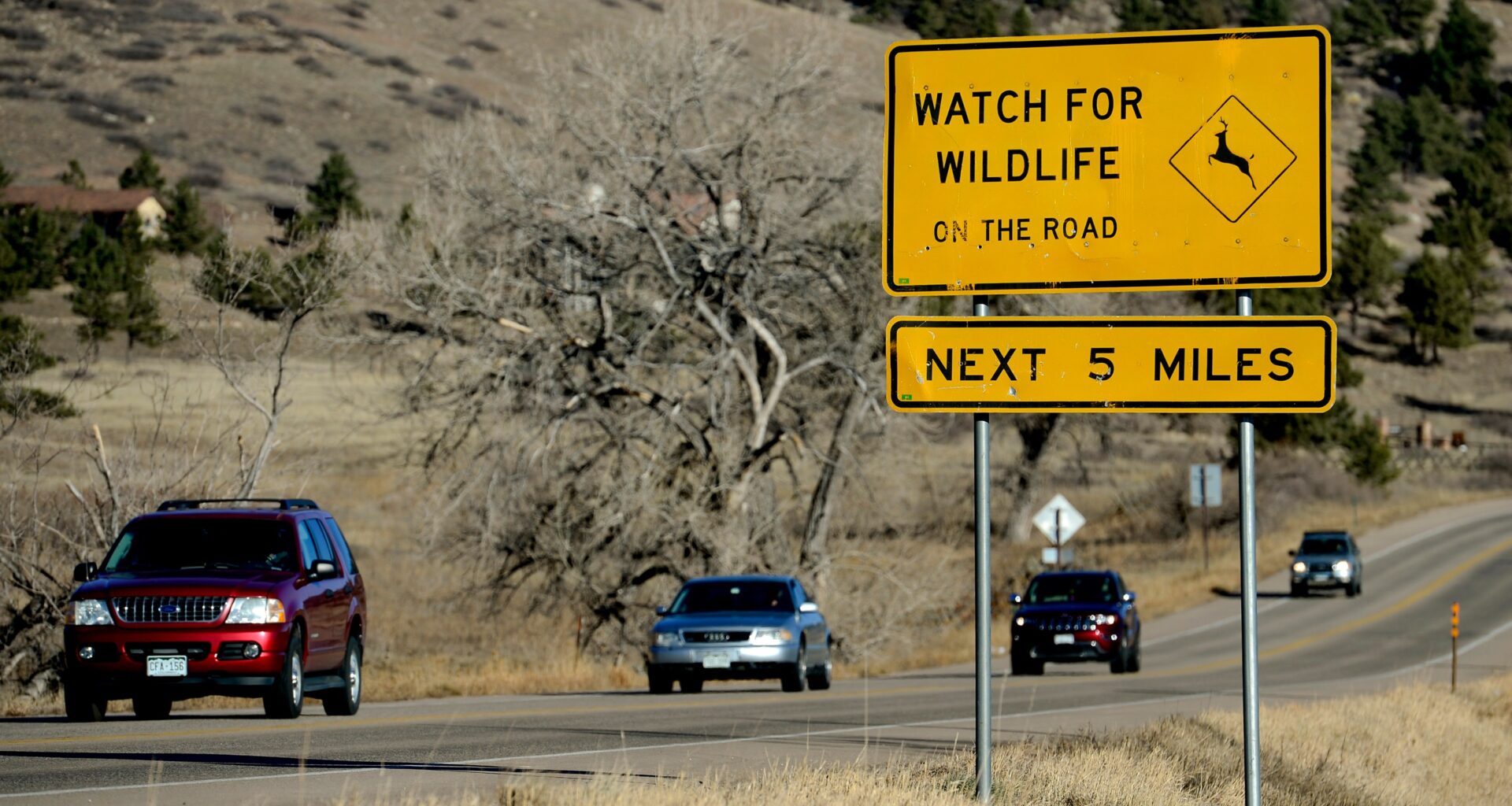
Colorado drivers are not the only ones on the roads this fall. As the leaves turn and temperatures drop, the state’s wildlife is on the move, too.
October through December is the peak season for wildlife crashes as animals migrate to lower elevations for the coming winter, often crossing roads along the way, Colorado State Patrol said in a release.
State Patrol has investigated more wildlife crashes each year since 2021. Last year, the agency responded to 3,904 such crashes.
Deer and elk are the most frequent victims, but pronghorn, bears and marmots have also been struck by vehicles, the state patrol said.
Some of the roads with the highest risk for wildlife crashes include:
U.S. 160 from Durango to Pagosa Springs and Durango to Mancos
U.S. 50 from Pueblo to the eastern state line, Blue Mesa Reservoir and Gunnison to Parlin
Interstate 70 in Floyd Hill, Mt. Vernon Canyon and Eagle
Interstate 25 from Castle Rock to Larkspur
U.S. 285 in Morrison
U.S. 40 from Craig to Steamboat, Tabernash, and Berthoud Pass
U.S. 24 from Riverside to Buena Vista, Newett to Johnson Village
U.S. 550 north of Durango and from Montrose to Ouray
The best way to avoid hitting wildlife is to drive the speed limit and slow down when it’s more difficult to see the road, the agency said. That way, drivers have time to react and brake safely.
But sometimes that braking safely isn’t an option. In that case, drivers should stay in their lane and drive through the animal, the agency said. Those traveling in a single lane or an outside lane, with a white stripe on the white side, can angle their car slightly, away from oncoming traffic, to hit the butt of the animal.
Drivers should never swerve or jerk the steering wheel, the state patrol said.
“It is up to all of us to remove distractions and watch out for these beautiful animals,” Col. Matthew C. Packard, chief of the state patrol, said in a statement.
Get more Colorado news by signing up for our Mile High Roundup email newsletter.