
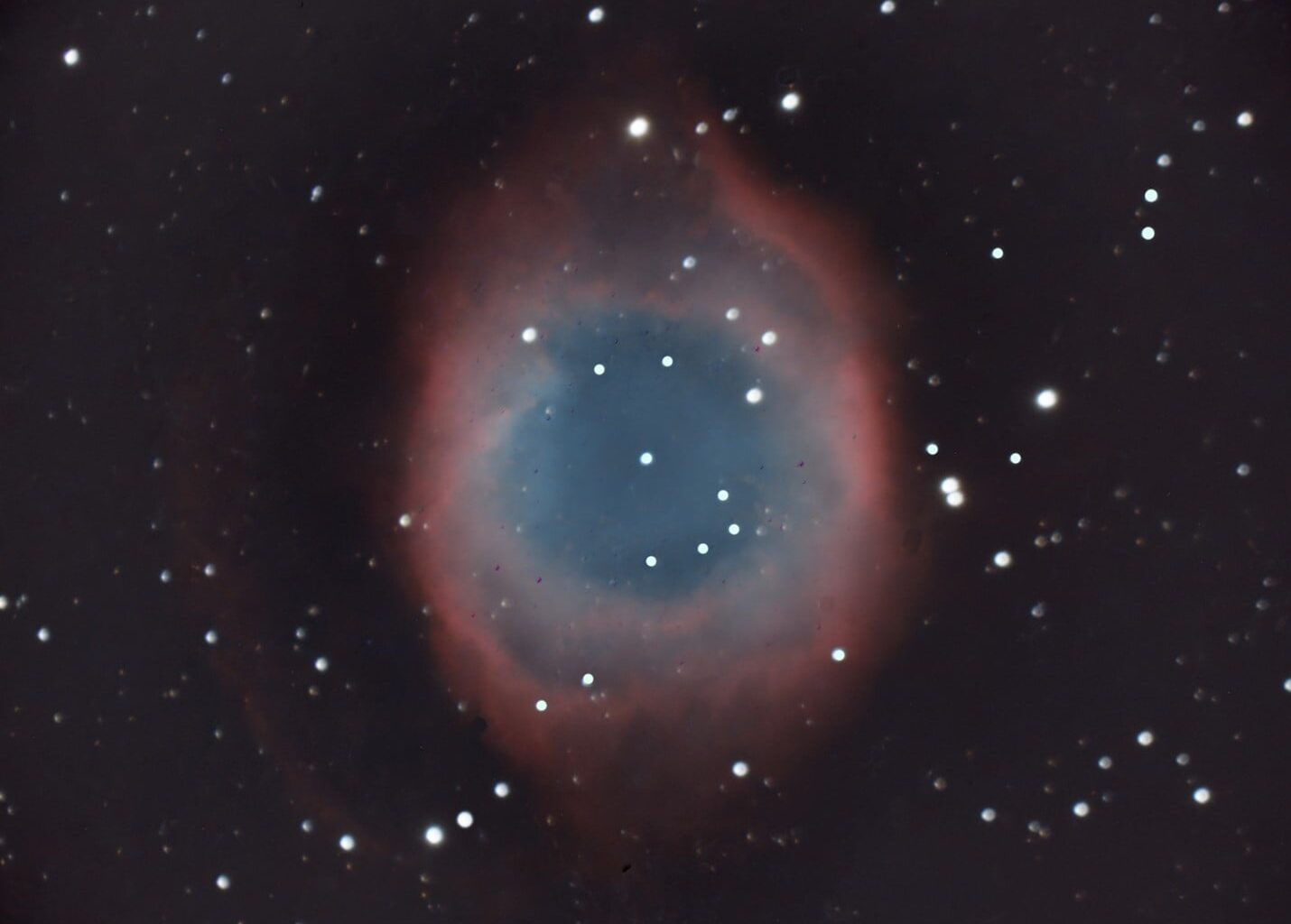
Special Nor’easter Addition
Unfortunately, the large nor’easter that took out NC 12 also took out a part of my observatory. Everything is pretty much back to normal now, but the repairs left me running short of time for observations.
The above is the Helix Nebula, NGC 7293.
This planetary nebula was discovered by Karl Ludwig Harding in the 1820s. It’s about 800 light-years away from us and has a visual magnitude of +7.6. It is commonly called the “Eye of God,” but Lord of the Rings fans often call it the “Eye of Sauron.”
What you can look for in October’s Night Skies
You might be able to see Venus and Mercury right above the western horizon just after sundown.
Saturn will rise in the east right after sundown.
The Orionids Meteor Shower is active from the beginning of October through the first week of November. The peak is on the night of October 21. As the name implies, the Orionids are associated with the constellation Orion. The shooting stars will seem to originate near the constellation, but they’re really debris from Halley’s Comet.
At midnight on the 21st, Orion will be about 15 degrees above the eastern horizon. The best way to view the meteor shower is to pick a clear night, go up on the beach around midnight and gaze in the direction of Orion. Once your eyes adjust to the darkness, you should start seeing some shooting stars.
Moon Phases:
Last Quarter is October 3
New Moon is October 10
1st Quarter is October 18
Full Moon is October 26