
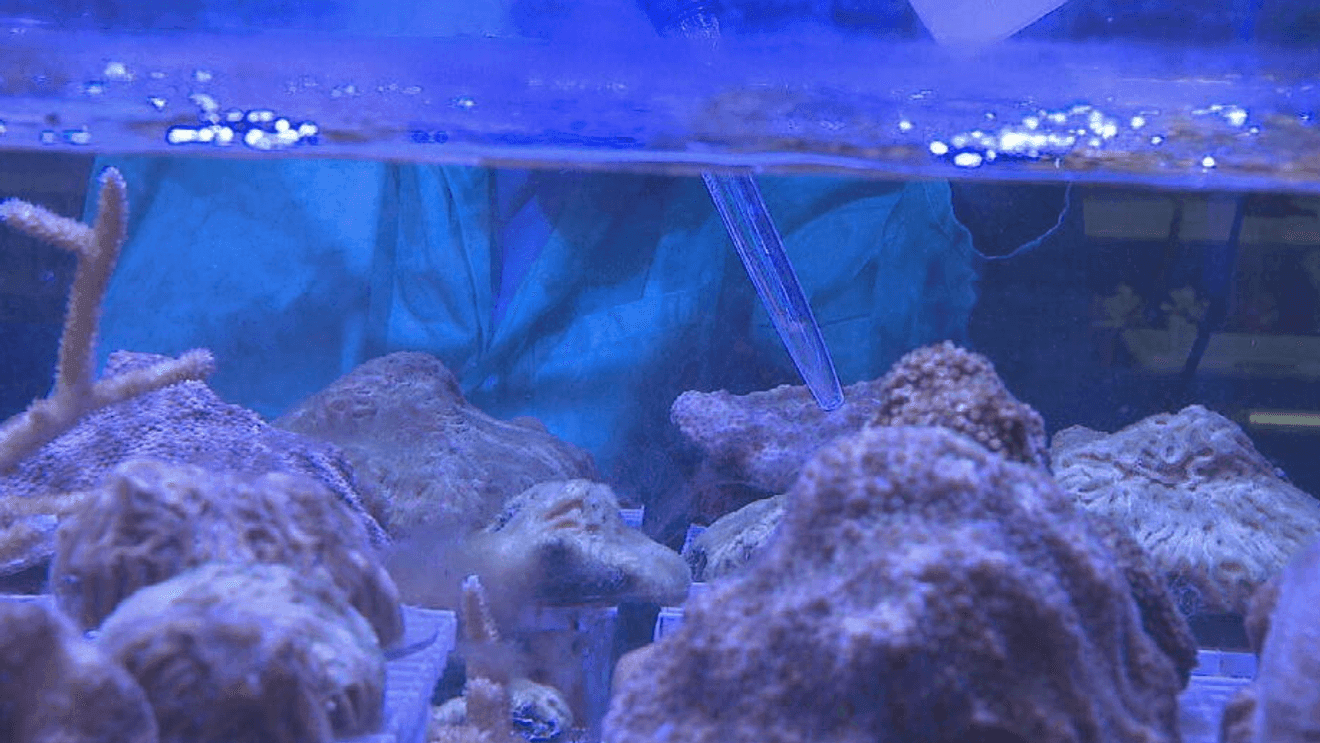
GULF BREEZE, Fla. — WEAR News got an inside look at a federal coral reef research lab in Northwest Florida.
It’s called the “Gulf Coast Environmental Science Laboratory.” And it’s part of the Environmental Protection Agency (EPA).
Scientists say you can’t find any coral reefs in Florida, north of Fort Lauderdale. But in Gulf Breeze, researchers are studying coral from across the globe.
As you’re crossing over the Bob Sikes Bridge to Pensacola Beach, look right. You’ll see a nearly 100,000 square-foot EPA research facility sitting on its own island.
Inside are a team of chemists, divers and biologists at work, studying how environmental stressors can affect some of the world’s most fragile ecosystems — like coral reefs.
“So some of the experiments, primarily what we focus on here are land-based sources of pollution,” said Cheryl Hankins, research biologist at the Gulf Coastal Science Branch. “And some of the research that we’ve done in the past and some of our current stuff involves microplastics, UV filters, ultraviolet filters, the active ingredients that are in sunscreen.”
The lab is currently home to 15 different species of coral.
“Most of the corals you see in here are Atlantic species or Caribbean species,” Hankins said. “This tank over here that you see are Hawaii corals.”
The goal is to identify how human activity impacts reef health.
“And you’re able to take that information and translate it into real science that we can apply and use in terms of making decisions for regulatory agencies and customers, stakeholders in the regions that sort of thing” said Teresa Booeshaghi, associate administrator for the Office of Applied Science and Environmental Solutions.
Booeshaghi says coral reefs are the cornerstone of much of the ocean.
WEAR: Why does coral matter and the health of coral matter to humans?Booeshaghi: Yeah, so I mean it has a huge impact as, you know, on our tourism economy, especially here in the state of Florida. You know, fishermen, recreational divers, but it also is a, you know, a stability factor for impacts, like storms and it provides some buffering for that sort of thing. So it’s a really important ecosystem. It does also support, it serves as sort of a nursery habitat for many species, so it’s a really vital piece of our environment.
Scientists at the lab also study pollution, contaminants, coastal ecosystems and water quality, using everything from field research to computer modeling.