
“What is taking shape in America is impressive.” This is how the French thinker Alexis de Tocqueville summarized the process of independence of the Thirteen Colonies and the birth of the country destined to become a beacon of freedom and democracy for the world.
It is one of the many insightful remarks made at the seminar “Transatlantic Relations on the 250th Anniversary of U.S. Independence,” held at the Casa de América and sponsored by the Franklin-UAH Institute, the Spain-U.S. Council Foundation, and the U.S. Embassy in Spain and Andorra.
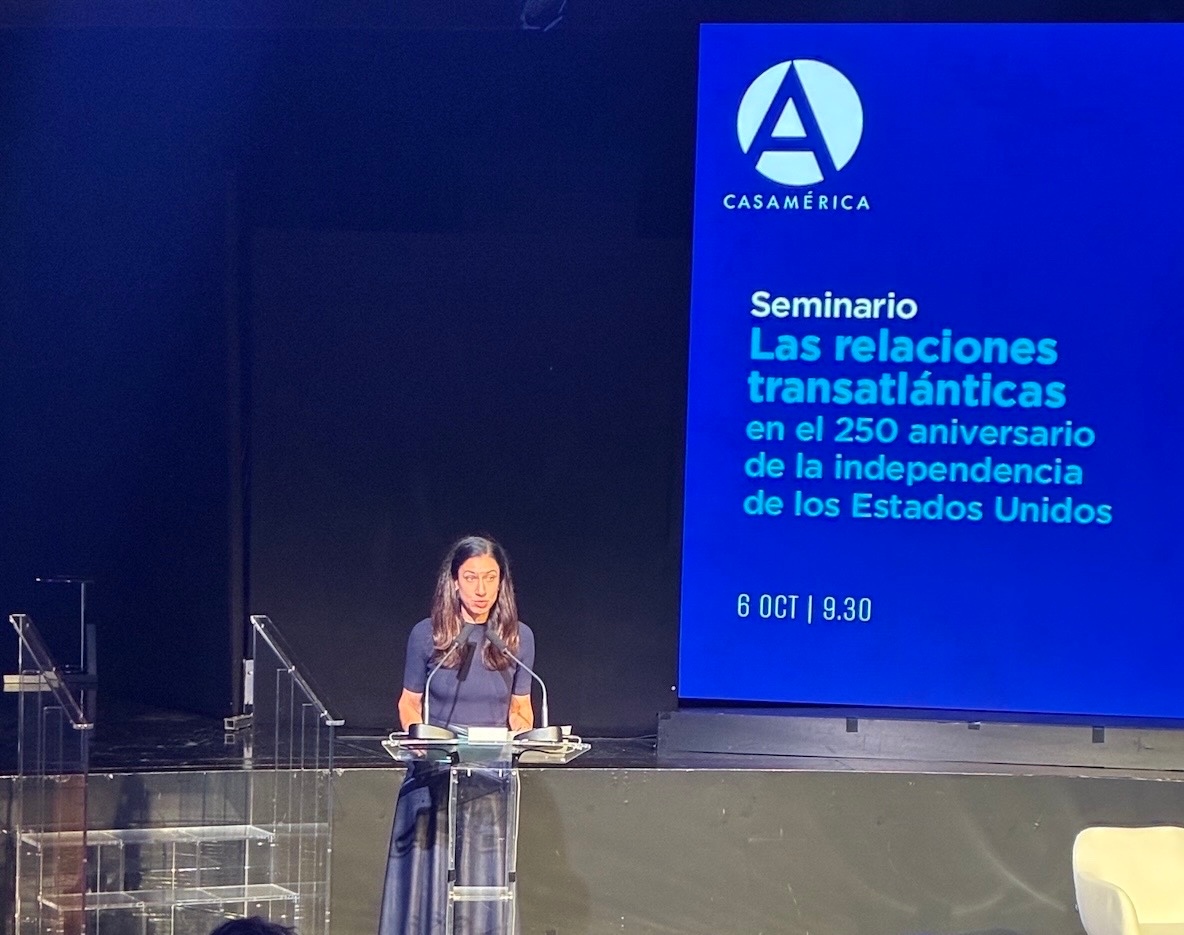
Michelle Riebeling, Counselor for Public Diplomacy at the U.S. Embassy in Spain and Andorra, highlighted the depth of the ties and shared values between Spain and the Americas during her remarks.
Four roundtable discussions and talks explored many aspects of Spain’s role in the birth of the nation, which not long afterward would play a decisive role in ensuring that Europe preserved its freedoms and was able to achieve prosperity after defeating Nazism, winning the Cold War against communism, and establishing itself as the destination for all those who aspire to realize their greatest dreams and innovative projects.
The first wake-up call came from the current president of the Council of State, Carmen Calvo, who captivated the audience by highlighting the figure of José de Gálvez, the brother of Bernardo—the latter being the better-known and more popular figure. “It was José who truly carried out the will of King Charles III to provide the rebels with decisive financial and in-kind aid—gunpowder and cannons—in their fight against England.” That “pygmy republic—but God knows how far it may go,” in the words of the Count of Aranda, soon became a laboratory of ideas for the politics and democracy of the future. “The people will decide which governments remain in power; they will rise or fall and be replaced by others,” proclaimed Professor José Antonio Gurpegui, director of the Franklin-UAH, quoting Tocqueville.
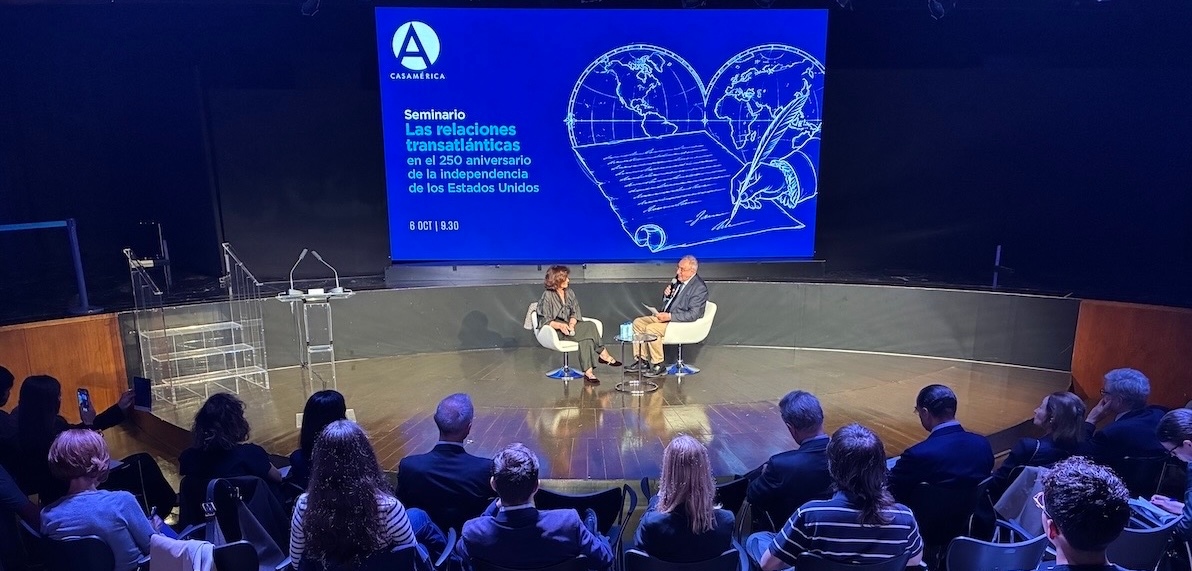
José Antonio Gurpegui, Director of the Franklin-UAH Institute, engaged in an in-depth conversation with the President of the Council of State, Carmen Calvo, regarding the major role Spain played in the birth of the United States.
The former Chief of the General Staff of the Armed Forces (Jemad) and ex-director of the CNI, Félix Sanz Roldán, pointed out that if Spain’s role in that independence is less well known than France’s, it is due, among other reasons, to the fact that it was Charles III himself who advocated secrecy regarding Spanish aid and support operations, and even to the fact that the Spanish naval fleet, which was then far more powerful than the French one, agreed with Paris to safeguard France’s overseas possessions while French ships and sailors were engaged in the decisive victory at Yorktown.
The lieutenant general recounted how Spain had differences with the United States practically from the very beginning: first over border disputes, when quite a few Black slaves sought the protection and shelter of the Spanish Crown; then came 1898, which instilled truly monstrous lies—attributed to the Spanish—in the minds of several generations of Americans, “which I encountered and refuted during my nine-year stay in a country that I love and respect, as I do its people.” Then came the 1920s, Hemingway, Dos Passos, the Civil War, and the subsequent dictatorship. “In reality,” says Sanz Roldán, “relations with the United States only began to normalize under King Juan Carlos I.”
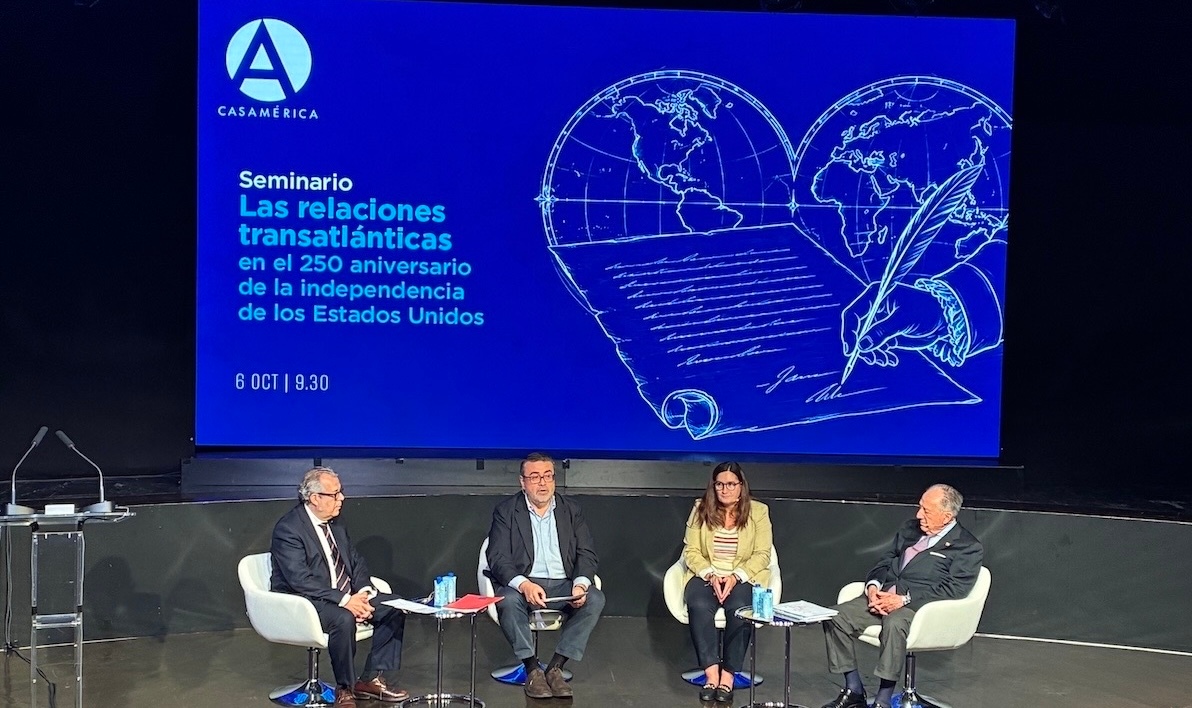
Panel discussion featuring Manuel Lucena (CSIC researcher), Raquel Barras (GEIS-Franklin researcher), and Félix Sanz Roldán (Chief of the Defence Staff [JEMAD] 2004–2008 and former Director of the CNI), moderated by researcher Pedro Rodríguez. Photo Casa América
Manuel Lucena, a historian at the CSIC, believes that, contrary to a fairly widespread belief, King Charles III of Spainachieved everything he set out to do, with the exception of reclaiming Gibraltar. But, in addition to wresting the island of Menorca back from the British, he had to contend with revolts in Peru and Colombia against his modernizing reforms, just as he did domestically with the Esquilache mutiny. None of that resistance stemmed from any supposed desire for independence from Spain, since those Spaniards on the other side of the Atlantic were well aware of the power and prosperity that working and doing business in the Empire’s viceroyalties afforded them.
Regarding current bilateral relations, Sanz Roldán himself highlighted Spain’s status as a reliable ally with a compelling example: “Spanish pilots and aircraft monitor NATO’s eastern airspace, including border areas in the Baltic States. We have now completed 16 rotations of these highly specialized teams, and the Baltic states have not yet purchased a single aircraft. ‘Are we worse allies for not wanting to spend 5% of our GDP?’ he asked, while asserting that our status as a partner and ally should not be measured solely by the money we contribute, but by what we do in solidarity with the goal of our common defense.”
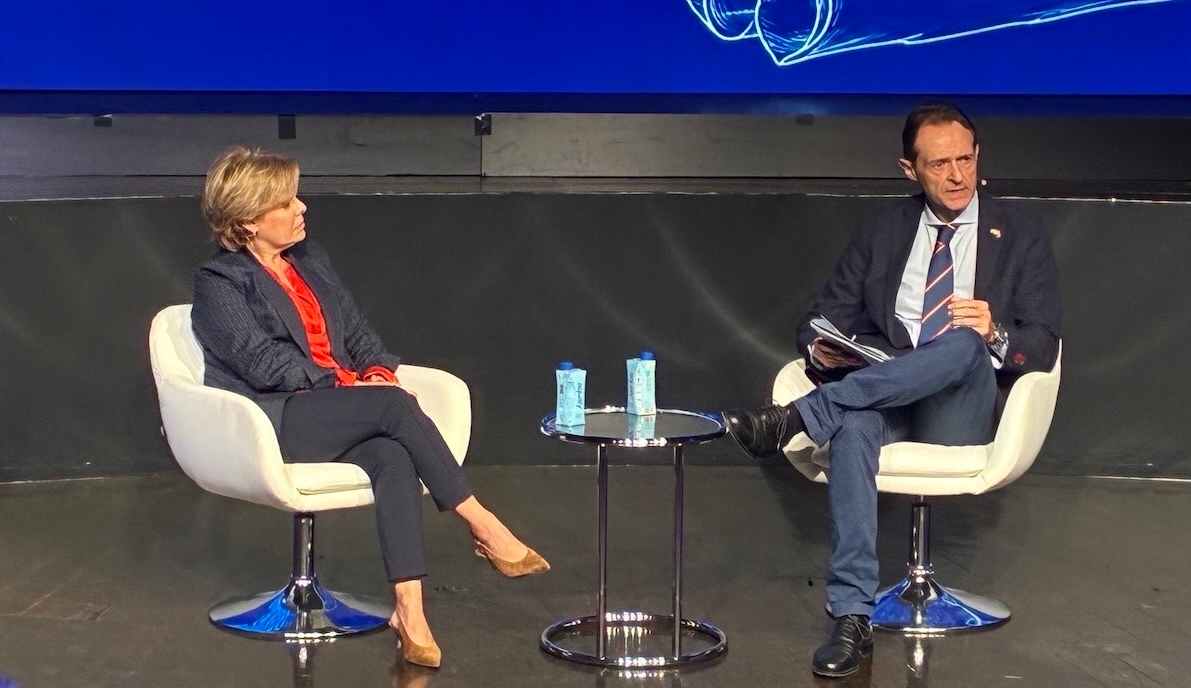
Soraya Sáenz de Santamaría, State Attorney and former Deputy Prime Minister, analyzed the state of Spain-U.S. relations in conversation with David García Cantalapiedra of the Franklin-UAH Institute.
Regarding relations and future prospects, the former Deputy Prime Minister, Soraya Sáenz de Santamaría, after listing a series of events from recent history, emphasized China’s meteoric rise and the Asian giant’s decisive entry into the World Trade Organization (WTO), in the very same year—2001—that the attacks on the Twin Towers in New York took place. “From that point on, China used the WTO’s own rules to establish itself as an economic power with enormous influence and rapidly growing ambitions.” However, the state attorney pointed out some of China’s weaknesses, which she summed up in a pithy phrase: “China is growing old [due to the rapid aging of its population] before it has become rich.”
Regarding the future of transatlantic relations, she highlighted the fact that every year 30,000 students from the United States choose Spanish universities to pursue their studies—a flow that, like no other, fosters the forging of personal and professional ties, grounded in a significant set of shared values, which will shape the elites of the future and, therefore, shape a world undergoing the most rapid change in human history.
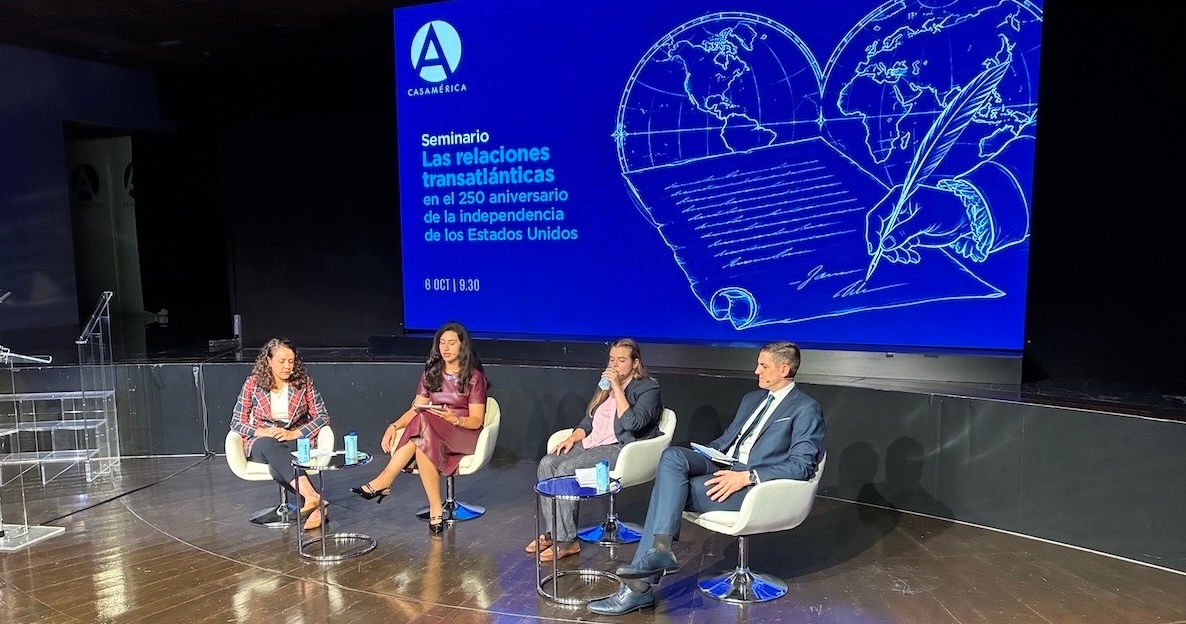
Mesa sobre el futuro de las relaciones transatlánticas y los próximos líderes a un lado y otro del océano, conformada por
Natalia Oliva (Ferrrovial), Clara Sánchez Portela (secretaria general del Consejo Atlántico Juvenil Español y Jesús García Aparicio,
secretario de Fulbright Network Spain, moderados por Alba Grieb, investigadora GEIS
And here is a telling anecdote illustrating American appreciation for Spain. Carmen Calvo also recounted it: “When President Obama visited the Rota base, near the end of his term, he told Spanish authorities that, among the rotating postings where U.S. troops are stationed around the world, ‘the jackpot was—and is—the Rota base.’”