
Since 1999, the world has celebrated World Space Week in early October, honoring science and technology and all things outer space.
The celebration spans Oct. 4-10, marked by two significant space-related events. On Oct. 4, 1957, the first artificial Earth satellite, Sputnik 1, was launched. A decade later on Oct. 10, 1967, the Outer Space Treaty, which forms the basis of international space law, was signed.
Of the roughly 800 people in history to cross the boundary into space, here are several from South Carolina.

Apollo 16 astronaut Charles Duke, who walked on the moon, at the Johnston Peach Blossom Festival in this 2023 file photo.
Charles Moss Duke Jr.
Duke is the only South Carolinian to set foot on the moon. In typical southern fashion, he brought grits with him as his one personal item. A Lancaster native who didn’t initially dream of being an astronaut, Duke ended up on the Apollo 16 mission in 1972.
He followed his father’s military path and joined the Air Force. He then received his master’s degree in aeronautics and astronautics from the Massachusetts Institute of Technology, which led him to working on MIT’s Apollo navigation system. This work was where he met astronauts who inspired him to later join NASA’s astronaut program, which eventually led him to the moon.
Throughout his career, Duke served as the spacecraft communicator for the Apollo 11 moon landing and as the lunar module pilot for Apollo 16. Not only was Duke was the first South Carolinian and 10th person to walk on the moon, he was also the youngest to do so — a record he still holds.
While Duke currently resides in New Braunfels, Texas, he vacations in Pawleys Island every year and says he plans to eventually move back to South Carolina.
Official NASA portrait of Ronald E. McNair, Courtesy of Wikimedia Commons.
Ronald McNair
Born and raised in Lake City, McNair was the second African American to travel to space.
After graduating high school in South Carolina, McNair attended North Carolina A&T State University, where he earned a bachelor of science degree in physics. He went to the Massachusetts Institute of Technology to get a doctorate in physics and later received an Honorary Doctorate of Laws from North Carolina A&T State University.
His career with NASA began after he was selected as one of 35 candidates out of a pool of 10,000 to be a part of its astronaut program in 1978.
McNair’s first trip to space was in 1984 as a mission specialist on NASA’s 10th shuttle mission. He traveled aboard the Space Shuttle Challenger with five other astronauts. The mission notably carried out the first untethered spacewalk.
McNair’s second mission was again aboard Challenger, this the fatal mission that killed seven astronauts when the shuttle exploded shortly after launch. School children across the country were watching the Jan. 28, 1986, launch because Christa McAuliffe was to be the first teacher in space.
NASA astronaut Randy Bresnik, who graduated from The Citadel in 1989, was named commander of the Artemis III crew on June 9, 2026.
FILE/NASA/Provided
Randy Bresnik
The first Citadel graduate to fly to space, Bresnik made history again in June when he was named commander of the four-person Artemis III crew.
The Kentucky native earned a bachelor of arts degree in mathematics from The Citadel in 1989. He became a U.S. Marine colonel before joining NASA in 2004.
The Artemis III mission will be Bresnik’s third mission to space, having flown aboard the Space Shuttle Atlantis in 2009 and the Soyuz MS-05 spacecraft from the Baikonur Cosmodrome in Kazakhstan in 2017. Both flights were to the International Space Station.
Astronaut Catherine “Cady” Coleman was born in Charleston and has logged more than 4,330 hours in space.
Cadey Coleman/Provided
Catherine “Cady” Coleman
A chemist, engineer, former U.S. Air Force colonel and a retired NASA astronaut, Coleman was born in Charleston and now lives in Massachusetts with her family.
She was selected by NASA in 1992. Her career includes two Space Shuttle missions, having spent 159 days in space aboard the Expedition 27 that departed the International Space Station on May 23, 2011.
Coleman has held numerous roles, including astronaut, CAPCOM, chief of robotics, and leader of space station habitability and supply operations. She contributed to major programs such as the International Space Station, the Return to Flight effort after the Space Shuttle Columbia explosion, and partnerships with commercial companies like SpaceX and Orbital ATK. Her final NASA assignment focused on open innovation and public-private partnerships at NASA.
Coleman logged more than 4,330 hours in space aboard the Space Shuttle Columbia and the International Space Station.
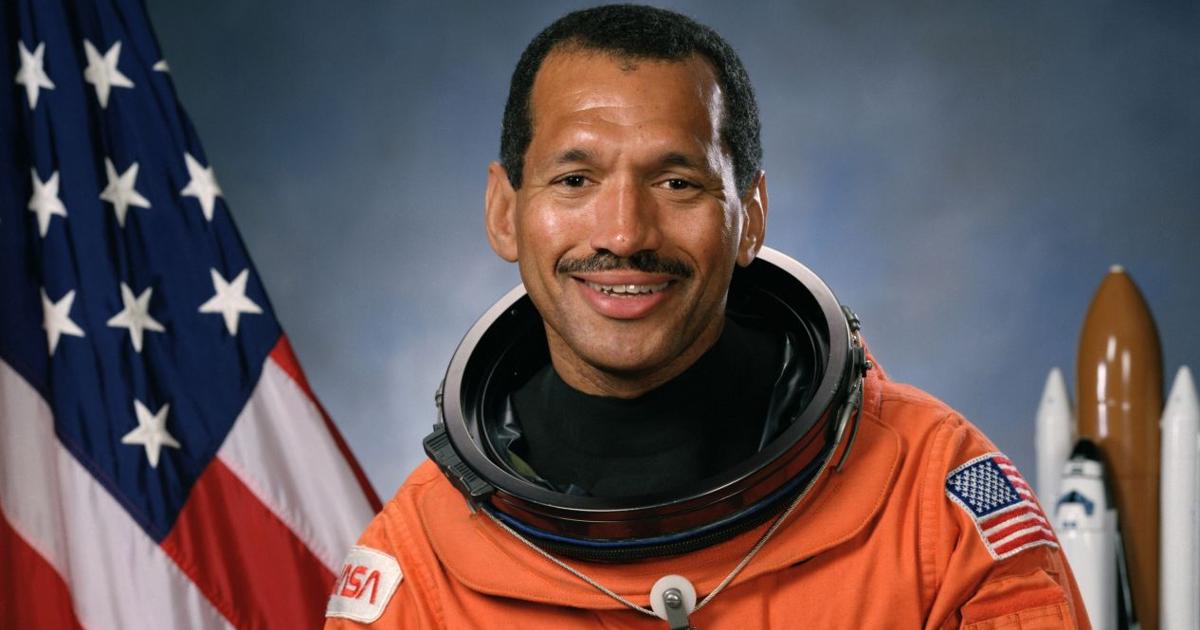
Astronaut Charles F. Bolden Jr., of Columbia, became the first African American to hold the office of NASA administrator. He is one of the most prominent members of the Martin family.
File/NASA/Provided
Charles Bolden
Maj. Gen. Charles Frank Bolden Jr. served as administrator of NASA after being appointed by President Barack Obama in 2009.
The Columbia native graduated from the U.S. Naval Academy and became a Marine aviator and test pilot. He flew four space missions, logging more than 680 hours in space before retiring from NASA in 2017.
He is one of a handful of NASA astronauts recruited by Nichelle Nichols to increase the minority and female astronauts. Nichols was an actress known for her role as Uhura on the original Star Trek series. NASA hired her in the late 1970s, leading to the recruitment of Guion Bluford, the first African-American astronaut, and Sally Ride, the first female astronaut.
Since his retirement, Bolden has sough to give back to the community he calls home through various efforts such as visiting an Aiken elementary school to talk about his experience in space.
Astronaut John H. Casper, mission commander, floats near the Commercial Generic Bioprocessing Apparatus (CGBA) station on Endeavour’s middeck. A friction car and its accompanying loop — part of the Toys in Space package onboard — can be seen just above Casper’s head. The photograph was taken with a 35mm camera in January 1993.
NASA/Provided
John Casper
Born in Greenville, Casper became an astronaut in 1985 and is a veteran of four Space Shuttle missions — three as commander and one as a pilot. He logged more than 825 hours in space between 1990 and 1996.
In February 1990, Space Shuttle Atlantis launched from Kennedy Space Center in Florida. The mission is historic because the shuttle flew at 62 degrees inclination, the highest inclination flown to date by a manned U.S. space flight.
On his final shuttle mission in 1996 aboard Endeavour, Casper served as commander on a crew that performed a record number of rendezvous sequences.
Casper held several roles at NASA, including director of safety, reliability and quality assurances at the Johnson Space Center.
He earned a bachelor’s degree in engineering science at the U.S. Air Force Academy in 1966. He flew 229 combat missions in Vietnam and received two Distinguished Flying Crosses, according to Purdue University, where he attended a graduate program.
Frank L. Culberston Jr.
Of all his historic moments, Culbertson was the only American who was not on Earth during the Sept. 11 attacks.
Born in Charleston, he considers Holly Hill his hometown and graduated from Holly Hill High School in 1967. He went on to the U.S. Naval Academy, earning an aerospace engineering degree from the Naval Academy in 1971.
After graduating, Culbertson flew for the Navy for more than a decade, until he was selected as an astronaut in May 1984.
Throughout his nearly 20-year NASA career, Culbertson logged more than 143 days in space across three flights aboard Space Shuttles Atlantis and Discovery.
His last was NASA’s third expedition to the International Space Station. He served as commander of the mission that launched Aug. 10, 2001.