
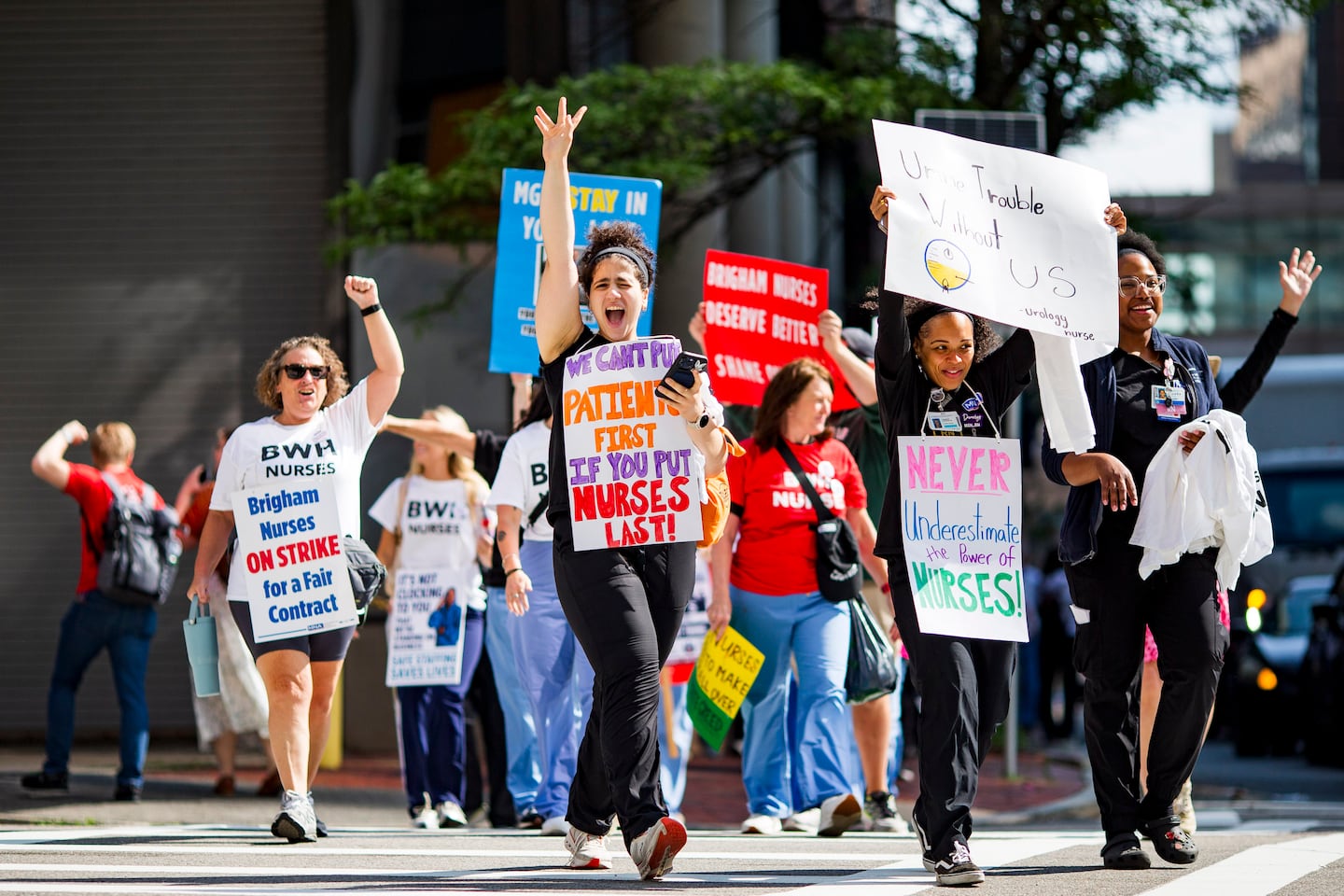
The preparations include bringing in 1,600 to 2,000 temporary nurses, most of them from Colorado-based U.S. Nursing. That company provided temporary nurses for five days this summer after the union staged a one-day strike on July 8 and the hospital locked out the Brigham nurses for four more days.
“They are top notch,” said Pamela Linzer, associate chief nursing officer at Brigham, who said the average replacement nurse has eight to 10 years’ experience, typically at acute care teaching hospitals. Many of them, she added, filled in for Brigham’s nurses in July. “They’re ready to hit the ground running at 7 in the morning on Wednesday.”
The reason there would be significantly fewer temporary nurses than striking nurses, she said, is because many of the 4,000 unionized nurses work part time.
Some of the fill-in nurses have signed contracts to work for two weeks, Linzer said, while others have committed to work as long as the potential strike goes. She confirmed that some of the nurses have agreed to work five 12-hour shifts in a row.
Dr. Paul Biddinger, chief preparedness and continuity officer for Brigham’s parent corporation, Mass General Brigham, said the state Department of Public Health will have inspectors at the hospital every day to make sure there are no lapses in care.
Brigham will “briefly pause new admissions to the hospital starting at 5 a.m. on the morning of the strike” to allow “a transition of nurses’ teams,” he said. “But we expect to resume normal admissions shortly after.”
“In most cases, patient care will continue as normal,” he said.
In contrast to the earlier strike, the one next week does not have a scheduled end date. On Sept. 24, rank-and-file union members overwhelmingly voted to authorize an open-ended strike if Brigham didn’t offer a satisfactory contract proposal.
The MNA last authorized an open-ended strike at Tenet Healthcare’s Saint Vincent Hospital in Worcester in February 2021. It lasted 301 days, making it the longest nurses strike in state history, and involved about 800 nurses.
The contract dispute at Brigham has been largely over wages, though the union said it was also demanding the new contract provide more affordable health insurance options and limit the hospital’s use of temporary nurses.
The union initially wanted a 3 percent raise for the first six months of the contract and a 4 percent raise for the next 12 months. The hospital wasn’t offering any new across-the-board raise, but noted nurses already received a 5 percent “step” increase on the yearly anniversary of their hiring until they reach two decades of service.
On Thursday, the union said the nurses “significantly reduced their wage proposal,” offered to extend the proposed contract term from 18 months to two-and-a-half years, and agreed to increase the proposed limit on temporary nurses from 10 percent per hospital unit to 15 percent, among other concessions.
In response to the union’s proposal on temporary nurse limits, Brigham offered to share data on any department where more than 15 percent of the nurses are temporary. “Our goal would be to work together to address recruitments issues,” the hospital said.
Brigham also offered one of two updated wage options. The first would restructure the pay step scales, while the other would add an additional step for the most tenured nurses that would give them a 2.5 percent raise.
Currently, Brigham nurses start at $86,700 annually, and those with two decades of service earned at least $220,000, according to MGB. Nearly one-third of the union local, or 1,322 nurses, were earning that maximum amount, MGB said, making them among the highest paid in the state.
Over the past five fiscal years, Brigham said, nurses’ base wages have increased by an average of 55 percent.
Brigham nurses say the across-the-board raise is crucial because of inflation, the high cost of living in Greater Boston, and the need to retain highly trained employees.
Brigham nurses have expressed concern about the continuity of care for their patients during a strike. Michele Hassler, a longtime oncology nurse who cares for patients receiving bone marrow transplants, said she is dreading Wednesday.
“I don’t want to leave their care to somebody who is not going to necessarily know what to do for them and make sure that they get home safely,” she said.
Numerous federal and local officials have urged both sides to reach an agreement.
The Massachusetts congressional delegation on Wednesday issued a statement saying that a strike “has the potential for serious impacts on our communities, patients, and healthcare workers, which we know no nurse or patient wishes to experience.”
“We call on Mass General Brigham to remain at the bargaining table with the Massachusetts Nurses Association and work to reach a good faith agreement that addresses the needs of nurses, patients, and our constituents,” said the delegation.
Jonathan Saltzman can be reached at jonathan.saltzman@globe.com. Marin Wolf can be reached at marin.wolf@globe.com.