
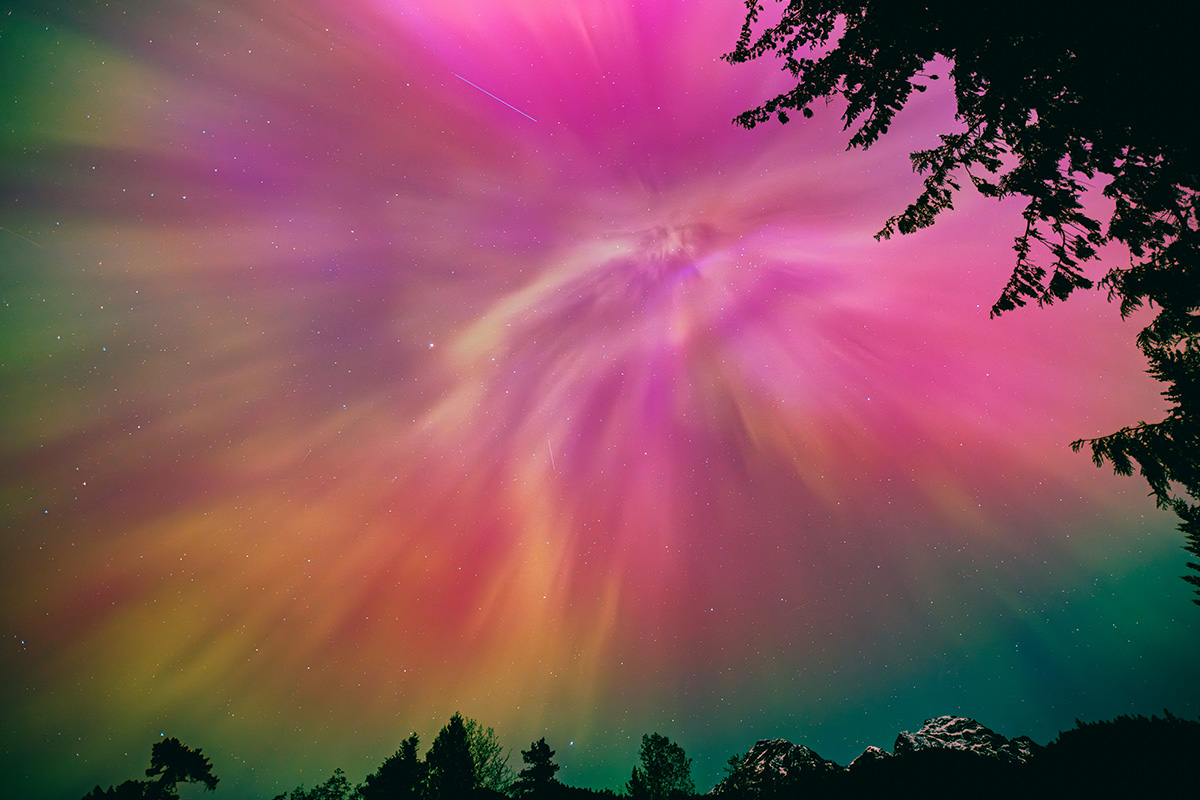
If your weekend plans are looking bleak, we might have something to get you excited. A possible aurora australis is on the cards for parts of Australia and New Zealand this Friday night – with a forecast currently spanning Tasmania, Victoria and parts of New South Wales, the ACT, South Australia and Western Australia. NOAA has forecast a G2 storm which could trigger an aurora australis roughly around midnight on Friday 9 October – potentially on Saturday 10 and Sunday 11 too.
Here’s how to catch it.
When and where can you see the aurora australis?
For Australian skywatchers, Friday 9 October is the main night to watch.
As for location, the further south you are, the better your chances. Tasmania, Victoria and New Zealand are currently among the best-placed states, while parts of NSW, the ACT, South Australia and Western Australia could also have a chance if geomagnetic activity reaches the forecast levels.
In terms of optimising your chances, your best bet is to find somewhere away from city lights with a clear view towards the southern horizon. If you’re not near a dark sky reserve, stretches of beach and open fields work well.
What time should you look up?
The aurora can’t be seen during daylight, so even if the geomagnetic storm arrives earlier in the day, you’ll need to wait until darkness falls. As a general guide, wait until around 75 to 90 minutes after sunset. Based on sunset times for October 9, that’s approximately:
Sydney: 8:18–8:33pm AEDT
Melbourne: 8:46–9:01pm AEDT
Canberra: 8:27–8:42pm AEDT
Hobart: 8:40–8:55pm AEDT
Adelaide: 8:39–8:54pm ACDT
Perth: 7:38–7:53pm AWST
Auckland: 8:46–9:01pm NZDT
Wellington: 8:49–9:04pm NZDT
Christchurch: 9:00–9:15pm NZDT
Dunedin: 9:10–9:25pm NZDT
Keep in mind that these times are a guide for when the sky should be dark enough to start looking, not a prediction that the aurora will appear at exactly that time. Current prediction say the aurora could start to manifest at approximately midnight. But the forecast can change. We will update the times if they change.
What causes the aurora australis and what does it actually look like?
In general terms, an aurora australis is caused by a coronal mass ejection – essentially a cloud of charged solar material produced by the sun, which then travels towards Earth.
It won’t necessarily cause the sky to turn neon green, but can instead result in a faint glow low on the horizon. Stronger geomagnetic activity can bring more obvious greens, pinks and purples, but there is no guarantee of a dramatic light show.
Stay inspired, follow us.


Feature image by Kush Dwivedi via Unsplash.