
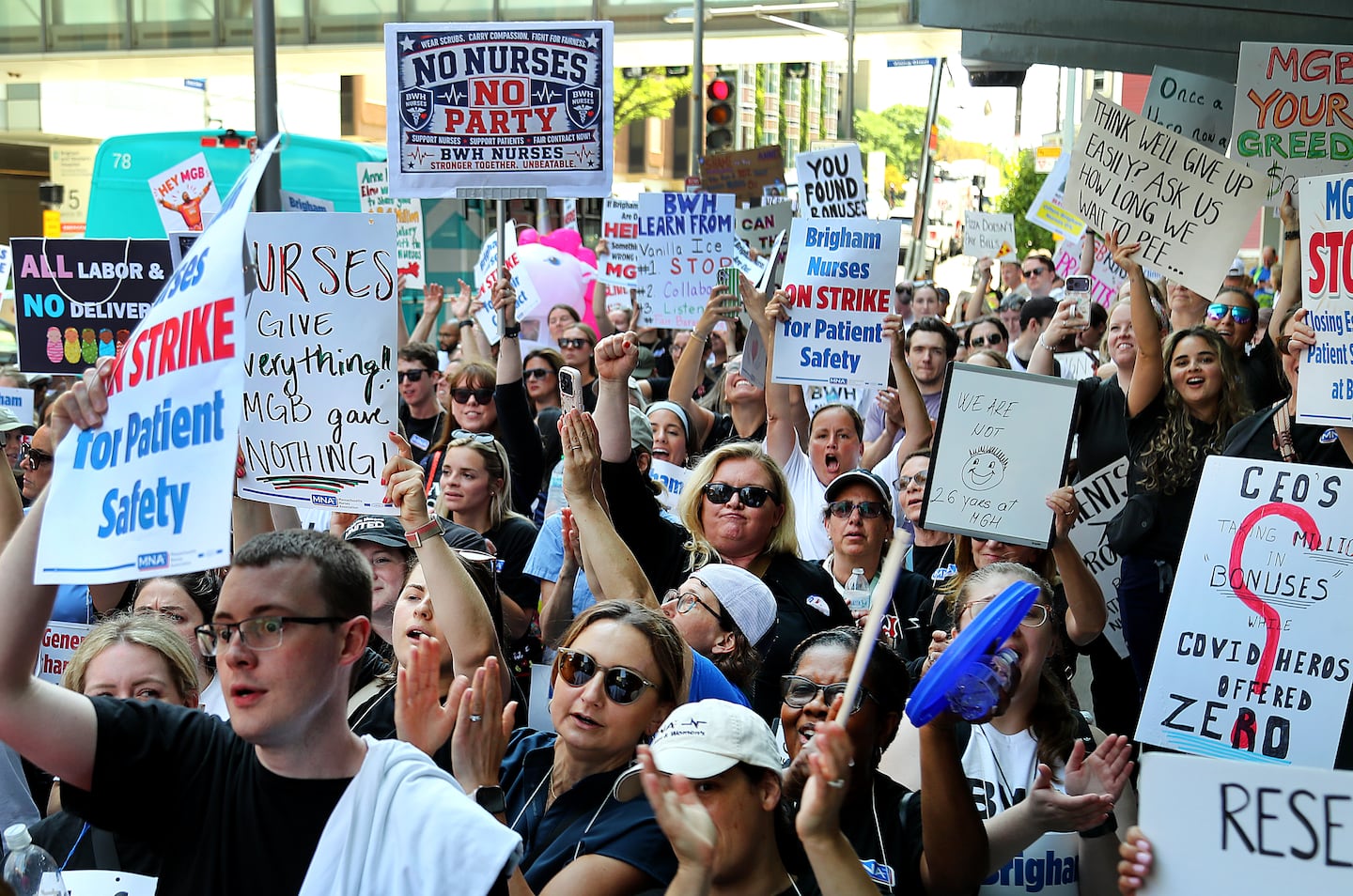
The latest movement in the ongoing labor battle has, at least temporarily, delayed a walkout that would be disruptive to patients, the hospital, and the nurses. Union members have prepared to go without pay and Brigham’s contributions to their health insurance premiums.
In a statement, the union said the choice to postpone was made with consideration of “the complexity of the agreement and the impact of a potential strike on our nurses and the community.”
Get Power Play
A twice-weekly dive into the power players and moves driving business in Massachusetts, authored by long-time business columnists Shirley Leung and Jon Chesto.
Brigham, one of the Mass General Brigham health system’s two flagship hospitals, said the proposal given Saturday was its “best and final offer.”
“The hospital believes its final proposal reflects the value our nurses bring to patient care while balancing our responsibility to patients, our workforce, and the long-term strength of the hospital,” Brigham said.
The union did not share details of the latest proposal, saying only that it made progress on issues related to patient care and the workplace.
The proposal does not, however, include cost of living wage increases, a major sticking point of the eight month negotiations. Brigham nurses say the across-the-board raise is crucial because of inflation and how expensive it is to live in greater Boston.
The union previously wanted a 3 percent raise for the first six months of the contract and a 4 percent raise for the next 12 months. The hospital wasn’t offering any new across-the-board raise, but noted nurses already received a 5 percent step increase on the yearly anniversary of their hiring until they reach two decades of service.
At a bargaining session on Thursday, the union said nurses “significantly reduced their wage proposal,” offered to extend the proposed contract term from 18 months to two-and-a-half years, and agreed to increase the proposed limit on temporary nurses from 10 percent per hospital unit to 15 percent, among other concessions.
In response to the union’s proposal on temporary nurse limits, the Brigham offered to share data on any department where more than 15 percent of the nurses are travelers.
The Brigham also offered one of two updated wage options. The first would restructure the pay step scales, while the other would add an additional step for the most tenured nurses that would give them a 2.5 percent raise.
Currently, Brigham nurses start at $86,700 annually, and those with two decades of service earned at least $220,000, according to MGB. Nearly one-third of the local, or 1,322 nurses, were earning that maximum amount, MGB said, making them among the highest paid in the state.
The labor conflict escalated this summer when nurses staged a one-day lockout on July 8. Immediately after that strike, the hospital locked out the nurses for four more days, saying it had to provide fill-in nurses five days of work.
Earlier this week, the union filed a complaint with Attorney General Andrea Joy Campbell, asking her to investigate MGB for potential violations of federal and state laws that regulate nonprofit health care systems.
The union said MGB has allowed members of its board of trustees to enrich their own corporations through contracts those companies have with the health system.
Jessica Pastore, an MGB spokesperson, described the letter as without merit, saying the system has a rigorous conflict-of-interest policy that requires board members to disclose potential conflicts and recuse themselves from any matter in which they have a personal or business interest.
If the nurses at the Brigham vote to approve MGB’s latest proposal, they would be the latest group of Massachusetts health care workers to approve a union contract after a summer of intense labor activity.
Nearly 2,000 nurses at Boston Medical Center voted to ratify a new contract, avoiding a potential three-day strike, their union announced Friday.
And earlier this summer, nurses at UMass Memorial Medical Center’s University Campus authorized a 14-day strike over what they described as chronic staffing shortages. That walkout never came to fruition, as the union later approved a three-year contract with the Worcester hospital.
Marin Wolf can be reached at marin.wolf@globe.com.