

When Lindsay Martin received a panicked phone call from his wife about his 21-year-old daughter, he found it hard to accept the news.
Earlier that day, Dale Alice Martin sought treatment at Waterbury Hospital for a broken ankle she sustained doing farm work. Fourteen hours later, she was brain dead.
The doctor told Martin that his daughter went into cardiac arrest.
“I’m listening to the sort of chaos on the other end of the phone,” Martin said, describing the phone call the day his daughter was declared brain dead on April 10, 2025.
“Are her pupils responsive?” Martin asked, to which the doctor responded they were not.
Martin said he knew at that moment that he had lost his daughter.
“I hung up the phone and I was in shock,” he said.
Martin later learned from the medical examiner that his daughter died from cardiac arrest due to several narcotics given for pain, according to the Pelham, New York, resident and his lawyer, Christopher Mattei of Koskoff, Koskoff & Bieder.
The Centers for Medicare and Medicaid Services found that “the facility failed to ensure that an adequate/complete physician’s telephone order was directed to prevent an unintentional duplication of narcotic medications.”
The CMS report said further that the medical doctor “acknowledged that he should have been specific and verbally directed to discontinue the Morphine IVP and start Dilaudid.”
Martin filed a lawsuit in Waterbury Superior Court against Waterbury Hospital, the doctor and nurse overseeing Dale Martin’s care, The Connecticut Spine and Disc Institute and Prospect Medical Holdings, the previous owner of the hospital, alleging that Dale Martin’s death was “caused by the failure of Waterbury Hospital” to adequately care for and monitor their daughter, according to the lawsuit.
“Within 14 hours of admission, providers at the hospital had administered so much pain medication that Dale stopped breathing and later died,” the lawsuit said. “No one checked on Dale during this time. The same medications that were interfering with Dale’s breathing were also sedating her. Dale could not even call for help as she suffocated. At 7 a.m. on April 10, a Waterbury Hospital nurse finally checked on Dale. It was far too late. Her heart had stopped beating.”
Shahrzad Rasekh/CT Mirror
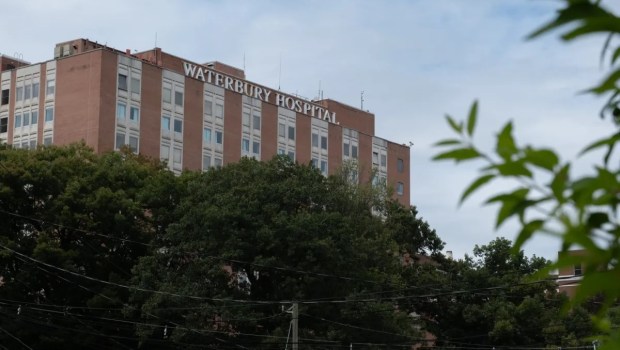
Waterbury Hospital is one of three facilities owned by Prospect Medical Holdings in Connecticut. (Shahrzad Rasekh/CT Mirror)
Waterbury Hospital struggled for years under the ownership of Prospect Medical Holdings, a California-based private equity company that state and federal officials said drained profits from the hospital at the expense of patient care.
When Prospect filed for bankruptcy in January 2025, all three of the hospitals it owned in the state, including Manchester Memorial and Rockville General, were for years struggling with inadequate staffing, antiquated equipment and financial challenges.
In January, Hartford HealthCare purchased Manchester Memorial and Rockville General. UConn Health purchased Waterbury Hospital two months later.
Prospect spurred scrutiny about the role of private equity in healthcare companies and concerns that such firms strip equity and cut costs to the detriment of the hospital and its patients.
The role of private equity in patient care is an important aspect of the lawsuit, Mattei said.
“We will obviously learn more about the extent to which Prospect’s mismanagement of Waterbury Hospital contributed to the specific circumstances on the night that Dale died,” Mattei said. “But what we expect to find is that this was a hospital that was largely operating on fumes as a result of Prospect dismantling infrastructure within the hospital, reducing staff, training, and finding every way possible to extract value out of the hospital in a way that jeopardized care.”
Prospect Medical Holdings and the Connecticut Spine and Disc Institute did not return emails for comment for this story.
Lauresha Xhihani, administrative director of communications and marketing for UConn Health Waterbury Hospital, said “this matter involves events that occurred in April 2025 when a different owner, Prospect Medical Holdings, operated Waterbury Hospital.”
Citing the new ownership of the hospital, Xhihani said, “The quality, safety and wellbeing of our patients is our top priority.”
Ed Gadomski, Connecticut Healthcare Associates Internal Union organizer, who represents the nurses and technicians at Waterbury Hospital, told the Courant that under Prospect’s ownership, “the hospital was severely understaffed, leaving nurses burdened with assignment overload of patients, lack of needed medical supplies, and deteriorating physical conditions that worsened on a daily basis when hospital ownership refused to reinvest monies back into the hospital.
“This all leads to a higher potential of a possible bad outcome or patient harm,” Gadomski continued. ”Cost cutting which included staff reductions can lead to effects such as longer wait times, falls, hospital-acquired infections, and other events. The sad part of the story is that there are certainly situations that could have been preventable if patient care was valued over profits.”
State Sen. Saud Anwar, a South Windsor Democrat and co-chair of the Public Health Committee, who has advocated for legislation restricting private equity in hospitals, said, “No private equity’s profit is worth a patient’s life.
“When private equity starts to look at the patient as a source of their investors’ return, rather than the patient’s wellbeing, we have taken a wrong path,” he said. “And there’s no balance sheet that can measure the worth of a human life.”
Anwar said that private equity created a healthcare crisis in communities it served.
Matt Parr, communications director at the Private Equity Stakeholder’s Project, a nonprofit research watchdog of the private equity industry, said because of the vast amount of money that was taken out of the system, Prospect did not have the financial resources to properly staff hospitals.
Calls for restriction of private equity
For years, doctors and health experts have pointed to the detrimental effects of private equity on patient care, with studies showing an increase in falls, infection risk and deaths, in hospitals owned by private equity companies.
Dr. Zirui Song, associate professor of healthcare policy and medicine at Harvard University and Massachusetts General Hospital, who has studied private equity in hospitals for the last five years, recently published a study with several other researchers in the Annals of Internal Medicine which found a 13% increase in patient deaths in the emergency departments of private equity hospitals compared to those that were not owned by private equity.
Song has said staffing cuts have been a common strategy after private equity acquisition of acute care hospitals. In private equity hospitals there was an increase of seven deaths per 10,000 ED visits relative to non-private equity hospitals, according to Song’s study.
State and federal lawmakers have called for legislation restricting private equity.
U.S. Sen. Chris Murphy, a member of the Health, Education, Labor and Pensions Committee, has spoken on the negative impact of private equity on healthcare. Last summer he issued a report: “A Dangerous Prospect: How Private Equity Decimated Connecticut Hospitals,” finding that Prospect Medical “employed a ‘buy, strip, flip’ strategy in which they sold off assets while gutting staff … and degraded the safety and quality of care for vulnerable communities without the financial means to fight back,” according to information released from Murphy’s office.
This year, Murphy introduced legislation with Rep. Mary Gay Scanlon, D-Pa, to ban private equity ownership of hospitals and nursing homes, making them ineligible to receive Medicare funding. The legislation has yet to pass.
In the state, Senate President Pro Tem Martin Looney called for the legislature this year to restrict private equity in the healthcare, nursing homes, housing, child care and special education industries, saying its role in essential public services is “dangerous and toxic as a matter of public policy.”
Gov. Ned Lamont signed legislation in May that beginning on July 1, 2027, prohibits hospitals from entering into sale-leaseback transactions, which involve a company selling a hospital’s building and land on its main campus, then forcing it to pay rent for its use. The new law also requires hospitals to annually attest to the Department of Public Health that no private equity entity has a controlling interest in the hospital.
Sen. Jeff Gordon, a Woodstock Republican and physician, said that he voted against the legislation because it did not go far enough in restricting private equity.
“I feel very strongly that the bill ended up being a waste,” he said. “It really needed to go further and be stronger to protect hospitals from private equity. It completely failed because it still allows private equity to be involved, even if not a majority stake.”
Anwar said the bill restricts private equity from hospital ownership, but that there are other areas where legislators can remove or reduce private equity’s impact.
Lawmakers also passed legislation that requires, beginning in February 2028, that each nursing home annually attest that no investment entity has control over resident “health, safety or care,” according to the Office of Legislative Research analysis of the law.
Looking for answers
When Martin’s daughter was declared brain dead last year, there was a 72-hour waiting period to see if she would regain brain function.
Martin said that while watching his daughter hooked up to a ventilator, he sought answers from the hospital but did not get an explanation.
“For three days, we set vigil in her hospital room, listening to the beeping of the monitors and seeing the machines keep her lungs and heart moving, waiting for the expiration of the 72 hours,” he said. “And in that time, you know, we kept asking, how did this happen?”
Dale Martin never regained brain function and doctors took her off the ventilator on April 13, 2025.
“It’s incredibly difficult to wrap your head around how this can happen in a hospital that’s supposed to be a house of healing,” Martin said. “There’s no explanation for how this could occur.”
Reflecting on Prospect’s ownership, Martin said, “we didn’t know till after Dale’s death that she was admitted to a bankrupt hospital that was under investigation where nurses allegedly were buying food for patients, where the level of funding was so constrained that the hospital may not have been able to function properly. Dale did not have a choice of where to go. She was brought to the nearest hospital.”
Martin takes long pauses, often becoming choked up as he speaks about his daughter.
Dale Martin was a rising senior at Trinity University in San Antonio, Texas. She was taking a sabbatical to work at a farm in Bethlehem, her father said.
“She was a nonjudgmental, giving person,” Martin said. “She was a volunteer music teacher to disadvantaged children and held herself out as a helper in life.”
He said the rise of private equity in healthcare is unsettling.
“I will say the sophistication of the financial engineering that underwrites this greed is hard to stop,” he said. “So, where there’s money to be made, people find a way to get around the intent of the rules.”
Dale Martin was an organ donor and her father said he received a letter from the recipient of her transplanted heart who said, “it is often the case that the recipient of an organ takes on the personality of the donor,” describing how he had been a coldhearted person.
“But with Dale’s heart, he now cries at cat videos and is a much more empathetic human being,” Martin said. “I would describe Dale as one of the most empathetic, caring people who’s ever walked the face of the planet and part of her is still doing that.”