
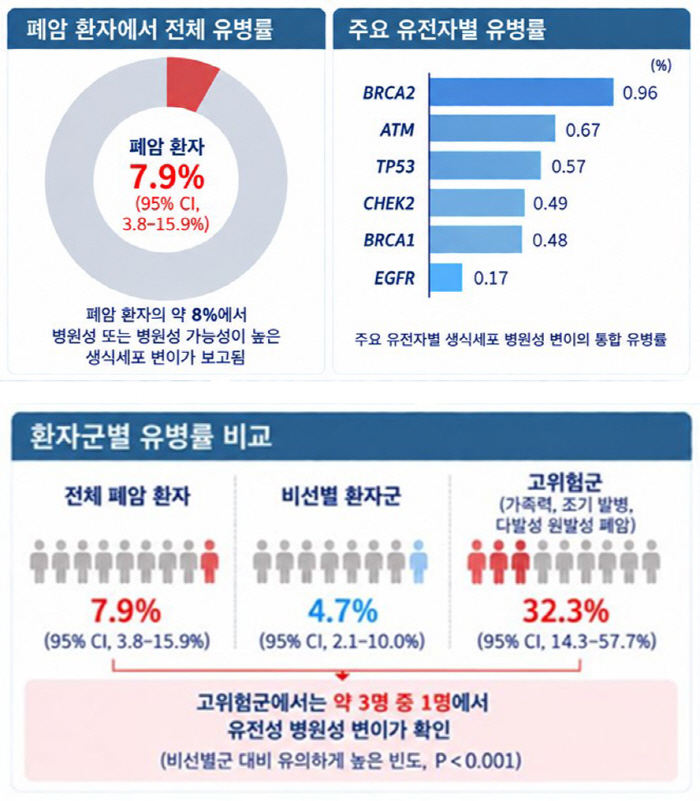
Chart showing the overall prevalence of germline pathogenic or likely pathogenic variants in lung cancer patients and prevalence by major gene (top), and comparing prevalence in unselected patients (4.7%) with that in
[Sportschosun reporter Jang Jong-ho] South Korean researchers have published the results of a meta-analysis finding that about 8% of lung cancer patients have a genetic predisposition that may contribute to cancer development. The study found that prevalence was as high as about 32% in selected high-risk groups, particularly those with a family history of lung cancer, lung cancer diagnosed at a young age, or multiple primary lung cancers.
Lung cancer is one of the leading causes of cancer deaths worldwide, and smoking is known to be a major risk factor. However, some cases, such as lung cancer in nonsmokers or at a young age, are difficult to explain solely by environmental factors, prompting growing interest in genetic predisposition. Previous studies differed in their study populations and testing scope, limiting the ability to gain a comprehensive understanding of the distribution of germline pathogenic variants, a form of genetic predisposition.
Against this backdrop, a joint research team comprising Professor Ji-young Lee of the Department of Radiology at Seoul National University Hospital; Professor Si-hyeon Kim of the Department of Clinical Genomic Medicine; Professor Kwon-jung Na of the Department of Thoracic and Cardiovascular Surgery; Professor Jin-mo Koo of the Department of Radiology; and Professor Sun-ho Yoon of the Department of Radiology at National Jewish Health analyzed 28 studies related to lung cancer. They examined the overall prevalence of germline pathogenic or likely pathogenic variants, prevalence by major gene, and associated factors.
The analysis found that the prevalence of these variants among all lung cancer patients was 7.9%, with the highest rates mainly found in genes involved in DNA damage repair. By gene, prevalence was highest for BRCA2 (0.96%), followed by ATM (0.67%), TP53 (0.57%), CHEK2 (0.49%), and BRCA1 (0.48%).
Differences in prevalence were also observed according to patients’ clinical characteristics. Prevalence in high-risk groups selected based on factors such as family history, diagnosis at a young age, and multiple primary lung cancers was 32.3%, significantly higher than the 4.7% among unselected patients.
Analysis by genetic background found no significant difference in overall prevalence. However, variants in major DNA damage repair genes were more common in non-Asian and mixed-ancestry populations than among East Asians.
The prevalence of pathogenic variants also tended to be higher when the average age of the patient group included in a study was lower and when more genes were tested.
Professor Ji-young Lee (Department of Radiology) said, “In this study, the prevalence of germline pathogenic variants was higher among patients with high-risk characteristics, including a family history and diagnosis at a young age.” Lee added, “These findings may provide a basis for considering the role of personalized genetic evaluation in high-risk patients, and point to the potential to help prevent cancer and enable early diagnosis for patients and their families.”
Professor Si-hyeon Kim (Department of Clinical Genomic Medicine) said, “Genetic predispositions such as BRCA1/2 gene variants are well known in breast and ovarian cancers, but the distribution and characteristics of genetic factors in lung cancer have been relatively poorly understood.” Kim added, “This study is significant in that it brings together previous research to provide a systematic account of genetic predisposition to lung cancer.”
The study was published online in the international journal Journal of Thoracic Oncology (IF 23.3).
Reporter Jang Jong-ho bellho@sportschosun.com

From left: Professor Ji-young Lee of the Department of Radiology at Seoul National University Hospital; Professor Si-hyeon Kim of the Department of Clinical Genomic Medicine; Professor Kwon-jung Na of the Department of
This article has been translated by GripLabs Mingo AI.
원문보기
(View Original Korean Article)
‘A 22-million-won electric car is coming… Citroën revives its 2CV, famed for keeping eggs intact’
‘“Prostrated himself and prayed before a tiger”… Man in his 20s killed in zoo tragedy after bizarre behavior’