
The annual Visions of Denver Architecture Photo Contest is a very casual affair, and that’s what makes it a pleasure for both the photographers who enter and the Denverites who wait each year to see their pictures of buildings in the city.
Anyone can submit a photo, so the winners’ list often ends up being a mix of serious professionals who make their living creating photos, and hobbyists who are out there for the fun of it — there is no hierarchy. And there’s no official time limit on when the images are captured. That means photographers can go out hunting for a great shot just for the competition, or folks can root through their personal archives — digital or print — for that favorite picture they always thought deserved more eyes.
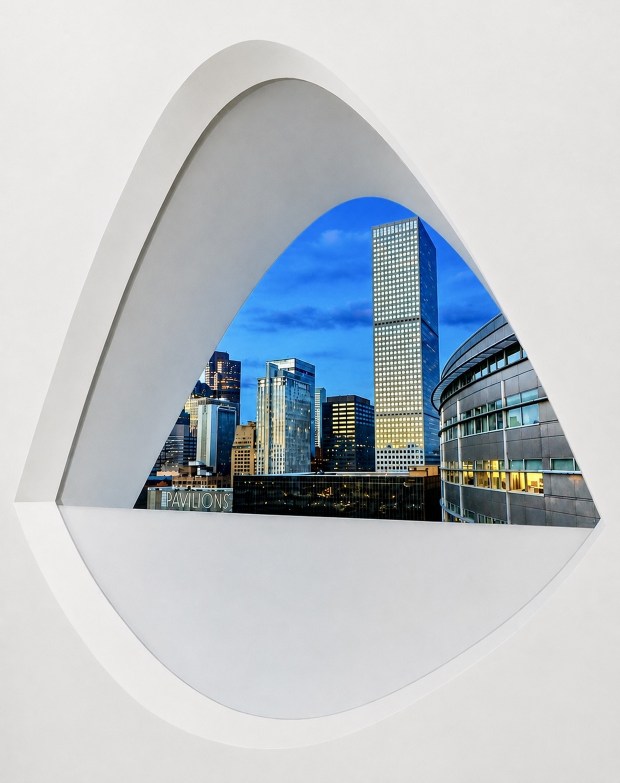 This photo, by John Deffenbaugh, captures Republic Plaza, Denver’s tallest building, through a window of the recently built Populous Hotel. (Provided by the Denver Architecture Foundation)
That gives a nice duality to the batch of winning photos published online by the competition’s main sponsor, the Denver Architecture Foundation, which updated the name of the event this year while keeping the basic premise the same (in earlier iterations it was called the Y/Our Denver photo contest).
The photos can feel fresh and journalistic because they document new buildings popping up in the city. Or they can feel timeless because they feature long-standing structural landmarks from updated viewpoints.
Or they can do both. One example among this year’s winners is John Deffenbaugh‘s image of Denver’s skyline centered on the 42-year-old downtown skyscraper called Republic Plaza, which happens to be the city’s tallest building. His scene is framed through the curving windows of the recently built Populus Hotel — designed by the architecture firm Studio Gang — that mimic the bark of an aspen tree. The photo simultaneously presents a view of old Denver and new Denver.
“It was taken from a restroom at the top of the Populus Hotel. They are gender-neutral, so they have individual stalls, and some have great views,” he said. “It was dusk and I was struck by the contrast between the colors of downtown in the background and the pale foreground.”
The moment was serendipitous, he said. “A basic function turned into a delight, a hallmark of great design.”
Other photos that highlight recent design projects include Deanna Marie Raso’s picture focusing on the curving stairway that connects the first and second floors of the Denver Art Museum’s Martin Building, originally designed by Gio Ponti. The stair was added during a 2021 renovation, led by the Boston firm Machado Silvetti.
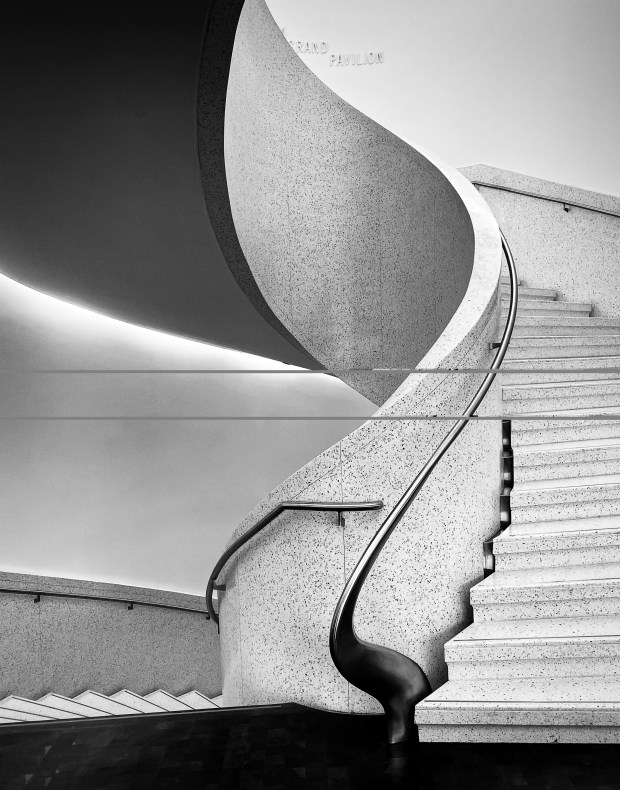 This is Deanna Marie Raso’s photo titled “DAM – Martin Building Stairs No. 1.” It took the prize for “Best Urban Interior.” (Provided by the Denver Architecture Foundation)
Raso’s photo won the “Best Urban Interior” category in this year’s contest.
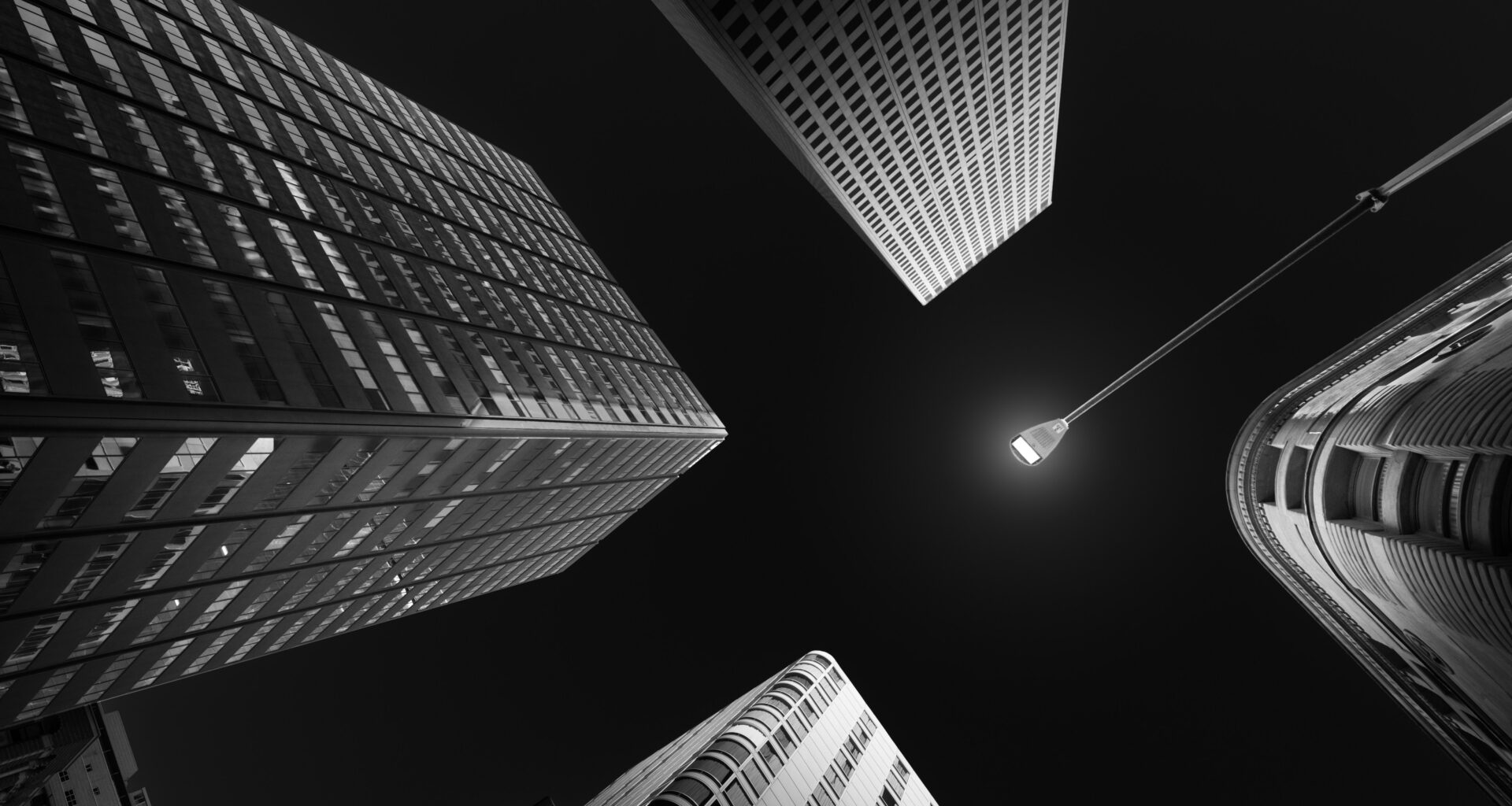
Similarly, Frank Varney’s image of the Triangle Building on Wewatta Street downtown offers a chance to take a closer look at another newish building, designed by Anderson Mason Dale Architects. Varney’s shot captures the structure’s sharp corners from ground level, making it almost look like the bow of a ship pulling into a port.
Varney, whose picture took the category of “Best Urban Detail,” photographed the building on a very bright day and emphasized its mirrored exterior surface, which almost disappears into the surrounding blue sky and the puffs of clouds that are passing by.
As for photos that capture old Denver, the contest drew scores of good examples. There is a vintage photo by Alan Golin Gass of the Tivoli Brewery on the Auraria Campus downtown. The photographer, who also happens to be a legendary Denver architect himself, took the image years ago when there was almost no development surrounding the ornate, white structure. The photo won the category of “Best Urban Landscape.”
Another photo that captures a familiar setting is Kyle Durlam’s skyline shot of the State Capitol and the equally iconic Cathedral Basilica of the Immaculate Conception. The buildings seem to exist in a dreamy yellow haze, with a backdrop of Colorado’s foothills rendered in shades of gold.
It is not a new photo at all, Durlam explained when I asked about the image, and it is wrapped up in his own family memories. He took it from a waiting room at St. Joseph’s Hospital (a building that has since been torn down) in 2010 while his father was having a major surgery.
Durlam, a busy photographer with plenty of experience shooting Denver landmarks, saw an opportunity and seized it.
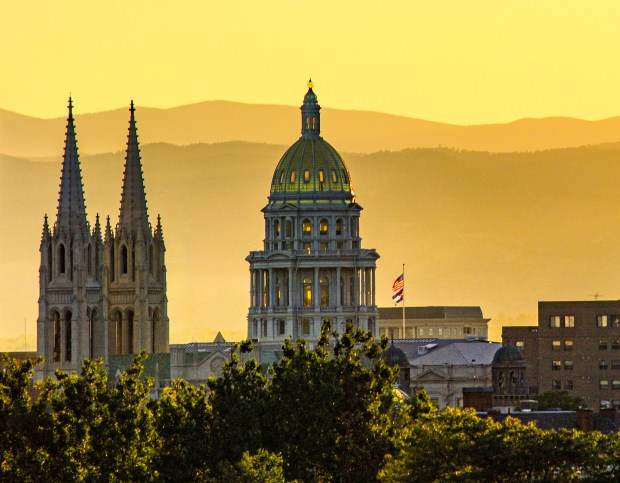 Kyle Durlam titled this photo “Capitol Hills.” (Provided by the Denver Architecture Foundation)
“The sunset was setting up nicely and I had my camera with me only because I had needed it for a client meeting earlier in the day. Pure luck there,” he said in response to my query about the image. “I especially like that vantage point because it makes the Cathedral Basilica of the Immaculate Conception look like it is further east of the State Capitol than it really is.”
Durlam’s photo represents well why the Denver Architecture Photo Contest is so popular. It focuses on the best vistas in the city while highlighting two art forms at the same time: photography and building design. Its unpretentious nature — letting anyone play the game — makes it an accessible art exercise everyone here can appreciate.
The photos are currently on view in a gallery posted on the website of the Denver Architecture Foundation. The virtual exhibit features 30 images from 17 photographers selected by this year’s juror, Emily Minton Redfield.
To view the images, go to: denverarchitecture.org
Ray Mark Rinaldi is a Denver-based freelance writer who specializes in fine arts.