
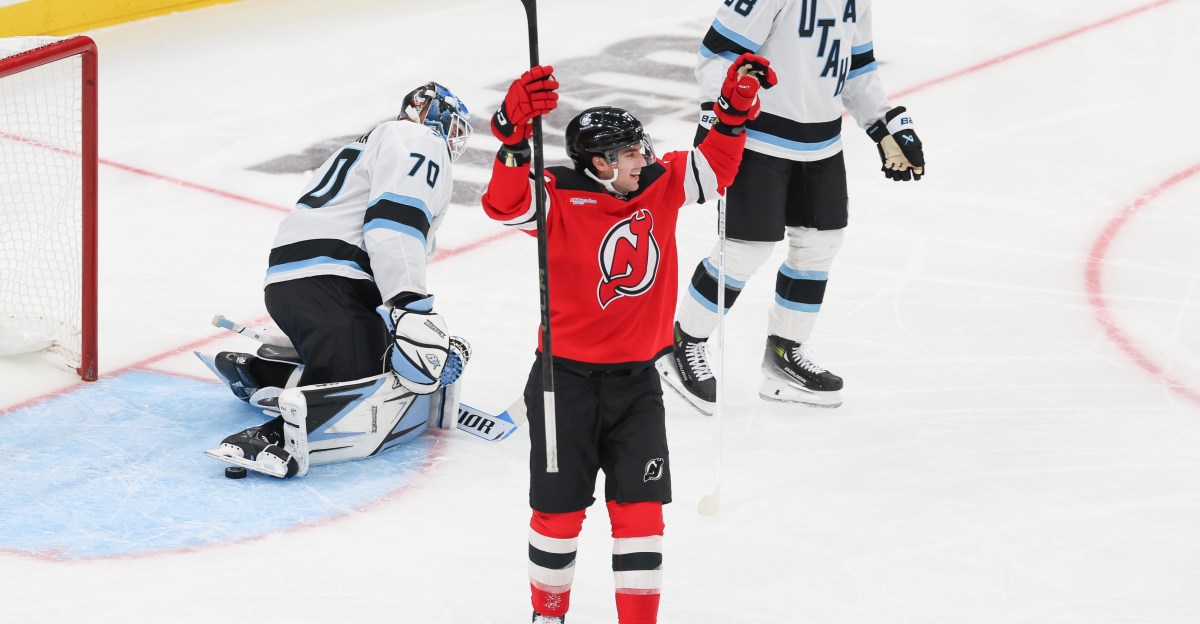
When first-year general manager Sunny Mehta acquired Luke Evangelista from the Nashville Predators at the beginning of September, I have to admit that I was only superficially familiar with his game. I had heard good things, I had seen good stats, but I did not have much experience watching Evangelista play with my own eyes at all, nor did I ever do a deep dive into those stats that I only took cursory glances at. But after the trade, I watched some more tape and spelunked deep into whatever stats I could find. The end result was me growing to love this trade and expecting big things from Evangelista. When Mehta doubled down on Evangelista and extended him long term, I was thrilled. It was entirely possible that he wouldn’t live up to expectations, and in fact my bold prediction in our season previews was that Evangelista would struggle out of the gate before exploding after the Christmas break.
But through four games this season, Evangelista has proven me wrong and been terrific.
I realize we are dealing with microscopic sample sizes here, but through the first four games of the year, Evangelista has been one of the best players on the Devils. There is room for growth, and he could eventually hit a wall. But right here and right now, Evangelista has fit well with Nico Hischier and Timo Meier.
Today, we’re going to analyze the numbers to try and quantify Evangelista’s on-ice impact. As we’ll see, it will be a fun exercise not only because the early returns are great, but perhaps more importantly, they could easily be predictive of future performance. And if Evangelista really does play like this consistently, this is going to go down as one of the best trades in Devils history.
Traditional Areas Of Growth
Let’s start with a few things that don’t really involve diving into advanced metrics. A big measure of whether a player is looked favorably upon by their coach is their ice time. Evangelista was starting to gain the trust of the Nashville coaching staff last year, jumping from an average time on ice of 13:52 per game in 2024-25 to 16:37 last season. That’s a pretty seismic leap, and through the early portion of the schedule this year, Evangelista has taken yet another seismic leap in this department with the Devils. Head coach Sheldon Keefe is giving Evangelista 18:35 TOI per game. That’s third on the team among forwards, only trailing exactly who you’d expect him to be trailing: Jack Hughes and Nico Hischier. If you don’t believe me when I say that Evangelista has been doing well so far, then maybe you’ll believe Keefe, who is showing how much he thinks of Evangelista through his ice time.
When it comes to another big area of growth for Evangelista, we’re seeing promise there as well. Evangelista came to New Jersey as a pure playmaker. His passing metrics were pristine, and his traditional stats reflected that, with way more assists than goals over the course of his young career. He only scored 12 goals a season ago, and his career high was a mere 16 in 2023-24. He has not been a goal-scorer, and to his credit, he knew that. During his introductory press conference with the New Jersey media, Evangelista specifically cited his shot as an area of focus for him this past offseason. He said he wanted to get better not only as far as shooting better, but also improving his ability to get his shot off in the first place.
So far so good, as Evangelista has recorded 12 shots on goal through four games. That 3.0 shots per game average is way up from 2.2 shots per game last season. Taking close to one additional shot per game might not seem like a whole lot, but it adds up. And lo and behold, Evangelista has already scored twice, notching both his markers in the game against Utah. Even someone like me, who is about as bullish on Evangelista as anyone, will tell you that he will absolutely not maintain this current 42-goal pace. But just getting into the 20’s would show huge growth. And if he continues to present himself as a more dangerous shooting option, that should open up even more opportunities for Evangelista to make plays and set up his teammates. The fact that he is showing real growth as a shooter means opponents have to pay more attention to him as a scoring threat, which Evangelista can use to his advantage to create more passing lanes to find his teammates.
And in case you’re thinking that all these shots might just be low-danger muffins, NHL Edge has you covered. According to NHL Edge, Evangelista is among the league leaders when it comes to not only shots on goal, but dangerous shots on goal. His 12 total shots on goal rank in the 82nd percentile among NHL forwards. Among those 12, he’s got five shots from mid-range (90th percentile), and a killer six shots from the high-danger areas (92nd percentile). Just looking at his heat map, he is absolutely peppering goalies from right in front of the crease (and in the case of one shot, in the crease itself).
Evangelista is gaining more and more ice time, blossoming as a goal-scoring threat, and showing real growth as he reaches his peak. It’s all very promising stuff.
Game By Game, Opponent By Opponent
As far as the advanced metrics go, Evangelista has really tilted the ice in his four games with the Devils. Using Natural Stat Trick as our guide, we’ll see that he’s not only winning at the macro level, but at the micro level too.
First the macro. Here are Evangelista’s 5-on-5 numbers in all the major categories:
Corsi For%60.38Scoring Chances For%68.33High Danger Corsi For%70.00Expected Goals%73.35
Needless to say, those are absurd numbers. Evangelista has been a play-driving deity thus far.
But is it possible that Evangelista is living off of one or two incredible games, covering up for a few mediocre performances? We’ll break it down opponent by opponent to show that Evangelista has been consistently dominant across the board:
Corsi For%60.00Scoring Chances For%75.00High Danger Corsi For%100.00Expected Goals%69.24
Just about every Devil feasted against the surprisingly disappointing Flyers in the season opener, and Evangelista was no exception. That HDCF number looks especially impressive, but to be fair the battle was only won 1-0. Then again, holding your opponents to zero high dangers chances in an entire game is pretty impressive.
10/3 vs. New York Islanders
Corsi For%75.00Scoring Chances For%72.22High Danger Corsi For%77.78Expected Goals%82.27
We all know the Islander game was a debacle. And we all know that score effects played a role in a lot of Devils’ numbers looking as good as they did. But even if you want to knock 20 whole points off of each number due to score effects, Evangelista would still come out looking good. And perhaps the best evidence of all that Evangelista had a genuinely good game despite the score is this: He finished the night as one of only three Devils to not be on the ice for a goal against, alongside Nico Hischier and Luke Hughes. In a dark night, Evangelista shined.
Corsi For%52.17Scoring Chances For%70.00High Danger Corsi For%75.00Expected Goals%72.17
The CF% was good-not-great, but otherwise Evangelista was up to his usual tricks against the Mammoth as well. He also scored his first two goals as a Devil in this game, so Evangelista’s impact was felt strongly despite the loss.
Corsi For%55.17Scoring Chances For%60.00High Danger Corsi For%50.00Expected Goals%64.99
This honestly might be Evangelista’s worst game of the season considering the opponent and how relatively middling some of these numbers are. But still, Evangelista did not outright lose the battle in any category, and while the CF% and HDCF% numbers might be disappointing, he made up for it with strong SCF% and xG% figures. Even during an “off” game, Evangelista drove play.
No matter what angle you choose to look at his numbers from, Evangelista is directing traffic in the right direction this season. He will of course have some clunkers as the season goes on, but these are very encouraging metrics that indicate that he should continue to drive play with regularity. And with consistently impressive advanced metrics usually come impressive actual goal results, which is, of course, the whole point of it all.
The Other Fancy Stats Back This Up
Something I like doing when dissecting advanced numbers is taking a look at a variety of different sources. After all, Natural Stat Trick is great, but that’s only one public model. To help cover for some blind spots that it might have, we’ll turn to a few other metrics to try and quantify Evangelista’s impact.
We’ll start with one of my favorites: Hockey Stat Cards. According to their Net Rating metric, Evangelista has been one of the strongest forwards in the league this season. Both his Offensive Net Rating and his Defensive Net Rating currently sit in the 81st percentile among forwards. Added together, his overall Net Rating is in the 86th percentile league-wide. That is borderline elite stuff, and it’s encouraging to see him drive play on both sides of the puck, which was one of his strengths in Nashville.
Next we’ll go to Hockey Stats (not to be confused with the aforementioned Hockey Stat Cards). According to their model, Evangelista is rocking an xG% of 62%. This is by far the highest mark of his career according to this metric, and way above his 53% that he posted a season ago.
Over at Moneypuck, I thought it would be good to see how Evangelista is performing holistically on a line with Hischier and Meier. Through roughly 38 minutes of 5-on-5 ice time together, the trio is annihilating opponents to the tune of a 66.7 xG%. Obviously Evangelista isn’t the only one contributing here, but for context, in 476 minutes together last year, Hischier and Meier combined with Dawson Mercer to post a 59.8 xG% per Moneypuck. That’s a stellar number itself, but Evangelista has managed to help Hischier and Meier top that so far. So it stands to reason that Evangelista is doing is fair share with the two Swiss stars.
And finally, I want to go back to the NHL Edge data. One of the metrics the Edge numbers track is how much time a player spends in the defensive, neutral, and offensive zone. For Evangelista, the percentage of his ice time that he spends in the defensive zone is 36.3%. According to the data, the average NHL forward spends 39.8% of their time in the defensive zone, so Evangelista is ahead of the pack in this regard (81st percentile to be exact). He’s actually below the 50th percentile in time spent in the neutral zone (17.3%, compared to the average of 18.7%). But while he’s only a rumor in the neutral zone, he’s living in the offensive zone, sitting in the 86th percentile with 46.5% of his ice time spent there (compared to the NHL average for forwards of 41.5%). Evangelista spends less time defending and more time attacking than the average forward, to the point where he’s borderline elite at avoid bad situations and creating good ones.
Final Thoughts And Your Take
It is, of course, still very early. Evangelista could hit a wall. He could go into a deep shooting slump. He could lose chemistry with Hischier and Meier. Evangelista is not a perfect player. But whether you look at the traditional numbers or the advanced stats, he has been very strong through his first four games as a Devil. I don’t think it’s out of the realm of possibility to say that Evangelista has a real shot at becoming a true member of the core very soon. For a while now, that core has consisted of Hughes, Hischier, and Bratt at the center. Meier, Hamilton, and Luke Hughes have all taken turns joining them at various points. But in my opinion, none of them are presently part of the inner-circle core, even if they all have a chance to get back there.
But for Evangelista, if he continues to play this way, he will join the inner circle in no time. The Devils have needed a shot in the arm to their forward group for quite some time now. Evangelista might not be the pure goal scorer that we’ve all craved since Tyler Toffoli was traded away, but his overall value has the potential to be much, much greater than anything Toffoli did as a Devil. He’s been a great addition to this team, and it’s a comforting thought knowing that he may just be scratching the surface of what he can do.
What do you make of Evangelista’s start to the season? Has he impressed you as much as he has impressed me? What are some areas that you think he can still improve on? As always, thanks for reading!